Showing posts with label Healing Eucharist. Show all posts

Wednesday, December 12, 2018

Embrace the Dark

This sermon was preached on the Feast Day of Saint Juan de la Cruz (John of the Cross), mystic and monastic. The readings which inspired the sermon were the following:

Our first lesson from the Song of Solomon bears repeating:

“Upon my bed at night 
I sought him whom my soul loves; 
I sought him, but found him not; 
I called him, but he gave no answer. 

“I will rise now and go about the city, 
in the streets and in the squares; 
I will seek him whom my soul loves.” 
I sought him, but found him not. 

The sentinels found me, 
as they went about in the city. 
“Have you seen him whom my soul loves?” 
Scarcely had I passed them, when I found him whom my soul loves. 

I held him, and would not let him go 
until I brought him into my mother’s house, 
and into the chamber of her that conceived me. 

The Song of Solomon, as you may recall, stands out in the Hebrew Bible. In truth, it is unique in all our Holy Scripture. Love poetry, often erotic in nature, is not standard fare elsewhere in “The Good Book.” So, why read such provocative words? Because these words that we heard today describe so precisely, succinctly, and perfectly the spiritual journey of those Christian seekers called mystics. One of those mystics we celebrate today—I’ll get to him in a moment. But, right now I want to make a case for us all to become Christian mystics.

Often times, even in the Church, mystics get painted as looneys, dreamers, or at the very least unlike us normal folk. However, most of us who yearn for a closer relationship with Christ would love nothing more than to have a mystical experience with Our Divine Lord. So what gives? Why are we so weary of mystical experiences with God? And, what do these poetic words from the Song of Solomon have to do with becoming a mystic?

Let us start with the Scripture, as this passage portrays for us a roadmap to having an encounter with the Divine. This story depicts one lover in search of another. Now, some might argue that this story is about God searching for us, but I believe it outlines our search for God. We want God—sometimes we think we want something else, but truly behind all our desires is intimacy with the Lover of Our Souls. Sometimes though, we feel like God is not with us—even if God is always there.

Still, we go searching. If we do not find God close by, then we must go out in search for “him whom [our souls] love.” What if we do not sense God even in our own household? What if we miss God in the routine experiences of day-to-day life? Where do we go to find God? Well, like the lover in the Song of Solomon, we must search beyond just our bed and our own home. This searching though presents obstacles.

In this passage we discover that one lover must overcome sleepiness, darkness, and even guards to find the beloved and to go home. This struggle is our roadmap to finding God as Christian seekers. We aim to experience God’s presence. And, despite God’s infinite nearness, sometimes to get beyond our own doubts we must tiredly search in the darkness. There God invites us to relinquish thoughts, feelings, emotions, persons, situations, and conditions that distract us from intimacy with Our Great Beloved. There we find our home where we dwell with God. The saint whom we celebrate today modeled this mystical journey for us.

Now, we might not even have that saint’s words were it not for something that happened long after his death. Juan de la Cruz, or John of the Cross, is the person the Church celebrates today. He served as a strict Carmelite priest and monk in the 16th Century. More on his life shortly, but after his death Pope Benedict XIII made John a saint in the early 18th Century. This was lovely, but his life was quickly forgotten except for by some Carmelites. It was thanks to Pope Pius XI that we have been given the treasures of John’s journey as a mystical. In 1926 Pius XI made John of the Cross a Doctor of the Church, thus his example and writings were given new life. It was then that we in the English speaking world were given a taste of this mystic Christian’s example.

The life of John of the Cross looked very much like this bit from the Song of Solomon and it outlined a journey that we might take. When John became a Carmelite brother he felt that the order needed some reform, as it had become too relaxed. This was a lover in search of his beloved. However, on his pursuit to finding God and reforming the order, he was confronted with sentinels and darkness. The sentinels came in the form of other Carmelites who did not want reform and thus locked him up in Toledo (Holy Toledo!). Within the trying months in jail John encountered darkness. He was persecuted. His spirit was tried. It was there that he composed some of his most profound mystical writing. And through this darkness he even found his beloved, like the lover in the Scripture.

John of the Cross helped us to understand that darkness is not the opposite of God or something merely to be overcome. Instead as we experience the “dark night of the soul” (a phrase coined by John) we discover that God’s presence can be found in illuminating and challenging darkness, just as it is in overwhelming and inspiring brightness. Other saints of the Church including Mother Teresa of Calcutta, Teresa of Avila (who was John’s contemporary), Thomas Merton, and the recently deceased Thomas Keating all endorse this mystical model of “endarkenment” or embracing the dark night of the soul. Each of these holy ones had moments when they were persecuted, lost, or disenchanted with their Christian journey, such that they found God not in the usual places of light, but in Celestial Darkness.

During this season when we remember Christ’s coming in Jesus of Nazareth and look forward to Christ’s coming at the end, may we also wait and watch in the darkness for Christ’s coming now. With fewer and fewer hours of brightness from the sun each day and with the challenges of our own lives, may we recognize that God’s presence shines luminously even as that around us appears dazzlingly dark. May we be like the lover in the Song of Solomon, desperately seeking our beloved even through weariness, sentinels, and other challenges. May we be like John of the Cross who experienced intimacy with the Great Beloved by embracing the dark night of the soul. Amen.

Wednesday, October 10, 2018

The Power of Prayer

This sermon was preached on the Feast Day of Vida Dutton Scudder at St. John’s Church. The readings for this day were the following: 


Psalm 25:1–14
John 6:37–51

The Dean and President of the Seminary of the Southwest (SSW) when I attended school there was a priest named Doug Travis. To my class he was a monumental figure. He almost felt like a folk hero with a hallmark deep, booming voice. He hailed from out in West Texas in a little town called Tulia. Anytime he presided at Holy Eucharist he—how do I put this?—glistened. Once when he was having a coughing fit during the Eucharistic Prayer he even drank some of the unconsecrated wine just to keep going with the service. But, his legend did not only have to do with humorous liturgical moments in the middle of the service.

Dean Travis had helped SSW through some of its darkest days. During the aftermath that followed the 2008 financial crisis, he made some very difficult decisions that allowed for the seminary to keep going. When he had to fire some longtime employees he did so with such grace and care that people still talked about it when I arrived a couple years later. He never talked about these difficulties, rather he chose to point to what he truly believed was the goal of seminary education: forming mature, Christian leaders.

Almost every sermon that Dean Travis gave had to do with this theme of developing influential people to step up in the 21st Century Church. My friends started to think that he was like a toy with a drawstring that once pulled released one of a handful of catchphrases. Sure, “Mature Christian Leadership,” was one of them, but he also almost always said, “The older and older I get, the more and more convinced I am of…” (fill in the blank). One such sermon still resonates to this day.

While talking about some research that showed that people are more spiritual than they have ever been, but at the same time less religious, Dean Travis pointed to something one of his daughters said. She was more convicted of the power of the Church than ever. Dean Travis on the other hand insisted that the older and older he got the more and more convinced he was not of the power of the Church, but of the power of God. Though the Church is flawed, God is not. Even if the Church fails, God won’t. Hearing these words from the leader of a seminary were both powerful and challenging. He then charged us to be part of leading people to Christ in the Church—not for self-promotion, but for sustenance, life, and transformation. Dean Travis’ words continue to challenge me to wonder why is it that I do what I do, why do we do what we do? We stumbled upon our answer today.

In this afternoon’s first lesson we heard of the perfect vision—not for the Church, but for all of Creation. Isaiah described that in God’s perfect reign even the nature of wild animals changes such that all dwell in peace. Wolf and lamb, leopard and kid, calf and lion, child and snake all living in harmony with one another. These images are so profound that they often overshadow the very first words about this peaceable kingdom. “A shoot shall come out from the stump of Jesse.” These words that prophesized Christ Jesus’ ministry also provide an image for us in the modern Church.

Think about this, a stump is something that is dead or dying. When we see stumps in our yards we want them removed. I watched during construction as a landscaping company sawed down some stumps and used machinery to dig up their roots. A stump then is an eyesore, a nuisance, or at best a place to sit for a moment. But, it is from that place of death and dying that God brings about the salvation of all people. We can take heart in this.

In our own lives, in the world, and even in the Church we might see things that are not life-giving. What are the stumps of your life? A once vibrant relationship now dormant? A long ago brilliant hope in our government now decaying? A closely held belief, now dying, that you might finally pursue your true calling in life? Whatever the stump God wants to raise a shoot out of it. God yearns to bring new life and God’s reign of peace from it—especially in the Church! So how does this happen?

The saint we celebrate today had an answer for this question. Vida Dutton Scudder was born driven! She was the child of Congregationalist missionaries in India in the mid-19th Century. After excelling in school and college Scudder founded several religious organizations devoted to community living and intercessory prayer. It is in this latter area of ministry that Scudder provided for us a way to bring new shoots out of stumps where resurrection is needed.

Scudder’s example and writings about having an active and vibrant prayer life give us a most helpful pathway. On this journey we are invited to access God’s deep desires to bring new life to us. Scudder wrote, “If prayer is the deep secret creative force that Jesus tells us it is, we should be very busy with it,” adding that there exists a surefire way “of directly helping on the Kingdom of God. That way is prayer. Social intercession may be the mightiest force in the world.”[1] If you are seeking something, pray for it. If you are yearning for new life, speak to God about it. If you want a shoot to grow out of a stump, give it to God in prayer. And not just like we are writing a letter to some cosmic Santa Claus.

When we pray we open our hearts to God. We speak and we listen. We pass along our deepest desires and we hear God’s deepest longings for us. To paraphrase Dean Travis, the older and older I get the more and more convinced I am that when we take the broken stumps in our lives to God in prayer God raises new shoots in us such that we become mature Christian leaders for this day. Pray always for God’s reign to come!


[1] Lesser Feasts and Fasts (2006). “Vida Dutton Scudder.” 410.

Tuesday, June 12, 2018

Faith Stands With The People

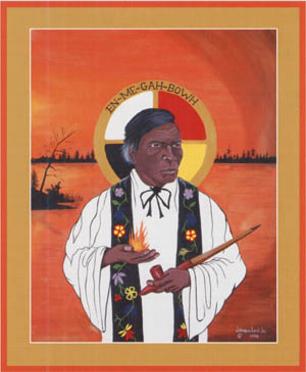
Enmegahbowh was the first Native American ordained in the Episcopal Church.

This morning at staff meeting we read this coming Sunday’s Gospel lesson. We do this every week to start our time together. Always I hear something that gives me a new insight on the Good News of Christ Jesus. Usually though, someone else says those wise words. This morning though I heard something come out of my own mouth that I really needed to hear.

In regards to the Parable of the Mustard Seed, which is this Sunday’s lesson, I said this story is an opportunity for us to trust God more deeply—even when the evidence is not there. Today and every day, we have this option. We always possesses the opening to have faith. Of course, this is not always easy.

There are moments in life when our hearts are troubled. Times when we receive difficult news, when we face adversity, or when that which previously brought us strength no longer does. During these days we can respond in many different ways.

We can give up on God, try to rely upon ourselves, turn to some other substitute for God, complain that life is not fair, or avoid our troubles altogether. I have done all of these before with only pain to show as a result! And, while in the moment they may feel good and right and fitting responses, they do not in the end lead to the fullness of life in Christ. There is of course, a generous other course to take when this world seems hard to bear.

In today’s Gospel lesson from Luke we discover the wild, counter-cultural path to blessedness. Jesus tells his followers that despite what the world told them God’s hallowed ones were poor, hungry, weeping, hated, and persecuted. What? Jesus’ words make no sense! I have spent my life avoiding these negative things. And, perhaps you have as well. So, how can these things lead to blessedness?

When facing poverty, hunger, sadness, hatred, or persecution one can respond with fear, anger, or bitterness. Or, one can see these moments of hardship as blessed moments when one trusts more fully in God. Yes, it sounds illogical. Sure, it’s a bit crazy. Of course, I would expect you to look at me funny at this moment. Still, when we face big challenges and when we find ourselves without the elements of a “good life,” then we discover that we cannot make it on our own. This is a natural next step in maturing our faith, and what is more we have countless examples in the history of the Church that show us this path. And, we celebrate one such hallowed one today.

Enmegahbowh was the first Native American to be ordained in the Episcopal Church. Even before his ordination, he showed great faith in God—even against great adversity. Enmegahbowh grew up with some standing among the Ojibwa people, and he was raised to be a medicine man. Despite his position, the chief of the Ojibwa tribe imprisoned Enmegahbowh, presumably because the latter had professed his faith in Christ.

During Enmegahbowh’s imprisonment, the tribe leader planned a general massacre of white people settling in that part of Minnesota. Enmegahbowh escaped imprisonment to inform the settlement at Fort Ripley. This prevented more blood from being shed.

When after this, Enmegahbowh was offered a more comfortable life in Canada, he chose another path. Enmegahbowh’s name in English means “The man who stands by his people.” He truly lived into the fittingness of his name by staying with the Ojibwa people despite opportunities for an easier life. His faith in God meant that he would remain poor, hungry, and even hated by some for some hard years. He did this not because he expected something more, but solely because he trusted in what God was doing. Eventually his trust in God was tangibly rewarded as his people received a new settlement, a steam sawmill, and church missionaries to help assist in the mission.

This one who stood with his people shows us an example of faithfulness. We too have opportunities every day, every hour, and every moment to trust God. This is not easy work. And, in fact, it may be the most difficult thing we ever do. Still, our lives as followers of Jesus call us to have faith even against the greatest troubles we face. Our faith will not make our problems disappear, nor will we be guaranteed a happy ending on this side of the grave. But, as we grow deeper in our faith what we will discover is that God walks with us and is present with us always. And that is the greatest blessing of all.

Tuesday, May 15, 2018

What’s Waiting For You?

This sermon was preached at St. John's Church, Decatur, AL during the Tuesday Healing Eucharist and was inspired by the following lessons:
Acts 20:17–27
John 17:1–11a 

A couple weeks back the air conditioning at our house went out. As we are renters, we were at the whims of a property manager and a landlord. It took ten days for the A/C to be restored. By the end of that time we were not all that happy. We were unable to sleep, irritable, and tired. But, this was nothing. Nothing, I tell you!

As we “suffered” without a modern convenience my mind went to some strange places. What would happen if the entire power grid went down? What if we were like Cape Town, South Africa, which is quickly running out of water? What if we, what if I had to endure something truly unbearable? This isn’t to make light of what we were going through. But, still these questions were haunting me, as I reflected upon the level of comfort in my life. There’s nothing wrong with comfort or convenience, but what happens when those are what we strive for in life?

In today’s lesson from the Acts of the Apostles, Paul cared not for his own security, but only for following the Spirit’s calling. Paul had endured trials. He had been persecuted as a traitor. The once zealous Pharisee now was working for the “other team” spreading the Good News of Christ Jesus. Perhaps the most remarkable words in this lesson arise from when Paul described the Holy Spirit’s voice in his life.

Paul trusted that he was following the Spirit’s invitation for him. He had been sharing God’s message of repentance and faithfulness. But, what was waiting for him as he continued to share this controversial message? What was waiting on him as he kept following the Spirit? How would this end? The Spirit told him that imprisonment and persecution were waiting. Remarkably Paul persisted. He kept on going. His focus was not on comfort or convenience, but on sharing the Good News of Christ! What about us?

A story from an outreach trip I took helps provide some perspective on how the Spirit calls us. Several years ago, I went with a group of students to Ecuador for a ten day mission trip. We worked hard ahead of time to learn about the culture, the country, the poverty, the politics, and the people. Once there our on the ground leader said some words that still challenge me. She stated, “The developed world is mostly interested in comfort and convenience, but the developing world focuses on justice and survival.” I was so convicted. How often do I solely focus on my own needs and wants, instead of what God is speaking in my life? My life as a child of God was transformed in that moment.

I began to wonder about how I focused my time, money, and energy. Why is my sight so limited? How is it that I am so focused on keeping up my own standard of living? Who am I completely overlooking as they cry out for justice not in a far off country but here in my own community? If I am so adamant about how it is unfair that the A/C is out at my house why don’t I get upset when I see a brother or sister who is without sufficient provision? Am I that calloused that I cannot hear the Spirit leading me? Even if it gets me in trouble, even if it leads to imprisonment or persecution, am I not to follow where the Spirit is leading?

God does not call us to intentionally seek imprisonment. Do not go away saying, “My priest wants me to go to jail.” No, we certainly are to be peaceable, respectful, and non-reactionary. However, we are bidden as followers of Jesus to speak up for the voiceless. We are to care for the downtrodden, the poor, and the imprisoned—not only by addressing their acute needs, but also through addressing the systematic sins of our society.

Paul knew that trials, imprisonment, and persecutions awaited him. Still he followed the Spirit. He kept sharing about God’s Good News—that Jesus had brought reconciliation and that we were to be faithful as God is faithful. Have I become so puny in spirit that I cannot endure hardship for the sake of sharing the same good news? The Spirit speaks to us, just as He/She/It spoke to Paul. We will not always hear comforting words from the Spirit. What is waiting for us? What is waiting for you?

If we have been given the gifts of God’s love, grace, and peace, then we have a responsibility to share that with all whom we meet. We are called by God to work through the Spirit to strive for justice. We cannot only seek comfort and convenience, but through the Spirit we are invited to care for those who are suffering in this world.

Tuesday, December 12, 2017

The Day of the Lord

Did DirecTV steal its ad campaign from Amos?
Have you seen or heard the most recent DirecTV advertisements? They describe how their customer service has outranked various cable companies’ customer care for seventeen years, but still some people prefer cable to DirecTV. Then, the narrator lists undesirable activities that some odd people might actually like. As one spot puts it, “Some people prefer cable [to DirecTV] like some people like banging their heads on a low ceiling, drinking spoiled milk, camping in poison ivy, [licking an envelope and] getting a paper cut, [or] getting their arm trapped in a vending machine.” To me it sounds like DirecTV stole a page from the prophet Amos’ book!

Here’s how our first reading for today began:
Alas for you who desire the day of the Lord!
    Why do you want the day of the Lord?
It is darkness, not light;
    as if someone fled from a lion,
    and was met by a bear;
or went into the house and rested a hand against the wall,
  and was bitten by a snake.
Is not the day of the Lord darkness, not light,
    and gloom with no brightness in it?

“What a cheerful description of God’s coming!” said no one after reading this passage. So what gives? Why is this the way that Amos depicts the day of the Lord? Well, to understand we have to know what was going on in Israel and Judah when Amos prophesied.

Many would describe the 8th Century (BCE) as the heyday of the People of Israel. The kingdom was expanding. Other nations feared the Israelite army. Wealth and prosperity were common in this day. However, all the riches were not shared among all people. In fact, prosperity remained with only a select few, primarily those who were in seats of power in Jerusalem. Onto the scene came the prophet Amos.

Amos was a farmer and herder from a rural area of Judah. He denounced those who lived in power, while many suffered for want. Even though some people prospered during this time Amos claimed that God’s justice and righteousness were not being executed by the People of God and that the Day of the Lord was indeed coming, which gets us back to our passage for today.

After a description of how those in power who ignore the outcasts of society will experience the day of the Lord—remember bears, snakes, and gloom—Amos switches his perspective to that of God. From God’s perspective, at least according to Amos, it is not enough to have festivals or solemn occasions. God desires more than burnt offerings, fatted animals, or even songs of praise. What God yearns for is a people committed to justice and righteousness! Of course, all of this is in the past, right?

Sadly, we still struggle with only a few having power, privilege, or wealth. We live in a time of great disparity between the wealthy and the poor. We live in an age when many pay lip service to God, but do not receive God’s grace with an open heart ready to serve those who are in great need. Acknowledging the similarities between 8th Century (BCE) Israel and 21st Century (AD) U.S.A., as well as the problematic disparities in both societies we would do well to wonder how it is we are to go onward? “What now?” we ask ourselves.

Against the backdrop of today’s election here in Alabama, when we will elect someone to represent us in a Senate, I hear Amos calling us to approach the day of the Lord. We may believe that—like the powerful of ancient Israel—our representatives in Washington are more concerned with their own power than taking care of those on the margins. So what is it that we are called to do? The day of the Lord approaches as a terrifying event for those who stand on the side of the powerful, but what is it that we are called to do if we find ourselves in positions of privilege? The Shepherd from Matthew’s Gospel account helps to guide us.

The Shepherd goes out in search of the lost—whoever they may be. Even when we look around and believe that perhaps it is the 99 sheep who are lost our God will come to bring us home. When things seem most difficult or painful or problematic we are not called to fix everything, rather we are called to stand still and wait for God coming to us. Then, with Jesus, our Shepherd leading us we are charged to go in search of those who have been on the wrong end of power. We are called to go with the Shepherd to execute justice and righteousness. This means we are called to care with our Shepherd for those vulnerable ones—especially women, children, and people of color—who have been so abused by the systems of power in this world!

The day of the Lord is coming! It may appear to be a scary day, but the Shepherd comes in search of all sheep even the most lost among us. When the Shepherd comes searching may we not only be found by Him, but with him “let justice roll down like waters, and righteousness like an ever-flowing stream” (Amos 5:24).

Tuesday, September 5, 2017

What About Demons?


After a certain number of days in class we could not collectively wait any longer. We had to ask our liturgy professor about “the page.” Of course, I am referring to the one page within the Book of Occasional Services that mentions exorcism. Exorcism is the practice of removing a demon from a person, place, or thing. When my seminary classmates and I stopped clamoring long enough for our professor to talk I remember thinking, “That’s it?”

At least where I went to seminary they did not teach me how to cast out those dark forces. The page in the book only refers to seeking consultation from your bishop. Some dioceses may have someone who openly speaks of her ability to help people overcome demonic forces, but I don’t know who that person is in our diocese. So what is the deal with demons? Is it just mental illness shrouded in old language or are there really forces controlled by Satan? What are demons anyway? To understand our current beliefs about demons we would do well to go back to Jesus’ own day.

Throughout the gospel accounts demons get portrayed in a fairly uniform way. According to The New Oxford Annotated Bible, “Demons were thought of as nonmaterial existences of a personal kind, hostile to human welfare and rebellious against God.”[1] Huh? Demons were thought not to have bodies, but they had personalities. They were mean to people, and they did not like God. What is more humans during this period of the New Testament did not know what to do in the face of demons. Jesus on the other hand did.

Using today’s Gospel lesson as an example, we discover that Jesus not only had power over demons, but seemingly he had a pre-existing relationship with them as a whole. Jesus who was teaching on the Sabbath—a big no-no!—astounded those in this Gentile territory with his authoritative teaching. In the midst of the lesson an unclean demon who was possessing a man came forth. Oddly, as the demon came in he made it known that he did not want Jesus to do anything to him, crying out, “Let us alone! What have you to do with us, Jesus of Nazareth?” If the demon had said nothing, would it not have been able to remain? We will return to this in a moment. For now notice that this demon knew who Jesus was, but there is even more.

The demons did not only notice Jesus, but they understood his identity far more easily than human beings did. In this encounter the demon says to Jesus, “I know who you are, the Holy One of God.” This strange nonmaterial entity got who Jesus was before the disciples had made their own messianic proclamation. Those around this encounter though did not get the full message. Instead they were just impressed with Jesus’ ability to cast out this force that usually leaves both victim and healer helpless.

Not only could Jesus communicate with these demonic forces he had control over them. As he cast out this demon he left the man whom the demon had possessed unharmed. The response from the people was not to fully understand who Jesus was—at least not at the time. Instead, they were just amazed at what had happened. Of course, this is a great first step in following Jesus—being amazed by him—still the trouble that arises as Jesus performs these healings happens when people merely expect a transactional relationship with this man from Nazareth. Heal this person and I will be impressed. So where does this leave us?

Let me return to the thought of a silent demon. In our current context as 21st Century Episcopalians leaving in a globalized world with advances in medicine, technology, education, entertainment, and so many other fields we may think this demon story is just a silly tale. However, what is to say that we do not all have immaterial personalized forces that could wreak havoc upon us? If put under enough stress I believe we may all face strange temptations presented to us by creatures that our conscious mind and our rational brain cannot understand. So many times though the demons we face now are silent. Perhaps said more fittingly, we all face challenges of sin that we cannot blame upon some personalized force, some demon or another.

If we all have the potential of facing demons or at least the real challenge of removing those things that distort our relationships with God and neighbor, what do we do? Well, I am not sure I have the perfect answer for this question. However, as I think of our current understanding of demons, I think we are called to actually do something that the demonic force from today’s lesson did. We are called to recognize Jesus as the Holy One. Whatever forces that we feel like are overwhelming us—whether it is deep seeded emotions, past traumatic experiences, current challenges, or anything else—we will face them more boldly with the help of the Holy One of God. This does not mean these problems will disappear, but we will not face them alone.

I still am not sure what the appropriate response to demons is. Nor, am I even sure what demons are. However, I know that we are called to respond to those challenges—as well as the joys—of life by daily asking Jesus to walk with us. God has authority to do all things—that is to say through God all things are possible. How will you rely upon God today?


x
[1] Soards, Marion L. "Luke." In The New Oxford Annotated Bible: New Revised Standard Version 4th Edition, 1837. New York: Oxford University Press, 2010.

Tuesday, August 29, 2017

On Mint, Dill, and Cumin

Today's Lessons:
1 Thess. 2:1–8
Ps. 139:1–9
Matt. 23:23–26

If you have driven past Kim’s and my little house on Walnut Street over the last few weeks, I am sorry. The hedges are growing a little too tall. The Jackson Vine has gotten out of control. The grass is starting to reach dangerous levels. To be frank we are being overrun. The rain and a newborn have prevented us from having ample time to care for much of our yard. We will get it fixed. Either that or our neighbors will forcibly remove us. One part of our yard does however look great.

Right by our back door a tiny patch of garden is in nearly pristine condition. My wife and mother-in-law have made sure that our little vegetable and herb garden are safe from weeds and varmints. To grow basil, thyme, mint, and rosemary has been one of the easiest parts of maintaining our yard. In fact, we have had to do almost nothing but pick weeds that are crowding these spices out. When Jesus says to the scribes and Pharisees that they are tithing herbs, I am starting to understand more fully what he meant.

Jesus challenged the religious people of his day to see that they were focused on ritual practices that were easier to accomplish, while they neglected those more challenging aspects of living together in community—not unlike a tenant letting his yard grow up tall with weeds. Sometimes we turn our religious practices into a game with a certain set of rules. I will be good when I say my prayers, go to church, and give a tithe. The scribes and Pharisees created a similar system in their day. They wanted to project the illusion that they were making large sacrifices when what they really did was tie heavy burdens on others, while refraining from any sacrificial living themselves. Thus, they tithed mint, dill, and cumin—common herbs cheap and easy to grow—while they did not pursue justice, mercy, and faith. Just to be clear this is not just something true of previous religious folk, as I find Jesus’ words convicting of my own actions.

Our world exists in a perilous period. People are armed with hatred, fear, and distrust. If we focus only on doing what is easy for the sake of fulfilling some arbitrary goal—like the Pharisee’s tithing herbs—Christ’s words will have seemingly fallen on deaf ears. Jesus yearned for those religious people in his day to take up justice, mercy, and faith as their lives’ work. I believe Jesus still desires this from us. 

How will we pursue justice? In what ways are we being merciful to others? When are we practicing our faith? These are wonderful starting questions for us to ponder, and let us start with the last first. 

When are we practicing our faith? Our church is about to go through some big physical changes. This is an extremely exciting time and has required people here to tithe much more than a few herbs. Our church has been extremely generous. As we feel some displacement and discomfort, we have an opportunity to spend some time being faithful in different ways. We must trust that God will guide us through this. We must have faith in God.

In what ways are we being merciful to others? This might be the most readily available practice for us to engage in and at the same time the most difficult to live into with vigor. God is always merciful to us. We mess up 100 times a day and God forgives us each and every time. And yet, we so often turn to our neighbors expecting them to do even more. Whether on FaceBook, in the neighborhood, at church, or elsewhere we are called to let go of the debts we hold against others. Be merciful to others as God is merciful to us.

Finally, how will we pursue justice? This world is unjust to so many people because of where they were born, their skin color, their beliefs, their gender, their sexual orientation, or their identity in some other way. We who have been given power or privilege as a birthright must be advocates and allies for those who have not historically had a voice. This is challenging work, but God who is just yearns for this world to be like God’s Kingdom where all have a place at the table. We must seek justice as God fights for justice.

Living in the way of Christ is not easy. We cannot simply bring a few herbs and spices to the table and call it a day. Instead we who have been given grace by God are called into living out this grace with others. As followers of Jesus let our identities be about justice, mercy, and faith. 

Tuesday, June 20, 2017

Lines In The Sand

Recently I heard someone say we all have lawyers in our heads. I chuckled at the comment, but the laughter faded a little bit as the person continued—something that happens often when we hear a difficult truth. “We are all hypocrites,” this person said, “However, we find ways to make sense of our inconsistent thoughts, actions, feelings, and behaviors after the fact.” This is where the lawyers come into play. After the wreckage comes our internal legal team to prove that we are right and someone else is wrong. I did not walk away from hearing this laughing—the truth hurts.

Our world feels full of hypocrisy at the moment. Hypocritical politicians—check! Two-faced corporations—yep! Corrupted religious figures—sadly, yes! As we all attempt to have our internal litigators weave our stories in line with our values, what we do not often have time for is understanding. We are far more concerned with having our “gotcha” moment, than we are at finding ways to raise not only the level of discourse, but also the level of compassion. So, what seems easiest for us to do is to draw lines in the sand forcing people to choose one side or another—our side or the wrong side. We, of course, always choose the right side.

My pastoral care professor in seminary, the Rev. Dr. Kathleen Russell, liked to ask us, “Would you rather be right or would you rather be kind?” Would you rather be right or would you rather be kind? I like what my professor said, although her words often convict me when I am trying to win an argument. The Rev. Dr. Russell’s words cut to the heart of what Jesus speaks to us today.

Jesus said, “You have heard that it was said, ‘You shall love your neighbor and hate your enemy.’ But I say to you, Love your enemies and pray for those who persecute you.” We appear to be coming into an age when we must define every category in which we belong and divide ourselves from everyone who does not fit into our own group. We are attempting to become insulated islands into ourselves. I used to believe that people could not possibly see me as their enemy and that I am not capable of seeing another as an adversary. How wrong I was!

We may believe that our day is more divisive than any other, but I believe Jesus was struggling with the same fervor and division in his time. So what do we do with the lines that we have drawn in the sand? Well, I find it funny that we use that language.

Sand is a moveable substance. It is not like stone or concrete or metal. All the lines that we draw in the sand are only as permanent as we make them. After a few days usually the wind or rain will mess with the dividing line we have created. We have to keep drawing that line to make sure it is still there. We are the ones that have to keep making enemies of each other. For God made us all in God’s image, which means we are all united as one Creation.

Oddly enough Jesus does not make it sound like an option for us to love our enemies and to pray for those who persecute us. To be children of our Father in heaven, to be the offspring of a God of mercy, compassion, and love we must love our enemies. God’s grace will always meet us where we are. I believe what God yearns for us to do is to allow this grace to flow through us such that we readily erase the lines in the sand.

We may have lawyers who are ready to argue every point proving us right, but I wonder if you would rather love another or be right. Part of you will no doubt say, “I want to be right” or “There’s no doubt, I am right.” And yet, screaming our arguments at others will only retrace the lines in the sand. Instead, Jesus calls us to go beyond what is common—being nice to those who are nice to us. Let us be children of our Father in heaven by loving even those who hate us. May we love our enemies as ourselves.


Tuesday, June 13, 2017

Children of Encouragement

Do you know anyone who possesses within them the uncanny gift of encouraging you? The hunch that resides within me points to all of us having someone in our life that particularly excels in lifting us up from a place of sadness to joy, fear to peace, even from death to life. Graciously God has gifted many people like that in my life. Today though I want to tell you about one such son of encouragement.

In the spring of 2005 I oddly decided to join the Track and Field team after having run zero competitive races in high school. At first, I was horrible. A few Sundays ago I told the story of being lost in the woods because I could not keep up with others. While I would like to say that being abandoned in the forest stood out as the low point on my running journey, but sadly it does not! After I started making progress as a runner I got injured. I had to train by myself in the pool because I could not put pressure on my calf. For a month or two I spent more time on the training table than on the track. Eventually though I healed, but then came the crushing reality: I was a bad runner.

Well, I thought I was a bad runner. In practice I could keep up with some other subpar individuals, but when it came to the race I finished dead last every time. Mostly I ran the 800 meters, which requires a runner to circle round the track twice at almost an all-out sprint. Consistently I ran 2:20 for that race, which is good for a bad high school freshman. I could not break through even though I knew I was much faster. Enter Ian Edward Pulaski Turner.

Now Ian Turner was a 6’1” freshman, as skinny as a rail and with a mop of curly hair on his head. Eventually he would become an all-conference and all-region runner in Cross-Country. He exuded a type of cool that was rare among distance men. Ian was not alone in his words of encouragement; however, for some reason his words sunk deeper within my soul than others.

After a very trying season for me our team traveled to the penultimate meet of the season, the Rhodes Invitational in Memphis, TN. I was slated to run in the slowest heat of the 800 meter race. Before the run Ian took me aside and spoke words that I will never forget. He said, “It’s a two lap race, but it’s an all out sprint. Go after on the first lap, then make the second lap crazy.” While these words seem silly the way in which he said them changed how I viewed myself. He saw in me something I could not see on my own. He knew that I had more in me than I had shown, so when the gun went off so did I!

I went through the first 200 in 27 seconds, which was flying for me. I rounded the first lap in first place as the timer rang the bell for the final lap. I pushed as hard as I could. Even though I felt like I was falling apart I heard Ian yell at me, “Make it crazy!” Other teammates chimed in and I fed off of their energy. I surged through the 600 meter mark in first place and as I tightened up on the home stretch I barely held off the other competitors. When I crossed the finish line I realized I had broken my previous best by 15 seconds—a huge personal record for such a short race. Without Ian and others I would have never been able to see that greatness within me.

Today we celebrate in the Church another son of encouragement. Joseph was a Levite born in Cyprus. He sold his own field and brought the money to hand over to the Apostles. This was the first mention of this man that we know as Barnabas. Barnabas literally translates as son of encouragement.

Barnabas encouraged his fellow disciples in more way than just financially. When Paul (formerly known as Saul) came to Jerusalem to meet with the Apostles, they would have nothing to do with him because of his previous behavior of persecuting Christians. Barnabas went to meet with Paul, then brought him to the others, even convincing them to accept them as a fellow disciple. Later, when Paul and Barnabas took Mark on a journey that caused Mark to turn back midway, Paul wanted to keep Mark from missionary work. Barnabas again gave a second chance, this time to Mark whom he took on a successful mission.

We live in a world that so readily pushes us to tear one another down. We exist in a society that seeks vengeance instead of forgiveness. We see all around us the belief that people do not deserve a second chance; however, Barnabas exemplified the truth of God’s way. God’s way always leads to forgiveness. God’s way always gives us another chance to receive the unconditional love that creates, redeems, and sustains the universe through Christ. God’s way always encourages us. Sometimes it will be through a son of encouragement named Barnabas or Ian other times we will receive that encouragement within us, from our church, or from the work we do in this world.

Where do you find support and encouragement? How will you encourage others like Ian and Barnabas? God bids us to lift each other up to persevere in running the race set before us.


x

Tuesday, April 25, 2017

How Do YOU Share the Good News?

So this is how the Gospel according to Mark concludes with casting out demons, handling snakes, drinking deadly things, and healing the sick. It is certainly interesting, even if it is a little bit Pentecostal for us Episcopalians. Then, much like at the end of Luke’s telling of the story, Jesus takes off up into heaven, as the credits begin to roll. Except, this was not really how Mark finished up his telling of the good news.

According to a note within the Oxford Annotated Bible what we heard today was actually part of the longer ending to Mark. This section was “possibly written in the early second century…These sentences borrow some motifs from the other Gospels and contain several unusual apocryphal elements.”[1] What? Essentially, some people were not quite satisfied with the original ending of Mark’s Gospel, and so they added an extra bit to bring it to a more satisfying close. However, did they really end it well? The analogy that comes to mind features a musician playing an entire piece in a major key, then finishing with a minor chord—something feels jarring. How did the story really end?

The original conclusion to Mark’s good news finishes mysteriously. The Passover Sabbath comes and goes and Mary Magdalene, Mary the mother of James, and Salome brought spices to anoint Jesus’ body. When the sun had risen they went to the tomb wondering who will roll away the stone, but upon arriving they saw that it was already open. Inside they found a man dressed in a white robe and the women were alarmed. The young man told them not to be alarmed and said if they were looking for Jesus who was crucified, he had been raised and so he was not there. Then, he sent them to tell the disciples that Jesus would meet them in Galilee, just as he had said. The story ends with the women fleeing the tomb in amazement. That’s it! No resurrected encounter with Jesus, but instead Mark finishes his tale with suspense! To me this stands out as just one more reason to love the way that Mark tells the Good News.

Of course, not everyone shares good news in the same way. Think about something monumental in your life. Perhaps it is a family wedding, maybe it is the birth of a child, or it could even be retiring from a long and prosperous career. How do you share that good news? Do you send out an announcement? Do you post something on FaceBook? Do you call all your best friends and relatives? When you tell people about this good news do you speak in hushed tones building the level of excitement? Do you bounce from exciting detail to exciting detail? Do you calmly build the story until you get to the best part? I imagine that each of us shares the good news in our lives in different ways, which is much like the four Gospel accounts we find in Holy Scripture. Each one has a different way of delivering the life-transforming story of Jesus.

Mark tells the Good News of Christ Jesus with immediacy, passion, and a vulnerability that stands out. We may forget that since Mark’s account comes second in the Bible that his was actually the oldest Gospel account we have in our cannon. Mark jumps right into the story of Jesus: “The beginning of the good news of Jesus Christ, the Son of God.” There are no birth narratives, no genealogies, and no teenage tales. Instead we immediately find ourselves planted within the ministry of John the baptizer.

As Mark bounces from one healing to another he speaks with such passion about Jesus’ love and connection for all of God’s people. Often this passion ties stories together in interesting ways, as a story about actual blindness may in fact also speak to spiritual blindness that the religious elite suffered. In Mark’s telling of the Good News fringe characters often figured out the love of God quickly and were never seen again, unlike the disciples who seem more stubborn.

Finally, the simplicity of Mark’s telling of the story—it is the shortest Gospel by far—brings out the vulnerability of God’s good news. Without all the extra details it feels as though the Truth has nowhere to hide, and is more readily available to us the readers. Even the true ending, leaves the listener at the edge of his or her seat. What happened after the tomb was empty? Did Jesus really show up in Galilee? Where are we to go?

As we celebrate St. Mark’s Day today I invite you to go out to discover the Risen Christ out in the world. When you meet Christ in your life share this good news with others. It may not be exactly like the Gospel according to Mark, but still it will be the Gospel according to you, for all of us are called to share the Good News of Christ Jesus the Son of God!


[1] Horsley, Richard A. "Mark." In Oxford Annotated Bible, by Ed. by Michael D. Coogan, 1824-25. New York: Oxford University Press, 2010.

Tuesday, April 4, 2017

Look and Live

When Nicodemus went to visit Jesus at night back in the third chapter of John, the teacher said some curious things. We might most quickly remember that he said that most famous verse John 3:16; however, that is not all he said. I’ve always been fascinated by Jesus comparing himself to a serpent lifted up in the wilderness, which comes just two sentences before the bold statement of God’s love of the world. Today we heard the precursor story from Numbers in which a bronze serpent made by Moses helped to heal those who were snake-bitten in the wilderness, as they complained about their current plight. What does this mean though? Why did Jesus compare the crucifixion with a somewhat obscure passage about the Israelites’ disobedience?

Pretty quickly we realize that the Son of Man being lifted up indicates the manner of death that Jesus would undertake upon the cross. And yet, if we expand the conversation that Jesus was having with Nicodemus in John’s Gospel even a little bit we hear that those who believe in the one lifted up have eternal life. Still to me this appears a little blurry. If we believe in Christ, then we gain life everlasting. Yes, we have heard this before many times, and I believe it, but this bit about the snakes in the wilderness still does not compute.

Looking more specifically at the story from Numbers may open up the wisdom of Jesus’ words for us. The snakes in the wilderness were not random. After being saved from a life of slavery in Egypt the people of Israel began to grumble to God. They took their complaints to Moses saying, “Why have you brought us up out of Egypt to die in the wilderness? For there is no food and no water, and we detest this miserable food.” Earlier in the Book of Numbers God gave the people the “miserable food” of manna, right before this story Moses had led the people to waters flowing from a rock, but this sustenance appeared boring to the people. Thus, they complained. God’s response startles me. He sent snakes.

God responded to the people’s complaints not with an affirming pat on the back or a hopeful way forward, but instead with poisonous serpents. These snakes bit the Israelites and many even died. The result of these bites though was for the people to recognize that they had sinned. Oddly enough the serpents helped the Israelites to see that speaking against God and against God’s servant had been foolish. This tough love led them to believe once more. We can understand this in our own lives. If we see a negative consequence of something that we have done we may change what we are doing, still it is hard for me to believe in a God who would send snakes, or a flood in the story of Noah, or even a worm in the story of Jonah. To quote Indiana Jones, “Why does it have to be snakes?”

While this bit of the story seems odd and perhaps a little tough for me to comprehend, something more exists if we dig a little deeper. When the people asked Moses to pray for God to relent. God’s response was not to take away the serpents altogether. Instead, God told Moses to make a serpent and when the people looked at the serpent they would live. This is where it gets really interesting. When the people were bit, as a response to their sins of impatience and unbelief, they were to look at a serpent, which was in fact a sign pointing to their sinful state. The serpent that Moses created signified both the results of their sinful state and the salvation that God would offer to cure them of its repercussions. Jesus very easily could be seen in a similar manner.

When we look upon Jesus high on the cross we are forced to see both the consequences of the sin that poisons us and the salvation that heals us from it. The sins of the world literally put Jesus upon the cross. Were the people of Jesus’ day not sinful they would have been able to see his true nature; however, God’s will was ultimate love and sacrifice even in the face of individual and systematic evil. When Jesus told Nicodemus, who would have been familiar with the story we heard from Numbers, that the Son of Man must be lifted up like the serpent in the wilderness our Lord connected a very important set of dots for the religious leader and for us.


Until we confront our sinful nature and have the courage to look at the wrongs we commit, then we will continue to live in a toxic state continuously bitten by the offspring of our sins. And yet, when we boldly believe in God something changes. We must be willing to trust that God will guide us through even those times when we have to confront the darkest parts of our selves. When we look at the serpent, which is the result of our sin AND the sign that points to our salvation, then we finally receive the antidote that gives us life. To believe in God is to trust that even in our sinfulness God’s love will guide us into life. May we be bold enough to see our sinful nature and even bolder still to believe that Jesus is the cure for our poisoned, fallen state!

Tuesday, March 21, 2017

Craws, Forgiveness, and Rat Poison

Most clichés or axioms make sense to me, and they probably do to you as well. “Barking up the wrong tree” means what it says, right? A hunting dog has mistaken where its prey currently resides. “Best thing since sliced bread” doesn’t take much for us to understand, correct? If you have ever purchased unsliced bread you know the greatness of being able to grab a piece without getting out a knife and cutting board. For something new in one’s life to be as good as that great invention means a lot. However, there is one adage that I get, but until today I did not fully understand.

“Wow! That really stuck in my craw.” I do not remember the first time I heard this phrase, but it has always stayed with me. This in and of itself is somewhat ironic because this idiom means something that we cannot get over easily. Of course, like all good expressions there is something fascinating behind it.

Robert Hendrickson wrote about the phrase “stuck in my craw” in the Encyclopedia of Word and Phrase Origins.  The craw, as you may already know is that first stomach of a bird where predigestion happens. However, as Hendrickson put it, “Hunters centuries ago noticed that some birds swallowed bits of stone that were too large to pass through the craw and into the digestive tract. These stones, unlike the sand and pebbles needed by birds to help grind food in the pouch, literally stuck in the craw, couldn't go down any farther. This oddity became part of the language of hunters and the phrase was soon used figuratively."[1] So, now that we know the root of this phrase, what is it that sticks in your craw? What is it that you cannot easily digest? What do you have a hard time forgiving someone else of doing to you or to others?

Intoday’s Gospel reading we heard something very challenging for those of us who like to hold grudges. The way that we forgive others is the same way we will be forgiven. Jesus’ parable about the indebted servant really sticks in my craw, not because it annoys me, but because it stops me in my tracks. If I keep holding on to something that someone has done against me, if I am focusing on those sins committed against me, then I am forgetting the truth that God forgives me of a much greater debt that I myself have committed. Having to continue to digest this story, though may be a continuing blessing in my life and our lives.

Every time we gather together we can quite easily call to mind the story of the ungrateful servant. For at each service we pray together the Lord’s Prayer. In that prayer we utter the line, “Forgive us our sins as we forgive those who sin against us.” Jesus both in this prayer and in today’s parable links together our forgiven-ness and our ability to forgive others. Of course, God forgives us first, but if we live in a state of holding something against others we are intentionally stunting God’s graciousness. We are living as stagnant water instead of living waters. We are plugging up God’s grace from flowing totally through us.

You may also know of another colorful expression that deals with this subject of forgiving others as we are forgiven. The noted author Ann Lamott in the book Traveling Mercies: Some Thoughts on Faith, wrote, “Not forgiving is like drinking rat poison and then waiting for the rat to die.” Something awful happens when we do not do the hard work of seeking to reconcile relationships with those who hurt us. Like the servant in today’s story, when we do not release the debts we hold against others, we bring this wound upon ourselves. As difficult as it can be to forgive those who hurt us, we must remember the abundant grace that God gifts us in saying we are forgiven of our sins.

All this being said, forgiving those who have truly harmed you may stick in your craw. Jesus though calls attention to this in today’s parable. After the one servant—who had been forgiven 10,000 talents, which if earning minimum wage would take someone roughly 20,000 years to make—came to his fellow servant—who owed him 100 denarii, which would take roughly a third of a year to earn—the second servant did not expect his debt to be forgiven. In fact, he pleaded with him saying, “Have Patience with me, and I will pay you everything.” Forgiveness as Jesus exemplified in this parable does not mean not remembering what one did to incur this debt, but rather to recall how much greater God’s forgiveness has been with us, and to act accordingly as others seek forgiveness with us.

The longer we continue to swallow the rat poison the longer we will feel toxic ourselves. Forgiveness does not always come easily. What people do may very well stick in our craws. However, we are called to know that God forgives us first and more abundantly than we deserve in 2,000 lifetimes! As we trust in the way that Jesus shows us may we continue to pray, “Forgive us our sins, as we forgive those who sin against us.”


[1] Encyclopedia of Word and Phrase Origins by Robert Hendrickson (Facts on File, New York, 1997).

Tuesday, February 21, 2017

Connectivity

Each Gospel account possesses its own particular flavor. This year on Sundays the Gospel lessons mostly come from Matthew, which gives us the Sermon on the Mount with challenges to tend for the outcast, the poor, and the lowly. Luke’s distinctness derives from the details, the Songs from Anna, Simeon, Zechariah, and Mary, as well as the parables. In John we find a sophisticated way of talking and thinking about God, a festive theme, and of course, the opening verses describing the Word creating all. While I love all of these appetizing aspects of other Gospel accounts, my favorite telling of the Good News is Mark’s.

Mark tells the story with perfect pace, as though the tale of Jesus could be turned into a screenplay and then a movie. Immediately the audience moves from one story to the next, until the events of Holy Week unfold slowly and deliberately to emphasize their importance. Also, the interpretation does not get accomplished by the narrator, but by us who hear the most basic details about the Son of Man. We must decide what to make of Jesus. When we read through the pages of Mark we may experience Jesus stepping out of the story and into our lives. To top it all off the original ending leads us to go out and see the Risen Lord in our own lives, in our own Galilee. What’s not to love about Mark’s expression of the Good News?

An enveloping structure additionally stands out as one of the other hallmarks found within the Gospel account of Mark. This means that sometimes stories happen within a story or are far more connected than we might initially imagine. In Chapter 11 the cursing of the fig tree immediately precedes and follows the cleansing of the Temple, as if to show us that our spirituality will wither and die like that tree if we turn our spiritual practices into money-making mockeries. To this end, we can swiftly discover that so much in Mark connects, and the edges of stories blur into one another masterfully, such that one helps us to interpret another. Today’s passage falls into this same pattern.

As Jesus and his disciples travel through Galilee, a rough place in which Jesus’ healing, feeding, and teaching flourished, this band of travelers kept a low profile. They did this because Jesus sought to teach them about the nature of the Son of Man. The Messiah would be betrayed, undergo suffering at human hands, and even die before rising again. With the backdrop of other lessons in his ministry, Jesus tries to show his closest followers what lies ahead. Their fear though precludes them from seeing or even asking for clarification. This is where the connectivity from one story to the next comes to the forefront.

While the disciples were walking with Jesus and hearing of what the Messiah must undergo, they begin to argue over who is the greatest. This is no coincidence. Even though they could not grasp where Jesus’ ministry was going, they did still make the connection between greatness and the coming of the Christ. However, they mistook what greatness looks like—just like we do so often in our lives.

To be the Messiah requires suffering greatly, laying down one’s life for another, and rebuffing the lure of power at every turn. “Whoever wants to be first must be last and servant of all.” Those who want to be followers of Jesus must also take on the mantle of the lowly and the role of the servant. However, what does this look like?

While it might seem like a random detail thrown into the story, Jesus’ invitation of a child to come among the disciples serves at the culmination of this lesson on discipleship. Children in that day and age were sadly on the lowest rung of society. Unlike in most of our society today where we celebrate children, back then young ones were seen primarily as cheap labor. Kids had rough lives that were liabilities on their families until they could start making money for their families. Jesus wisely saw this terrible reality and sought to encourage his disciples to flip the prevailing system on its head. In this way he bid them to welcome even the lowest members of society to be welcomed as though they were welcoming Jesus himself.

Connectivity in Mark’s Gospel account provides a beautiful way of us understanding the profound wisdom that Jesus left us. While we assuredly do not have to get every connection to follow Jesus, as we dig deeper into the Living Word of God we experience all the more Life in Christ. In our daily lives we may want to consider ourselves the greatest, but Jesus challenges us, like he challenged his disciples, to see that greatness in God’s eyes stems from becoming lowly and welcoming even those whom others despise or overlook. Who can you welcome, who can you serve, who can you love that everyone else misses or hates?

Tuesday, February 7, 2017

Create, Redeem, Sustain

Today's post is based on the readings for today in the Lesser Feasts and Fasts Eucharistic Lectionary:

Genesis 1:20-2:4a
Psalm 8
Mark 7:1-13

In the beginning God made all things very good. We began our Scriptural journey today with the fifth and sixth days of Creation, as well as the very first Sabbath on which God rested from creating all things! Next, we recited together a poetic recapitulation of God’s creative works with Psalm 8. Cattle, birds, fish, wild beasts, and even infants crying out to praise God who made heaven and earth; sun, moon, and stars.  Finally, we came to today’s Gospel lesson from Mark, which at first glance seems to run in juxtaposition with the first two Scriptural accounts chosen for today; however, if we look closer at this interaction be-tween Jesus and some scribes and Pharisees we will find the wiser logic of God. This logic runs through all of Scripture and it shows that God creates, redeems, and sustains all things!

As Jesus’ ministry began to gain some significance with a substantial following, some religious folk from Jerusalem came to see what was happening in Galilee. A modern analogy might be like if members of the Presiding Bishop’s staff came to see a new liturgy we were trying out or if officials from the Vatican were sent to inspect a ministry within the Catholic Church. I imagine the scribes and Pharisees carrying around clipboards like health inspectors making sure Jesus’ ministry was up to snuff. From their perspective it was not.

These Pharisees had a problem with Jesus’ disciples’ sanitary practices. Certainly this would have been of hygienic concern and at some time in the history of the people of Israel making sure their hands were clean would have saved lives. However, over the course of time it had shifted from something that was a beneficial health practice into a rigid religious tradition. Jesus spotted in the Pharisees a stark contradiction: they were focused on the motions of religion instead of seeing their religion as a vehicle to move them closer to God. In essence, the Pharisees worried about getting religion right instead of whether those practices awakened their hearts, enlivened their souls, and transformed their lives! Summarizing Isaiah Jesus said, “You abandon the commandment of God and hold to human tradition.”

Before going any further we must lay aside our current worldview to ensure that we can see from the perspective of the original audience. Unlike today there were no safety nets for those who would grow old: no 401ks, no Social Security, no Roth IRAs, no Mutual Funds, nor anything else of the like. Instead as family members would grow older they would be cared for within the younger generation’s home. Sometimes as many as four or five generations would all live together under one roof! This is not all that dissimilar to other cultures in different parts of the world today. The Pharisees though saw this as a way that they were losing money.

Jesus looked deeper than the surface practice of Corban to reveal the deception within the religious practice. When Jesus claimed, “You have a fine way of rejecting the commandment of God in order to keep your tradition!” what he was referring to was taking the crops, goods, and other funds that were to honor father and mother, and instead having those assessed as Temple taxes. In this way the Pharisees were robbing the elderly, so that they might have more vestments, bigger banquets, and a larger status within Jerusalem. God’s way though is always good, always creating, redeeming, and sustaining! God yearns to take care of those who are most vulnerable whether they are orphans, widows or widowers, the sick, the hungry, the homeless, the elderly, or whoever is being persecuted.

The act that God began in Creation continued in the redeeming work of Christ in Jesus’ life, death, and Resurrection, and it persists to this day in the all-encompassing presence of the Spirit! We are charged to perpetually examine the practices we maintain. Are they in line with the inherit goodness with which God made us? Do we need to shift how we practice our Tradition so that we might better follow God’s commandments, and in particular loving God and neighbor as ourselves? Are we neglecting the needy to maintain our own traditions? Religion is the vehicle that helps us to grow closer to God, but it is not what we worship, who we follow, or how we are sustained. We worship the Triune God, follow Jesus, and are nourished by the Spirit. If necessary reject the tradition, so that you may keep the commandments of God to love our neighbors and ourselves and through that we love God!

Tuesday, January 24, 2017

Florence Li Tim-Oi: An Icon of Vulnerability

Pep-talks and halftime speeches stand out as a fascinating and sometimes unpredictable variable in the sporting world. Science cannot measure the impact that words have upon the emotions, outlook, and performance of athletes. When I was growing up playing sports and running I found that the most powerful words of-ten calmed me down and focused me rather than exciting me or getting me pumped up to perform. How about the words that Jesus spoke in today’s Gospel lesson? What kind of pep-talk was he giving to his disciples?

When Jesus sent out the seventy he said to them, “See, I am sending you out like lambs into the midst of wolves” (Luke 10:3). WOW! Even when teams know that they are going to get destroyed on the playing field the coach will find some words to try and motivate her squad. Instead of sugar-coating the impending reality Jesus points to the truth of their forthcoming ministry: you do not have a chance on your own! Remarkably this is fantastically good news! Bear with me for a moment.

In the words Jesus spoke to the pairs of missionaries sent out into the world Jesus bid them to take no provisions, no food, no extra clothes, no smart phone, no maps, no safety net, NOTHING! In this way the Divine coach, so to speak, was preparing his team to practice the sacred sport of vulnerability. Jesus was not only challenging those seventy a couple thousand years ago. No, he speaks through time also to us. We too are called to lay down that which provides us safety and security, so that we may rely instead on the provision of God! What does this look like in modern times? I am so happy you asked!

Today we celebrate the ordination of Florence Li Tim-Oi, the first female priest within the Anglican Communion. She modeled reliance upon God in her persever-ance, her faithfulness, and her humility. If there was ever someone who was sent out like a sheep amidst wolves it was her, but throughout her life Florence found ways to continually bring peace to those whom she met, just like those disciples did long ago.

Li Tim-Oi, which means “beloved daughter” grew up in Hong Kong in the early 20th Century. When she received the Sacrament of Baptism at school she chose another name to be called. As she loved the life and work of Florence Nightingale she decided upon that name. Florence went to Union Theological College in Can-ton, and was later made a deaconess in 1941. 

World events got in the way of her ministry as Japanese invaders occupied Hong Kong. Priests were unable to travel to where she lived as a result of the occupation, but the Bishop of Hong Kong the Rt. Rev. Ronald Hall decided that “God’s work would reap better results if [Florence] had the proper title” of being priest (Holy Women, Holy Men, 186). On January 25, 1944 in the midst of World War II as dan-ger lurked around Florence, she was made the first female priest in the Anglican Communion. 

After war ceased her ordination drew much criticism. As she discerned what to do Florence humbly suppressed her own calling by not acting as a priest until the whole Anglican Communion recognized her order. She continued ministering in that time nonetheless. When communists came to power in 1949 Florence went to Beijing to further her own education and moved afterward to the Cathedral of Our Savior in Guangzhou. For sixteen years starting in the late 1950s all churches were closed as a Cultural Revolution swept through China. Florence had to work on farms and in factories during that time, but she never ceased her discipleship as she continued to minister to all whom she met through peace-bearing action.

In 1979 the churches reopened and Florence began again her public ministry. Then, two years later she traveled to Canada to visit her family. Then and there the Church finally fully licensed her as a priest in the Anglican Communion. After be-ing suppressed from practicing her rightful ministry for nearly forty years she was finally able to fully express her call! After craftily navigating many wolves this sheep of God finally was able to be who she was made to be!

Florence Li Tim-Oi exemplified for us how to live vulnerably in this world; howev-er, we may look at her life as something too monumental for us to emulate. God calls each of us through the words of Jesus to be sheep among wolves—meaning we must lay down our sense of comfort, convenience, and even security so that we may rely fully on God. This rarely happens all at once, but instead we would do well to practice a spiritual experiment. Take a look at your life, see if there is some-thing that you feel takes you away from loving God and loving your neighbor. Try cutting it out for a day, a week, or a month. Lent is right around the corner, which is the perfect time for becoming more sheep-like. 

God calls us to be sheep in the midst of wolves. How will you be like Florence Li Tim-Oi? What will you jettison that keeps you from relying upon God? Where in your life can you become more vulnerable? 

Tuesday, January 3, 2017

A New Intention: Stop Sin, Be Beloved


Something remarkable happens at this time each year. Millions of people spend billions of dollars on new diet plans, workout equipment, organizational materials, and whatever else gets marketed as a new year, new you product! What is your New Year’s Resolution? Have you kept it thus far? How is the new diet, workout routine, or prayer practice going?

While on one level taking on new routines this year could be seen as commendable, however the overarching concept of making yourself better stands in opposition with the message of Christ. As strange as it sounds, God did not send Jesus to us so that we might lose a few pounds or organize the garage in the New Year. In the First Letter of John we are reminded of our true nature, which requires no resolving to be “better” this year. John wrote, “Beloved, we are God’s children now; what we will be has not yet been revealed.” Living a healthy life for your sake or for your family’s is great! Being more prepared is fantastic! Exploring nature through exercise makes my heart sing. And yet, we are God’s children NOW!

The trouble with resolutions comes in a fundamental misunderstanding. We do not make ourselves good, instead God has made us good in our Creation and in our restoration. It is through Christ’s Incarnation in Jesus his life, death, and Resurrection that we see and experience ultimate goodness! John’s letter goes on to show us that as God’s beloveds our entire existence will take the shape of Christ’s own life! He wrote, “What we do know is this: when he is revealed, we will be like him, for we will see him as he is.” This stands out as AWESOMELY good news!

No resolution is needed for us to be made into God’s beloved. We are already these loved ones! And, as we see Christ in our lives and in the world around us life will take the shape of Christ: living, dying, and resurrecting. During Advent as my Sunday School class discussed the shape of the Church Calendar we found that in Maundy Thursday, Good Friday, and Easter Morning, what is known as the Triduum, most of or maybe even all our experiences exist. Fellowship, service, betrayal, denial, torture, greed, rage, self-emptying, love, isolation, forgiveness, solitude, death, and resurrection are all on display here. In the person of Jesus, Christ models for us all of human experience such that resolutions no longer make any sense. We are already beloved by God, how can we become better, how could we possibly achieve something greater? However, what may be beneficial to us in this New Year is an intention to remember that we are God’s beloveds through a practice or observation.

John the Baptizer shows us a helpful practice for now and into the future. In today’s Gospel lesson the forerunner of God knew that Jesus was the Lamb of God who came to take away the sin of the world. Notice that this text says sin and not sins. According to Richard Rohr, the Franciscan priest and monk at the Center for Action and Contemplation in New Mexico, this is no mistake. There is but one sin that John the Baptizer observed. Rohr states as this, “Ignorant hating, excluding, and killing is the universal sin of the world to this day.”[1] It dates back to Cain and Abel, was seen in the death of Jesus and the first martyr Stephen, and it is still seen in modern martyrdoms here and abroad. So what do we do?

May our intention be to stop the cycle of hating, excluding, and killing this year! May we practice the self-emptying love of Christ! May we be willing to give up our way, so that God’s way may be walked together, hand-in-hand with all the people of this world! These huge objectives of stopping hatred, bringing about peace, and uniting all people in love seem impossible; however, the reign of Christ has already begun and we can co-create with God through even the tiniest of steps. When we stop judging, manipulating, or reprimanding others we are then able to live into our belovedness, as instead of trying to change how others are we may take on their pain, empathize with others, and together be transformed by the resurrecting power of God’s love! THAT IS WHAT THE GOSPEL IS ALL ABOUT!

We are already God’s beloved. Now we are called into a new intention. As the Body of Christ we must be part of taking way the sin of the world (hating, excluding, and killing), so that we may instead remember that all are God’s beloved, as we are all healed by the Lamb of God!


[1] Rohr, Richard. Changing the Game. December 26, 2016. https://cac.org/changing-the-game-2016-12-26/ (accessed January 3, 2017).