Showing posts with label Holy Women Holy Men. Show all posts

Wednesday, October 10, 2018

The Power of Prayer

This sermon was preached on the Feast Day of Vida Dutton Scudder at St. John’s Church. The readings for this day were the following: 


Psalm 25:1–14
John 6:37–51

The Dean and President of the Seminary of the Southwest (SSW) when I attended school there was a priest named Doug Travis. To my class he was a monumental figure. He almost felt like a folk hero with a hallmark deep, booming voice. He hailed from out in West Texas in a little town called Tulia. Anytime he presided at Holy Eucharist he—how do I put this?—glistened. Once when he was having a coughing fit during the Eucharistic Prayer he even drank some of the unconsecrated wine just to keep going with the service. But, his legend did not only have to do with humorous liturgical moments in the middle of the service.

Dean Travis had helped SSW through some of its darkest days. During the aftermath that followed the 2008 financial crisis, he made some very difficult decisions that allowed for the seminary to keep going. When he had to fire some longtime employees he did so with such grace and care that people still talked about it when I arrived a couple years later. He never talked about these difficulties, rather he chose to point to what he truly believed was the goal of seminary education: forming mature, Christian leaders.

Almost every sermon that Dean Travis gave had to do with this theme of developing influential people to step up in the 21st Century Church. My friends started to think that he was like a toy with a drawstring that once pulled released one of a handful of catchphrases. Sure, “Mature Christian Leadership,” was one of them, but he also almost always said, “The older and older I get, the more and more convinced I am of…” (fill in the blank). One such sermon still resonates to this day.

While talking about some research that showed that people are more spiritual than they have ever been, but at the same time less religious, Dean Travis pointed to something one of his daughters said. She was more convicted of the power of the Church than ever. Dean Travis on the other hand insisted that the older and older he got the more and more convinced he was not of the power of the Church, but of the power of God. Though the Church is flawed, God is not. Even if the Church fails, God won’t. Hearing these words from the leader of a seminary were both powerful and challenging. He then charged us to be part of leading people to Christ in the Church—not for self-promotion, but for sustenance, life, and transformation. Dean Travis’ words continue to challenge me to wonder why is it that I do what I do, why do we do what we do? We stumbled upon our answer today.

In this afternoon’s first lesson we heard of the perfect vision—not for the Church, but for all of Creation. Isaiah described that in God’s perfect reign even the nature of wild animals changes such that all dwell in peace. Wolf and lamb, leopard and kid, calf and lion, child and snake all living in harmony with one another. These images are so profound that they often overshadow the very first words about this peaceable kingdom. “A shoot shall come out from the stump of Jesse.” These words that prophesized Christ Jesus’ ministry also provide an image for us in the modern Church.

Think about this, a stump is something that is dead or dying. When we see stumps in our yards we want them removed. I watched during construction as a landscaping company sawed down some stumps and used machinery to dig up their roots. A stump then is an eyesore, a nuisance, or at best a place to sit for a moment. But, it is from that place of death and dying that God brings about the salvation of all people. We can take heart in this.

In our own lives, in the world, and even in the Church we might see things that are not life-giving. What are the stumps of your life? A once vibrant relationship now dormant? A long ago brilliant hope in our government now decaying? A closely held belief, now dying, that you might finally pursue your true calling in life? Whatever the stump God wants to raise a shoot out of it. God yearns to bring new life and God’s reign of peace from it—especially in the Church! So how does this happen?

The saint we celebrate today had an answer for this question. Vida Dutton Scudder was born driven! She was the child of Congregationalist missionaries in India in the mid-19th Century. After excelling in school and college Scudder founded several religious organizations devoted to community living and intercessory prayer. It is in this latter area of ministry that Scudder provided for us a way to bring new shoots out of stumps where resurrection is needed.

Scudder’s example and writings about having an active and vibrant prayer life give us a most helpful pathway. On this journey we are invited to access God’s deep desires to bring new life to us. Scudder wrote, “If prayer is the deep secret creative force that Jesus tells us it is, we should be very busy with it,” adding that there exists a surefire way “of directly helping on the Kingdom of God. That way is prayer. Social intercession may be the mightiest force in the world.”[1] If you are seeking something, pray for it. If you are yearning for new life, speak to God about it. If you want a shoot to grow out of a stump, give it to God in prayer. And not just like we are writing a letter to some cosmic Santa Claus.

When we pray we open our hearts to God. We speak and we listen. We pass along our deepest desires and we hear God’s deepest longings for us. To paraphrase Dean Travis, the older and older I get the more and more convinced I am that when we take the broken stumps in our lives to God in prayer God raises new shoots in us such that we become mature Christian leaders for this day. Pray always for God’s reign to come!


[1] Lesser Feasts and Fasts (2006). “Vida Dutton Scudder.” 410.

Tuesday, January 24, 2017

Florence Li Tim-Oi: An Icon of Vulnerability

Pep-talks and halftime speeches stand out as a fascinating and sometimes unpredictable variable in the sporting world. Science cannot measure the impact that words have upon the emotions, outlook, and performance of athletes. When I was growing up playing sports and running I found that the most powerful words of-ten calmed me down and focused me rather than exciting me or getting me pumped up to perform. How about the words that Jesus spoke in today’s Gospel lesson? What kind of pep-talk was he giving to his disciples?

When Jesus sent out the seventy he said to them, “See, I am sending you out like lambs into the midst of wolves” (Luke 10:3). WOW! Even when teams know that they are going to get destroyed on the playing field the coach will find some words to try and motivate her squad. Instead of sugar-coating the impending reality Jesus points to the truth of their forthcoming ministry: you do not have a chance on your own! Remarkably this is fantastically good news! Bear with me for a moment.

In the words Jesus spoke to the pairs of missionaries sent out into the world Jesus bid them to take no provisions, no food, no extra clothes, no smart phone, no maps, no safety net, NOTHING! In this way the Divine coach, so to speak, was preparing his team to practice the sacred sport of vulnerability. Jesus was not only challenging those seventy a couple thousand years ago. No, he speaks through time also to us. We too are called to lay down that which provides us safety and security, so that we may rely instead on the provision of God! What does this look like in modern times? I am so happy you asked!

Today we celebrate the ordination of Florence Li Tim-Oi, the first female priest within the Anglican Communion. She modeled reliance upon God in her persever-ance, her faithfulness, and her humility. If there was ever someone who was sent out like a sheep amidst wolves it was her, but throughout her life Florence found ways to continually bring peace to those whom she met, just like those disciples did long ago.

Li Tim-Oi, which means “beloved daughter” grew up in Hong Kong in the early 20th Century. When she received the Sacrament of Baptism at school she chose another name to be called. As she loved the life and work of Florence Nightingale she decided upon that name. Florence went to Union Theological College in Can-ton, and was later made a deaconess in 1941. 

World events got in the way of her ministry as Japanese invaders occupied Hong Kong. Priests were unable to travel to where she lived as a result of the occupation, but the Bishop of Hong Kong the Rt. Rev. Ronald Hall decided that “God’s work would reap better results if [Florence] had the proper title” of being priest (Holy Women, Holy Men, 186). On January 25, 1944 in the midst of World War II as dan-ger lurked around Florence, she was made the first female priest in the Anglican Communion. 

After war ceased her ordination drew much criticism. As she discerned what to do Florence humbly suppressed her own calling by not acting as a priest until the whole Anglican Communion recognized her order. She continued ministering in that time nonetheless. When communists came to power in 1949 Florence went to Beijing to further her own education and moved afterward to the Cathedral of Our Savior in Guangzhou. For sixteen years starting in the late 1950s all churches were closed as a Cultural Revolution swept through China. Florence had to work on farms and in factories during that time, but she never ceased her discipleship as she continued to minister to all whom she met through peace-bearing action.

In 1979 the churches reopened and Florence began again her public ministry. Then, two years later she traveled to Canada to visit her family. Then and there the Church finally fully licensed her as a priest in the Anglican Communion. After be-ing suppressed from practicing her rightful ministry for nearly forty years she was finally able to fully express her call! After craftily navigating many wolves this sheep of God finally was able to be who she was made to be!

Florence Li Tim-Oi exemplified for us how to live vulnerably in this world; howev-er, we may look at her life as something too monumental for us to emulate. God calls each of us through the words of Jesus to be sheep among wolves—meaning we must lay down our sense of comfort, convenience, and even security so that we may rely fully on God. This rarely happens all at once, but instead we would do well to practice a spiritual experiment. Take a look at your life, see if there is some-thing that you feel takes you away from loving God and loving your neighbor. Try cutting it out for a day, a week, or a month. Lent is right around the corner, which is the perfect time for becoming more sheep-like. 

God calls us to be sheep in the midst of wolves. How will you be like Florence Li Tim-Oi? What will you jettison that keeps you from relying upon God? Where in your life can you become more vulnerable? 

Wednesday, February 17, 2016

Janani Luwum: Of Martyrs and Men

An icon of Janani Luwum, martyr and Archbishop of  the Church of Uganda
The stories of the Old Testament, the First Testament, always get me excited to follow God. When I hear about Moses taking God’s People across the Red Sea, or David slinging stones at Goliath, or Daniel in the Lion’s Den my heart races and I want to charge out of Church to take on any foe of the LORD, even if I realize quickly that God really wants no enemies. I get that same butterfly feeling in my stomach hearing today’s lesson from Daniel featuring Shadrach, Meshach, and Abednego. Let’s go out and jump into a pit of fire! RIGHT? COME ON!

When I hear stories about martyred saints though I get another feeling altogether. Those happy butterflies turn into nauseating pterodactyls. The story about the person of God that we celebrate today in the Church is a terrifying and inspiring tale of Faith, valor, and moral fortitude. We remember this day Janani Luwum.

Luwum was born in 1922 in Northern Uganda. He was a teacher and lay reader before being sent to Canterbury (St. Augustine’s) to be trained as an ordained minister. As a priest he served twenty-four congregations for several years, taught at a local theological school, and went back to England for further studies (London College of Divinity). God called him to serve as bishop of Northern Ugandan in 1969. Five years later he was elected Archbishop of Uganda, Rwanda, Burundi, and Boga-Zaire. Luwum’s service to the Church stands out as noble; however, what happened once he became Archbishop reflects clearly the light of Christ!

At that time Idi Amin was standing in power as a military dictator in Uganda. Amin ruled brutally over the people. Government troops ransacked a university where Luwum was the chair. After drafting a memorandum of protest against the state-sanctioned practices of rape and murder, the government-military searched Luwum’s home for arms. Amin soon summoned Luwum to his palace. With other Anglican, Catholic bishops, and even Muslim leaders Luwum went to the headquarters of Amin. The dictator accused Luwum of a murderous plot, then let most of the clerics go freely. Luwum was made to stay, and said to his friends, “They are going to kill me. I am not afraid.” Never was he seen alive again, but instead of telling the truth the government lied to its people saying Luwum died in a car accident while resisting arrest. Later his bullet-filled body was given to his family for a proper burial.

The stories of the Old Testament help us to not be afraid walking into the face of danger, opposing those in earthly seats of power. And yet, the story of Christ’s betrayal, torture, crucifixion, and death and that retelling through the martyrs of the Church encourage us to share the Good News even in the face of persecution. Yes, they do not have a neat, tidy, and happy ending. Yes, it seems awfully far-fetched that any of us will die a martyr’s death. Still, Luwum’s story is the story of Jesus. And, we are called in no less a way to make Christ known even in the face of drastic repercussions.

Martyrs teach us again the lesson that Jesus shared from the Cross. We must stand up to oppression of all kinds, but those who die preaching the Good News did not wake up one morning and think, “Today seems like a good day to be a martyr.” No, they had been practicing for this moment for years and years. To be a martyr means that we die, so that Christ might live in us. As Paul wrote to the Galatians, “It is no longer I who live, but it is Christ who lives in me.” This is the goal, the end for all of us who call ourselves Christians. 

We are called to in small ways let go of our individual selves, so that Christ may live in our stead. Take time each day sacrificing something else, so that you may pray. Carve out moments to dwell in God’s Holy Word. Take opportunities to serve those who are hurting, poor, and hungry in this world. This is the road to martyrdom. Yes, those Old Testament stories teach us not to be afraid, but the stories of martyrs show us the way that each of us must go courageously giving up our selves, so that Christ may be born through us. Be bold, be courageous, sacrifice yourself, so that Christ may live! 

Wednesday, November 18, 2015

Hilda, Abbess of Whitby: Living Your Rule of Life

Today the Church celebrates Hilda of Whitby
Whether we know it or not, we are living life by a rule. This rule is sometimes hidden and at other times as clear as day. We consciously or unconsciously go about our days with this rule helping to make our decisions: guiding us in what we say, where we go, and how we act. As strange as this might sound we all have a Rule of Life, but Hilda whom we celebrate today presents us with a challenge. Instead of slogging through life unaware of the rule, Hilda’s witness as a saint of the Church, emerges as an example of how to live intentionally, so that God may fully bear Christ in us.

We will come back to the Rule of Life in a moment. First, let us go back in time. The Venerable Bede, the famous Church historian, wrote, “Hilda’s career falls into two equal parts,” as she spent thirty-three years in secular habit before dedicating the second half of her time on earth to monastic living. Now, before you tune out because monasticism seems ridiculous to those of us who live outside the walls of an abbey or monastery, let me pass along some wisdom that has changed how I view nuns and monks.

During the Reformation, when the Church Catholic underwent marvelous growth and tremendous splintering, a shift occurred that seems all but forgotten. The Protestants who were fed up with clericalism, the putting of clergy and monastics on a pedestal, finally had Holy Scripture that they could read in their own language and eventually books of prayer, so they could spend time with God at their own home. Many family members began to see their households as little monasteries. This seems to be a lost gift from the Reformation: we are invited to see our households as safe havens where our life in Christ is shaped as family and individual, then we are called to go forth to serve Christ in the world around us.

This vision where the home is the cloistered harbor of formation does not happen haphazardly. Just like in Hilda’s day when she founded the Abbey at Whitby a deliberate Rule of Life helps to guide how one lives, moves, and has one’s being. Interpreting a Rule of Life can be tricky, for it can diverge into legalism and earning God’s favor if we are not careful; however, we all live by rules whether we know it or not. The daily routines that we fall into are our unintentional rules. A Rule of Life therefore is not something to be maintained without grace, as much as it is a map and a guide to reveal that we are already home in God when we feel lost.  Now what Hilda’s witness asks us to do is to take on an intentional way of living within our own little monasteries, such that we clear away the clutter that distracts us from living the abundant life in Christ.

Hilda challenged those who came under her guidance to take on the virtues of “justice, devotion, chastity, peace, and charity” (Holy Women, Holy Men, 686). Everyone who met Hilda called her “mother” for she was that nurturing as a leader. Even when the Church in East Anglia struggled to bring together the Celtic and Roman branches of spirituality, she served as an example of obedience and reconciliation in the face of tension and division. Her life exemplifies an intentionality where our Rule of Life at home guides us to contemplative action in the world. What is your Rule of Life? How will you intentionally shape your life? God’s abundant grace reigns down at all times and in all places, search out a Rule of Life that helps us you to live the abundant life in Christ.

Wednesday, November 6, 2013

William Temple: "The personality of every man and woman is sacred."

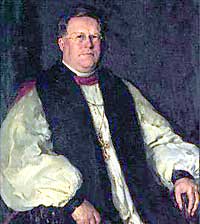
Archbishop William Temple (photo credit: http://satucket.com)

I have a confession to make. For as long as I have been a Christian, I have only been to church on Christmas one time. Whew, do I feel better! The year was 1993 and I wasn’t even ten years old yet. My family had been in London for most of the month of December on what was the best vacation of my childhood. Seeing so much history, culture, and art sparked within me an endearing love for all things English. To make thingseven better for Christmas holiday we traveled down to Canterbury to stay at a little bed and breakfast and to attend Christmas service at Canterbury Cathedral.

When my family walked in for church on Christmas day, I did not know the importance of the Cathedral: it is the center of worship in the Episcopal/Anglican world, it is the seat of the Archbishop of Canterbury, it is a historic site where Thomas Becket was martyred in 1170 and subsequently a place of pilgrimage. I did not realize all this on that Christmas morning. All I knew was that we were going into a very long service on Christmas day that was going to keep me from playing with my new toys. Yet, even as an overly-hyperactive child, I was blown away by what I heard and saw on that holy morning.

According to my mom, who keeps a meticulous journal, the 11:00AM service was a Mozart-Coronation-Mass Eucharist with Archbishop George Carey preaching. The choir was enchanting. The procession and the vestments were exquisite. The congregation was profoundly reverent. Even through the veil of my youthful inattentiveness I could tell that God was present, God had come to be with us.

One thing I do not remember well is the sermon from that day. In my memory I can see Archbishop Carey dressed in elaborate vestments, preaching with humble conviction, but I do not know what he said. Maybe he preached on the shepherds and the angels, or maybe he talked about Mary and Joseph. Probably though, he spoke about the Nativity Event, that is God comes to be with us.

Not too long before Archbishop Carey occupied the bishop’s seat at Canterbury, there was a man who not only talked about this, but also lived out his entire ministry showing to all whom he met that God became incarnate in the person of Jesus of Nazareth. William Temple was the 98th (or 99th depending on what resource one consults) Archbishop of Canterbury, and today, November 6th, we remember him in the Episcopal Church. He served as archbishop in the tumultuous years of the Second World War, but throughout his life he was an inspiration showing that God comes to be with us.

To say that William Temple was a preacher’s kid would be an understatement. His father, Frederick Temple, was a bishop and became the Archbishop of Canterbury when William was 15. Perpetually a believer with very few doubts, though William never had a rebellious stage or conversion experience, but rather he lived out his faith from a very early age. Knowing that God had come to dwell with humanity enlivened his ability to relate to all whom he met. His brilliant mind also enabled him to empathize with those from very different backgrounds than his own. “He wrote that in Jesus Christ God took flesh and dwelt among us, and as a consequence ‘the personality of every man and woman is sacred’” (Holy Women, Holy Men 668). This belief permeated throughout all his interactions enabling him to bring people from different political and ecumenical backgrounds together.

As he rose to prominence in the Church of England, moving into higher positions of leadership it seemed inevitable that he would one day be a bishop. Yet, when he was the rector at St. James’s Picadilly, he retired so that he could focus upon helping the laity to achieve more power within the church. For eight months he worked tirelessly to get an Act of Parliament passed so that church members and not politicians made the big decisions in the church. After it was eventually passed, he went back into the church and soon became bishop.

When he was appointed Archbishop of Canterbury, England was at war with Germany. In a bold act during the summer of 1944 during Operation Overlord, Temple visited the Allied troops fighting in Normandy, being the first Archbishop to “go to battle” since the Middle Ages. He was not one to shy away from getting politically involved and often was able to bring two opposing sides together by summarizing their points better than either side could do on their own. He denounced Nazism as idolatry, but advocated for humane treatment of Germans preaching against vengeance. He was an advocate of negotiated peace, but gained criticism for not condemning carpet bombing in Germany. Archbishop Temple died of complications with gout from which he suffered his entire life, before the conclusion of the war.

In all things Temple was one who lived out of the reality that God came to dwell with humanity. He treated all as if they were Jesus Christ himself. We who celebrate his life today are challenged to do the same. God came to earth and that makes the personality of all sacred. Let us so live that we might see each other as the bearer of Christ’s light in this world.

Wednesday, July 31, 2013

Ignatius of Loyola: Imitating Christ, Made in the Image of God

Today's Epistle reading comes from Paul's First Letter to the Corinthians (1031-11:1):

So, whether you eat or drink, or whatever you do, do everything for the glory of God. Give no offense to Jews or to Greeks or to the church of God, just as I try to please everyone in everything I do, not seeking my own advantage, but that of many, so that they may be saved.

Be imitators of me, as I am of Christ.

That last line gets me going a little bit. Paul tells those reading this letter that the way to be like Christ is to be like him. Wow! Isn’t that presumptuous. Of course, typically when we have such a reaction to some negative trait in someone else, that typically means that we possess that same characteristic somewhere within ourselves. Put simply, if you spot it, you got it. Even if this is true, and I am presumptuous, isn’t it a bold statement for Paul to say, “Be imitators of me, as I am of Christ.”?

Well, it might seem easy to sit back and criticize Paul for being a bit full of himself from our perspective, but honestly, as we have been reading 1 Corinthians in the Rector’s Bible Study with Evan, I have found myself liking and respecting Paul more and more. At the time the people in the church of Corinth were WILD! They were having affairs with their step mothers, they were having separate celebrations of the Eucharist, which negates even having COMMUNION in the first place, and they were getting drunk and going to church. At this point in his letter, he is summing up a major point he has been making, namely, “whatever you do, do everything for the glory of God” AND “Give no offense” to others, “so that may be saved.” 

Honestly, this recaps what Paul is trying to pass on to the Corinthians. Do everything for the glory of God and do nothing that offends others causing them to stumble on the path toward God. He has been addressing various concerns throughout his letter: Don’t eat food sacrificed to idols. You may know that there really are no other gods, but someone else might stumble because of what you do. Don’t drink heavily before coming to church, sure you may be able to handle your wine, but others will get the wrong impression. Don’t start communion without others, this defeats the whole purpose of coming together. In each of these examples we might get caught up in Paul saying “don’t,” but truthfully it is not about his prohibition on certain actions, rather it is about the intention Paul has behind these actions.

Contained within Paul's example is his intention to imitate Christ. We have different issues within our community than the people of Corinth. Still we seek examples of how we might be imitators of Christ. Even thinking of this is a bit intimidating. How will we ever imitate Christ? When I started to think, “How do we imitate Christ?” I looked at the word imitate and found myself thinking of a connected word: image. We are made in the image of God. This is good news. We are formed through Christ in God’s image. Still it is helpful for us to find clear examples of how to become vibrant images of Christ.

We have the white altar hanging set up just like last week when we celebrated the example of Thomas A Kempis. Again we are celebrating another of “God’s All-Stars” who lived his life in such a way that the Gospel was made clearer. Today we remember Ignatius of Loyola. Ignatius was born into a noble Basque family in Spain and fought as a knight seeking worldly glory. When injured during the Battle of Pamplona in 1521, he was forced to recover and during this time he had a conversion experience that shifted the trajectory of his life to aim straight towards God.

He went on retreat and discerned a call to ordained ministry, so he moved to Paris where he studied. There he met others who together founded the Society of Jesus, now known as the Jesuits. For the rest of his life, Ignatius lived in immense poverty, often praying seven hours a day in a cave. His book Spiritual Exercises has provided a spiritual framework for many to find God in their everyday life. It can be difficult to look at the life of someone who turned away from the comfort of their noble birth to live in poverty praying half of their waking hours. Even to someone who spent the last three years praying the daily office that seems unrealistic.

Our call though is to be imitators of Christ. This is not easy work. Perhaps we imitate Christ like Paul did, by encouraging others who were just starting off on their Christian journey. Maybe we are like Ignatius and we use our wealth to empower the weak. Or, perhaps we find the example of another person in our lives to be the best way to imitate Christ. We are made as Children of God, but we are challenged to open up to how God is making us more Christ-like. How will we be imitators of Christ?

We are made in the image of God, we are called to imitate Christ, and we are strengthened when we become Christ’s Body together. Amen.

Wednesday, July 24, 2013

Saints' Trading Cards: Luke 6:17–23

Today we celebrate the life of Thomas à Kempis. Protestants often get a little squeamish when we start talking about Saints. Are they closer to God than the average Christian? What about grace? Does that make everyone a Saint? As an Episcopalian, I know that my tradition's theology around Saints sometimes appears as clear as "looking through a glass dimly" to borrow Paul's words. Even after theological training and much time spent with Lesser Feasts and Fasts and Holy Women, Holy Men, both books celebrating Saints throughout the ages, I struggle to come up with the best definition of who a Saint is. Fortunately, I do not have the privilege to serve on some committee to say who is really a Saint and who is merely a saint.
Yet if someone did make the mistake of putting me in charge of discerning who belonged in a book like Holy Women, Holy Men I would stray from thinking that those to be recognized as Saints need to have two credible miracles to their name. Rather, I would wonder does this person follow the way of Christ Jesus and make the Gospel known and real to people in their unique time and location. Certainly this working definition sounds nice in this sermon, but maybe it does not hold up throughout the ages. Perhaps an analogy would work better though.

As a child, I was not all that into baseball cards, but I had friends who were. I can remember they would scour through plastic packaging searching for a prized rookie's or an all-star's special edition card. When they found it they were so very happy. They would put it in a plastic case or a book of cards. Then they would return to it every once in a while to admire it and to get inspired by it to go play that sport. Maybe the Saints are like that for us. I really do not think God has a special section of Heaven reserved for the VIPs, but maybe Saints are those folks that we get so excited about that we rip through the packaging so as to know them more intimately and to try and live our lives with God like them. One of those worth searching out in the "Saints' trading cards" is Thomas à Kempis.

Thomas was a man who lived in the late Middle Ages. He was the most well known author of the medieval age, although his book The Imitation of Christ may only be something that he compiled. Nevertheless, à Kempis after being educated as a young man, took on vows as an Augustinian monk, then later as a priest before he became a sub-prior in about the year 1425. From then until his death in 1471, he lived with the Order of the Brethren of the Common Life who took on a practical, rather than speculative, rule of life that was based on the Bible. Both lay and clergy members focused on living a pious life doing inner work and learning the virtues. Much of what elevates à Kempis as one to emulate is that he lived the Gospels out in his everyday life within this community and showed that one could connect with the life of Christ in Scripture, then complete action in the world. This countered the notions of the day that one had to pay a penance for God's love by giving money to the Church. As he shared his love of Christian virtues, his writing, and his life of discipline with the world in the location and time when he lived, to me he appears a Saint.

Thomas à Kempis took seriously the pursuit of the blessings from Jesus’ Sermon on the Plains (no it was not delivered in Auburn, AL). In his monastic life he took on a rule of life that made him poor, hungry, sorrowful, reviled, excluded and defamed on account of Jesus Christ. Yet, as he chased after Luke’s description of the beatitudes he found himself blessed. Really, we can do this too, and we do not even have to take a vow of poverty, silence, or celibacy.


Christ Jesus invites us to shape our lives and the lives of our families around the virtues. We can come in contact with the blessed poor, hungry, weeping, reviled souls and through this contact we become more saintly. When we share what we have been given by God with others, our lives transcend into something more saintly. When we say the Daily Office, like Thomas we are formed as more virtuous Christians. Certainly, we are all Saints, but I feel inspired that we can make known Jesus' Good News in this day and age, so that one day someone is ripping through packaging to seek out our Saints' trading cards.