Showing posts with label Trinity. Show all posts

Sunday, May 31, 2026

Sent Into The Life of God


Genesis 1:1-2:4a 

Psalm 8

2 Corinthians 13:11-13 

Matthew 28:16-20


© 2026 The Rev. Seth Olson


This sermon was delivered at the Episcopal Church of the Holy Apostles in Hoover, AL on Trinity Sunday. A video of the message may be found here


Holy God, may my words be your words, and when my words are not your words, may your people be wise enough to know the same. Amen. 


Today is Trinity Sunday, which means this is the Sunday when preachers everywhere are either coming up with some terribly inaccurate analogies, being tempted to explain too much, or feeling like they must apologize for not being able to explain enough.


Because the Trinity is not easy.


One God in three persons.

Father, Son, and Holy Spirit.

Not three gods.

Not one God wearing three different masks.

Not a math problem where one plus one plus one somehow equals one.


And honestly, if we try to make the Trinity small enough to fit neatly inside our minds, we usually end up making God too small. So today, instead of trying to solve the Trinity like a riddle, I want us to begin where the Gospel begins: with eleven disciples on a mountain in Galilee.


Matthew tells us that the eleven disciples went to Galilee, to the mountain where Jesus had directed them. And when they saw him, they worshiped him. But some doubted. That may be one of the most honest lines in all of Scripture.


They saw the risen Jesus.

They worshiped him.

And some doubted.


Their faith and their uncertainty were standing on the same mountain.


And Jesus does not shame them for it. He does not divide them into the good disciples and the questionable disciples. He does not say, “Those of you with complete confidence may come forward, and the rest of you can take some time to work on yourselves.”


He gives the same commission to the whole imperfect group. “All authority in heaven and on earth has been given to me. Go therefore and make disciples of all nations.”


In other words: you do not have to be completely certain before you can be sent.You do not have to have everything figured out before you can participate in the life and mission of God.


You do not have to be perfect before Christ can use you as a witness to grace. That is good news for the Church. It is good news for Holy Apostles. And it is good news for anyone who has ever loved Jesus and still had questions. Anyone who has ever worshiped and still wondered. Anyone who has ever shown up carrying both faith and doubt, both devotion and exhaustion, both hope and fear.


The risen Christ meets the disciples as they are. And then he sends them. But notice what Jesus sends them to do. He does not say, “Go win arguments.” He does not say, “Go build an institution.” He does not say, “Go protect your own comfort.”


He says, “Go therefore and make disciples of all nations, baptizing them in the name of the Father and of the Son and of the Holy Spirit, and teaching them to obey everything that I have commanded you.”


This is what we in the Church call the Great Commission. But sometimes I think we have heard it too narrowly.


To make disciples is not simply to get people to join our side. It is not merely to increase religious market share. It is not to pressure people into agreement. A disciple is a learner. An apprentice. Someone whose life is slowly being shaped by the way of Jesus.


So when Jesus sends the disciples, he sends them to invite others into a way of life: the way of mercy, forgiveness, courage, humility, justice, welcome, peace, and self-giving love.


He sends them to baptize in the name of the Father, and of the Son, and of the Holy Spirit. And that is where Trinity Sunday and the Great Commission kiss. 


The Trinity is not first an abstract doctrine to be explained. The Trinity is the life of God into which we are baptized. 


We are baptized into the name of the God who creates the heavens and the earth and calls them good. 


We are baptized into the name of the Son who takes on flesh, touches the untouchable, welcomes the sinner, forgives the enemy, washes feet, and lays down his life in love.


We are baptized into the name of the Holy Spirit, who breathes courage into frightened disciples, gathers divided people into communion, and sends ordinary human beings into the world as bearers of divine love.


The Trinity tells us that at the heart of all things is not loneliness. Not domination. Not fear. Not violence. Not isolation. At the heart of all things is communion. Relationship. Self-giving love.


God is not a solitary monarch sitting far away from the world. God is living love. Love given, love received, love shared. Father, Son, and Holy Spirit. And Jesus invites us into that life.


That is the point. Not that we would be able to define God perfectly, but that we would be swept up into the life of God and then sent out to live that divine life in the world. And that is where today’s Good News becomes very particular for us, Holy Apostles.


We bear the name “Apostles.” We are not only Holy People Gathered in a Church Building. We are Holy Apostles. Set apart and sent.


That does not mean we are impressive. The first apostles were not impressive in the way the world usually measures impressiveness. They were incomplete. They were uncertain. They were still carrying failure and grief. Some worshiped and some doubted, and maybe some did both at the same time.


And still Jesus sent them. So perhaps being Holy Apostles does not mean being the people who have everything figured out. Perhaps it means being a community willing to be drawn into the self-giving love of God and then sent back into Hoover, Shelby County, Birmingham, our homes, our schools, our workplaces, our neighborhoods, our friendships, our families, and all the ordinary places where human beings are aching to know that they are loved.


This is what we are sent to live. The grace of Jesus Christ. The love of God. The communion of the Holy Spirit.


That is how Paul says it in Second Corinthians. And it is more than a beautiful blessing at the end of a letter. It is a pattern for the Church. Grace. Love. Communion.


What if those became the marks of Holy Apostles? What if people encountered this parish and said, “That is a community where grace is real”? 


What if people came among us and discovered not a perfect church, but a loving one?


What if our life together became an invitation into communion in a lonely and fragmented world?


That is the divine life. And that is the mission.


And today, we hear this Gospel on a day when we are also saying thank you and farewell to Derek Kluz, who has helped lead this community in song for the last ten years. There is something deeply fitting about this.


Because music has a way of doing what doctrine alone cannot always do. Music can carry us into communion. Music can teach us how to breathe together. It can gather many voices into one song without making every voice the same.


For a decade, Derek has helped us sing the faith. He has helped us pray when words alone were not enough. He has helped us praise, grieve, rejoice, remember, and hope.


And now, on the Sunday of the Great Commission, we bless him as he is sent into a new chapter. That does not mean the communion ends. It means love moves outward. That is how the life of God works. The love of God is never stagnant. It creates. It gathers. It blesses. It sends.


Derek is being sent. And so are we.


Not in the same way, perhaps. Not to the same place. But every one of us who has been baptized into the name of the Father, and of the Son, and of the Holy Spirit has been drawn into the life of God and sent to make that life visible.


And Jesus gives one final promise. “Remember, I am with you always, to the end of the age.”


Matthew’s Gospel account begins with the promise of Emmanuel, God with us. And his Good News ends with the risen Christ saying, “I am with you always.”


That means we are not sent alone. Derek does not go alone. Holy Apostles does not continue alone. You do not step into your own calling alone. The crucified and risen Christ goes with us.


So, beloved Holy Apostles, on this Trinity Sunday, do not worry first about whether you can explain the Trinity. 


Live the Trinity.


Live as people created in love.


Live as people gathered in grace.


Live as people sent in communion.


Go into the world as disciples of Jesus. Teach mercy by practicing mercy. Teach forgiveness by forgiving. Teach welcome by welcoming. Teach love by loving.


And invite others—not merely with your words, but with your lives—into the self-giving love of God: Father, Son, and Holy Spirit.


Because that is who God is. And we are called to live and move and have our being in the Divine Life of the Trinity.


Amen.

Sunday, June 4, 2023

The Toomuchness of Life And the Freedom of the Trinity


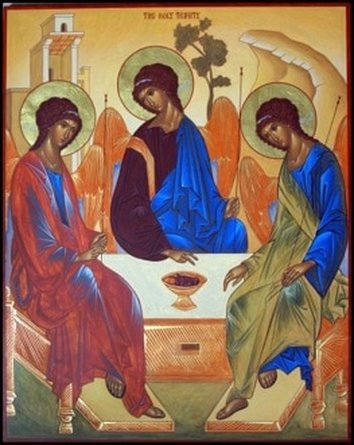
Rublev's Icon of the Hospitality of Abraham—in which we are invited to BE with God

Genesis 1:1-2:4a

 Psalm 8

2 Corinthians 13:11-13

Matthew 28:16-20

The Rev. Seth Olson © 2023

Video of this sermon may be found here. This is an Oops to Yeah style sermon (noted in parenthesis below).

Father, Son, and Spirit, Holy Trinity One God, let my words be your words, and when my words are not your words, let your people be wise enough to know the same. Amen. 

(Oops) A few years back, when I was a baby priest, when Kim and I were simply two crazy kids without two kids of our own, I received a phone call from a number that I did recognize. This was not at all uncommon, so I picked up the call wondering if it could be a parishioner in need. Then there was that unmistakable pause, an obvious sign that this was not family, friend, or neighbor. Still for some reason, yet unknown to me, I stayed on the line.

The nasally voice on the other end finally came through, “Hello Mr. Olson, this is Debra calling our valued customers on behalf of Charter.” Without any room for me to interrupt, she kept going, “Sir, I have to let you know that this phone call is being monitored for quality assurance purposes.” As she continued, I wondered when she would take a breath, so that I could say I am not interested in whatever she was selling, but still she kept speaking, “What we are doing today is making sure that you are getting the best services at this time okay.” For a second, I thought that was my chance, but she persisted about bundling services and faster internet. 

Finally, she took a breath and without thinking the following words emanated from my mouth: “I’m too busy to talk about this.” Before she even got a response out of her mouth, “When would be a good time to…” Click! I hung up the phone! Conversation over!

“I am too busy.” The words shocked me as they exited my mouth. Not that they were untrue then and even more so now, but hearing those words forced me to recognize my unhealthy behavior. Yes, we are all too busy to take phone calls from telemarketers, but “I’m too busy” might as well be the tagline for my life, and I have reason to believe I am not alone.

(Ugh) The contemporary American lifestyle generally and the Homewood way of life specifically is very busy, and pre-pandemic being busy was seen as a badge of honor. A few years back there was a great article written by Greg McKeown entitled “Why We Humblebrag About Being Busy.” To humblebrag is to, in a subtle way, talk about how much time we are spending on this project, that presentation, or some other report. McKeown suggests that the even more disturbing trend is that when we get into a state of “toomuchness” we try to fight it by adding more. More technology, more programming, more stuff does not usually lend itself to a simpler life.

McKeown is not alone in his assessment of the toomuchness of it all. There are others pointing to how we are busying ourselves with more and more programming (more soccer practice, more dance rehearsals, more social clubs, more pickleball games). It is as though we came through the pandemic, tried to keep doing everything we learned during that time to survive, and now we are trying to add back everything else we did before we knew what COVID-19 was. Instead of taking time to rest, when we do have free time, we fill it with doomscrolling through bad news, keeping up with the Jones on social media, or numbing our feelings away with one device or another. I don’t speak just as an observer, I am guilty of this too. Hi, it’s me. I’m the problem it’s me. There is another way though.

A few years ago, Brad’s good friend and pastor at Grace Methodist Church, Stephen Ingram wrote an open letter to the parents of his youth group members informing them that their children are in a bad place. As he wrote, they are “more stressed, full of anxiety, depressed, suicidal, over committed, over medicated, over worked and over extra-curriculared, and it is killing them, sometimes literally.” Ingram informed the parents that their children will probably not go to Harvard, or play professional sport, but that is okay because when we finally stop pushing ourselves and busying ourselves and extra-curricularing ourselves to death, when we finally shut down the devices and turn off the TV and finally let ourselves rest we start to discover something that we cannot otherwise experience. We heard it earlier this morning… It’s the model that God gave to us as a great gift—a gift we too often ignore.

(Aha) God spent a big chunk of time, six whole ages according to Genesis, creating the earth, the stars, the sun, the moon, the waters, everything that crawls, walks, swims, or flies and even us human beings (made in God’s own image). Yet something happened when God culminated this very good work. “And on the seventh day God finished the work that he had done, and he rested on the seventh day from all the work that he had done.” God rested. God didn’t do anything. God sat around, maybe God strung up a God’s sized hammock to just chill. I don’t know, but God did not do anything. God just was. When was the last time that you just were.

(Whee) McKeown and Ingram and Genesis encourage us to engage in a disciplined pursuit of less. Find the essential things that are crucial for the joy of life, and sand away the rest. It will probably be like cleaning out your closet—messy at first, but eventually freeing after giving away things that feel like they no longer belong to you. Yes, in giving all that away you will feel free. Somewhere in the midst of this freedom, where less is actually more—more joy, more peace, and more love for life—somewhere in this essentialist type of living is an opportunity. We heard that opportunity in today’s Gospel lesson.

This good news comes from the very end of Matthew’s Gospel account. The disciples have found themselves back where they started in Galilee. It’s fitting that Jesus brings them full circle, then he gives them what we call the Great Commission: “Go therefore and make disciples of all nations, baptizing them in the name of the Father and of the Son and of the Holy Spirit, and teaching them to obey everything that I have commanded you.”  Now, this commission might sound as though being flies out the window as Jesus said to go and do, but there was one last thing that Jesus said in that commissioning. “I am with you always, to the end of the age.” God is the great I AM, God is within the very act of being.

God in Jesus called his friends up a mountain. Earlier in this chapter of Matthew, the women (followers of Jesus) discovered that the tomb was empty and after conversing with angels, they learned that the disciples were to rendezvous with Christ on a mountaintop.

Yes, they are in Galilee where so much ministry happened, and yet they are called away from the madness of doing, so that they could be with Jesus. Now some of those on the mountain worshipped while others doubted, but neither of these things can happen if we are too busy zooming, scrolling, doing, and going. For us to even know what it is we are to do we must first slow down and be with God in our internal reality—our inner life, within our very souls.

(Yeah) Speaking of reality. Today is Trinity Sunday. When ordained ministers do our best to express the truth of the ultimate reality, which is God’s nature—Father, the Son, and the Holy Spirit. Now, I’ve spent the first ten minutes up here trying to tell you that we are not supposed to do something, so much as we are to be with someone—namely God. Thus, I believe our task on this Sunday is not to comprehend the Trinity but to be with a relational God who is Father, Son, and Holy Spirit. A God who is healthy community in God’s self. A God who is both self-differentiated and self-giving.

The trouble is that most of our lives we are too busy to experience anything other than the most urgent item on our to-do list, the most pressing family matter, the next bill, or whatever demands our attention. We become slaves to the urgent such that we take no time to slow down enough to notice that we are living within the life of the Trinity—let alone to contemplate the great mystery of God’s nature. To paraphrase Richard Rohr: a mystery (like the Trinity) is not something we cannot understand, it’s something we can endlessly understand. However, we cannot engage in this relationship if we are too busy. God is leaving breadcrumbs leading us home, back to the Table, hinting at how we already are in relationship with the Father, the Son, and the Holy Spirit. We will miss the greater glimpse of what a highly communal God looks like if we are too focused on doing ministry such that we never are with God simply being in relationship.

God who is both infinite and incarnate, transcendent and immediate, eternal and processing. God who is Creator, Redeemer, Sustainer. God who is Father, Son, and Holy Spirit is trying to speak with you. Are you too busy to take God’s call? Remember, the Great I AM is with you always, even to the end.