Showing posts with label Acts. Show all posts

Sunday, May 17, 2026

Not Comfortable and Not Comfortless

The Sunday between Ascension and Pentecost gives us much to ponder as the Church

Acts 1:6-14

Psalm 68:1-10, 33-36

1 Peter 4:12-14; 5:6-11

John 17:1-11


© 2026 The Rev. Seth Olson


This sermon was preached on the Seventh Sunday of Easter at the Episcopal Church of the Holy Apostles in Hoover, AL. You may watch a video of it here.


Holy God, may my words be your words, and when they are not your words, may your people be wise enough to know the same. Amen.


There is a strange little season in the life of the Church that we do not always know what to do with. It is the space between Ascension and Pentecost.


Jesus has been raised from the dead. He has appeared to the disciples, taught them, blessed them, and opened their minds to understand the Scriptures. And then, as Acts tells us, Jesus is lifted up, and a cloud takes him out of their sight.


But Pentecost has not happened yet. The Spirit has not rushed through the house. The disciples have not yet poured into the streets proclaiming the mighty acts of God. They are not where they were, but they are not yet where they are going. They are in-between.


And maybe that is why this Sunday feels so honest. Because so much of life is lived there: between one season ending and another beginning, between what we know and what we cannot yet see.


And today, on Senior Recognition Sunday, that in-between space is not just liturgical. It is personal.


Our seniors are standing in a threshold season. They are finishing one chapter of life and preparing for another. Some in the Class of 2026 will go to college, some will begin work, and some will take a different path. Some may feel excited, others anxious, and most probably feel a bit of both.


And they are stepping into a world that many of us do not quite know how to explain. It is a world of beauty, possibility, creativity, connection, and service. But it is also a world heavy with uncertainty: political division, war, anxiety, climate change, displacement, racism, sexism, homophobia, transphobia, white supremacy, and bigotry of all kinds. A world where people are often sorted into camps before they are seen as human beings. So the temptations for us are real.


One temptation is to say nothing: to proclaim a Gospel untouched by the actual wounds of the world. But that is not the Gospel of Jesus Christ.


Another temptation is to turn the Gospel into a weapon: to confuse the Kingdom of God with whichever political tribe makes us feel safest, angriest, or most righteous. But that is not the Gospel of Jesus Christ either.The Gospel gives us a harder and holier way: not silence, not partisan captivity, but faithful witness. 


And that is exactly where Acts meets us today. The disciples ask Jesus, “Lord, is this the time when you will restore the kingdom to Israel?” It is a very human question. Is now the time? Are you finally going to fix it? Are you finally going to make everything right? Can we please have the timeline?


Jesus does not shame them for asking, but he does not give them control either. He says, “It is not for you to know the times or periods that the Father has set by his own authority.” But then he says, “You will receive power when the Holy Spirit has come upon you; and you will be my witnesses.”


You do not get control, but you do get the Spirit. You do not get the whole timeline, but you do get a calling. That is the life of the Church.


And, dear seniors, that is not a bad word for you either…


You do not have to know your whole life right now. You do not have to see the entire map. You do not have to solve the world by age eighteen. You do not have to become impressive enough to justify all the love that has been poured into you.


You are not loved because you are impressive. You are loved because you are beloved. And the calling of your life is not first to be successful, polished, productive, and certain. The calling of your life is to receive the love of God, become more fully the person God created you to be, and bear witness to the love of Christ wherever you go. In short, your call is to live faithfully in response to Our God who is always faithfully with us.


That witness may look like kindness when someone feels alone. It may look like telling the truth when others laugh at cruelty. It may look like caring for creation, making art, studying, serving, building friendships, or practicing quiet faithfulness. The Spirit does not make all of us the same—the Spirit makes all of us witnesses.


And notice what the disciples do after Jesus ascends. No post-Ascension marketing roll-out, no doomscrolling the Roman Empire, and no wildly popular initial public offering. Instead, they return to Jerusalem, go upstairs, and devote themselves constantly to prayer.


That is not avoidance. It is preparation. 


Prayer is not the opposite of action. Prayer is how the Church remembers who we are before we act. Prayer is where we lay down our panic long enough to receive courage. Prayer is where we remember that Caesar is not Lord, fear is not Lord, the market is not Lord, the empire is not Lord, the algorithm is not Lord, and the loudest voice in the room is not Lord.


Jesus is Lord.


And in John’s Gospel lesson, we hear something beautiful: Jesus prays for his disciples. Jesus knows what is coming. He knows they will be confused and afraid. He knows they will deny, doubt, and scatter. And still, Jesus prays for them.


He does not pray for them because they are strong, but because they are his. He prays, “Holy Father, protect them in your name… so that they may be one, as we are one.” Jesus does not pray that they will be popular, win every argument, or escape all suffering. Jesus prays that they will be protected in God’s name and that they will be one.


That matters now to us in the Church, because we often confuse unity with agreement. But Jesus does not pray that his disciples will have identical opinions, politics, temperaments, backgrounds, gifts, or preferences.

He prays that they will be one in love—Christ’s self-giving love.


The kind of love that can tell the truth without contempt. The kind of love that can name injustice without hatred. The kind of love that can resist evil without becoming evil. The kind of love that can face a fractured world without giving in to despair.


That is the unity Jesus prays for. And the good news is that Jesus still prays for his own. Jesus prays for our seniors. Jesus prays for this parish. Jesus prays for every beloved child of God trying to live faithfully in an anxious age. 


And then, through the Spirit, Jesus sends us. So, seniors, as you go from this place into whatever comes next, remember this:


You are not alone. You are not your résumé, your GPA, or your college decision. You are not your anxiety, your worst decision, or the future you cannot yet see. You are beloved of God.


And you have a witness to bear now. You are not the Church of the future. You are the Church now. And the rest of us need your questions, your courage, your honesty, your dreams for a more merciful world, and your hope.


And to the rest of us: our calling is not simply to recognize these seniors and send them off with polite applause. Our calling is to bless them, support them, listen to them, pray for them, and learn from them. Because the Spirit’s presence has no minimum age.


So maybe today, the word for all of us is this: Stop staring anxiously into the sky. Not because heaven does not matter, but because Christ has given us work to do here on earth.


Pray deeply. Wait faithfully. Love boldly. Tell the truth gently. Protect the vulnerable. Resist despair. Cast your anxiety on God. Bear witness to Christ.


The world is uncertain, as it was for the disciples too. But Jesus prayed for them. Then came the Spirit. And the Good News moved through those prayerful ones.


May it be so with us. May it be so with these seniors. May it be so with the Church. Amen.


Sunday, May 3, 2026

We Are All Called To Be Witnesses

Stephen is the first martyr in Christ's Church. He modeled God's love in life and death. While it may sound disconcerting, each of us who claim to follow Jesus are also called to be martyrs.


© 2026 The Rev. Seth Olson


This sermon was preached on the Fifth Sunday of Easter at the Episcopal Church of the Holy Apostles in Hoover, AL. You may watch a video of it here.


Holy God, may my words be your words, and when my words are not your word, may your people be wise enough to know the same. Amen.

One day in seminary, I was sitting in a class on liturgy, our worship. It may be a churchy word, but liturgy simply means “the work of the people.” Christian worship is the holy work of turning our hearts, bodies, minds, imaginations, and lives toward God — the God who is more real than anything else.

I loved those classes because they helped me see that worship is not just something we attend. Worship is something that forms us.

And one day, in a lecture on the Daily Office — our prayer services for morning, noon, evening, and night — my professor, the Rev. Dr. Nathan Jennings, said something I am still turning over in my heart and mind.

He looked at us and said, “All of us are called to be martyrs.”

And the room got very quiet.

Because that is not exactly the kind of inspirational quote you put on a church brochure. “Come to church. All of us are called to be martyrs. Join us for coffee hour.”

Then he continued, “All of us are called to lay down our lives. Some Christians will give their lives by living for Christ. Others will give their lives by dying for Christ. Our prayers are practice for that. Because when we pray, we stop what we would otherwise be doing, and we turn toward God.” I have never forgotten that.

All of us are called to be martyrs. That may sound dramatic or troubling. But it is also deeply Christian. Because the word martyr does not first mean someone who dies. The word martyr means witness.

A martyr is someone whose life tells the truth. A martyr is someone who bears witness to what is most real, most holy, most life-giving, most true. Today, in Acts, we meet Stephen, the first martyr of the Church. But before Stephen is remembered for dying, he is called to serve.

Earlier in Acts, the apostles realize that some widows are being neglected in the daily distribution of food. The Church is growing, but growth has created a problem. Some people are being overlooked. Some are being left out. Some are not being cared for.

So the community chooses seven people to serve. Stephen is one of them. He is among the first deacons of the Church. That matters.

Stephen’s witness does not begin with a dramatic death. It begins with tables. It begins with food. It begins with noticing who is being neglected. Before Stephen preaches with courage, he serves with compassion. Before Stephen dies like Jesus, he lives like Jesus.

Sometimes we imagine martyrdom as something far away, heroic, and impossible. Something for saints in stained glass windows. Something for ancient Christians facing emperors. Something for people braver than we are. But Stephen’s martyrdom begins in an ordinary and holy place: caring for those who were being forgotten.

His life had already been laid down before the stones were ever picked up. And then, in today’s reading, Stephen stands before the powers of his day. He bears witness to the story of God. He tells the truth. When rage overtakes the crowd and violence begins, Stephen looks into heaven and sees Jesus standing at the right hand of God.

As he is being killed, Stephen prays, “Lord Jesus, receive my spirit.” And then he cries out, “Lord, do not hold this sin against them.” It is almost impossible to miss the echo of Jesus. “Father, into your hands I commend my spirit.” “Father, forgive them.”

Stephen has become so formed by the way of Jesus that even in the moment of his death, his life takes the shape of Christ. That is witness. That is martyrdom.

Not because Stephen wanted to suffer. Not because violence is holy. Not because God needed his death. But because Stephen’s life had been so given over to the love of God in Christ that even death could not make him stop bearing witness to mercy.

Most of us will not be called to Stephen’s death. But all of us are called to Stephen’s witness. All of us are called to lay down our lives — not usually all at once, but daily. Prayer by prayer. Choice by choice. Act of mercy by act of mercy. Forgiveness by forgiveness. Surrender by surrender.

We lay down the life we would otherwise be living so that we can live the life of Christ. Today’s Psalm reminds us that we do this when we metaphorically move from the fortresses of this world into the shelter of God who is our crag and our stronghold. Of course, making the shift from relying on ourselves to relying upon God isn’t always quick, easy, or straightforward. This is where First Peter helps us.

Peter writes, “Like newborn infants, long for the pure, spiritual milk, so that by it you may grow into salvation.” Grow into salvation. I love that phrase. Salvation is not just a status we claim. It is a life we grow into. We grow into mercy, courage, forgiveness, truth, love—we grow into the Way of Christ.

Peter then proclaims Christ, the rejected one, has become the cornerstone. The one cast aside becomes the foundation of a new way of being human. And then Peter says that we, too, are living stones, being built into a spiritual house. This doesn’t mean we create a walled off castle to keep us safe. We are to do this in the world with our lives. 

So, Peter here evokes baptismal language. Identity language. Calling language. “You are a chosen race, a royal priesthood, a holy nation, God’s own people.” Those words are not meant to make us arrogant, they’re not a weapon, nor a claim of superiority. They are a vocation.

Peter tells us who we are so that we can remember what we are for: “In order that you may proclaim the mighty acts of him who called you out of darkness into his marvelous light.”

God calls us out of darkness and into light. Out of fear into love, shame into belovedness, distorted relationships into reconciliation. God invites us to move from the shadowy places where we hide from God, ourselves, and each other — and into the marvelous light of Christ.

And then God sends us to proclaim that light. Not only with words, though words matter. But with lives that bear witness. Lives that say: another way is possible. A more merciful way, a more courageous way, a more truthful way, a more loving way is possible, which brings us to the Gospel. 

Thomas says to Jesus, “Lord, we do not know where you are going. How can we know the way?” Thomas is so relatable here because so often we do not know the way.

We don’t know how to be faithful in a world this anxious, to love enemies, to forgive, to give ourselves away without losing ourselves. Simply put, we do not know how to follow Jesus when the path gets taxing. 

And into this, Jesus speaks, “I am the way, and the truth, and the life.” Not: I will hand you a map, give you a five-step plan, or make the path easy. But: I am the way, which means we know the way by knowing Jesus. We know the way by seeing him touch the untouchable, feed the hungry, welcome sinners, forgive enemies, wash feet, and lay down his life in love.

And in the resurrection, we have seen that this self-giving love is not a pipe dream. It is not a sentimental ideal. It is not naïve optimism. It is the deepest truth of the universe. The way of Christ is the way of life.

So, in your holy imagination, wonder with me: What would it mean for you and me, for us to lay down my life? Not necessarily to die, but to witness. To give up what we would otherwise be doing so that love becomes visible.

Maybe it means coming alongside someone who is lonely. Perhaps it’s visiting someone in prison. Or your witness might be feeding the hungry, clothing the naked, or tending the sick. Your witness of God’s love might be forgiving someone who does not deserve it — which, of course, is the only kind of forgiveness there is. Witnessing can even mean loving the enemy without pretending the enemy has done no harm, telling the truth when silence would be easier, praying when we would rather stay busy, distracted, or numb. Now, all of these will cost us something. So how might we move towards this way of witnessing?

Prayer, for prayer is practice for martyrdom. Prayer is preparation for laying down our lives. We stop what we would otherwise be doing, and we turn toward God.

And, little by little, God forms us—like Stephen, like the apostles, like the saints who came before us, which means we do not do this alone.

We stand on the shoulders of those who have walked before us. We are surrounded by a great cloud of witnesses. And we walk alongside one another now. That is the point of the Church. We help each other walk the way of Christ. We remind each other that the Kingdom of God is near. We witness what it looks like!

And we practice together the self-giving love of Jesus until, by grace, our lives become the good news of Christ. So yes, as strange as it sounds, all of us are called to be martyrs because all of us are called to be witnesses.

All of us are called to lay down the lives we would otherwise live so that the life of Christ may be revealed in us. And the good news is this: The one who calls us is also the way. The one who sends us is also our refuge. The one who asks us to lay down our lives is the source of life. 

So may we place our spirits into the hands of God. May we grow into salvation. May we be built upon Christ, the cornerstone. May we walk the way of Jesus. And may our lives bear witness to the self-giving love that is the truest thing in all Creation. Amen.


Sunday, June 8, 2025

The Wild Breath of God

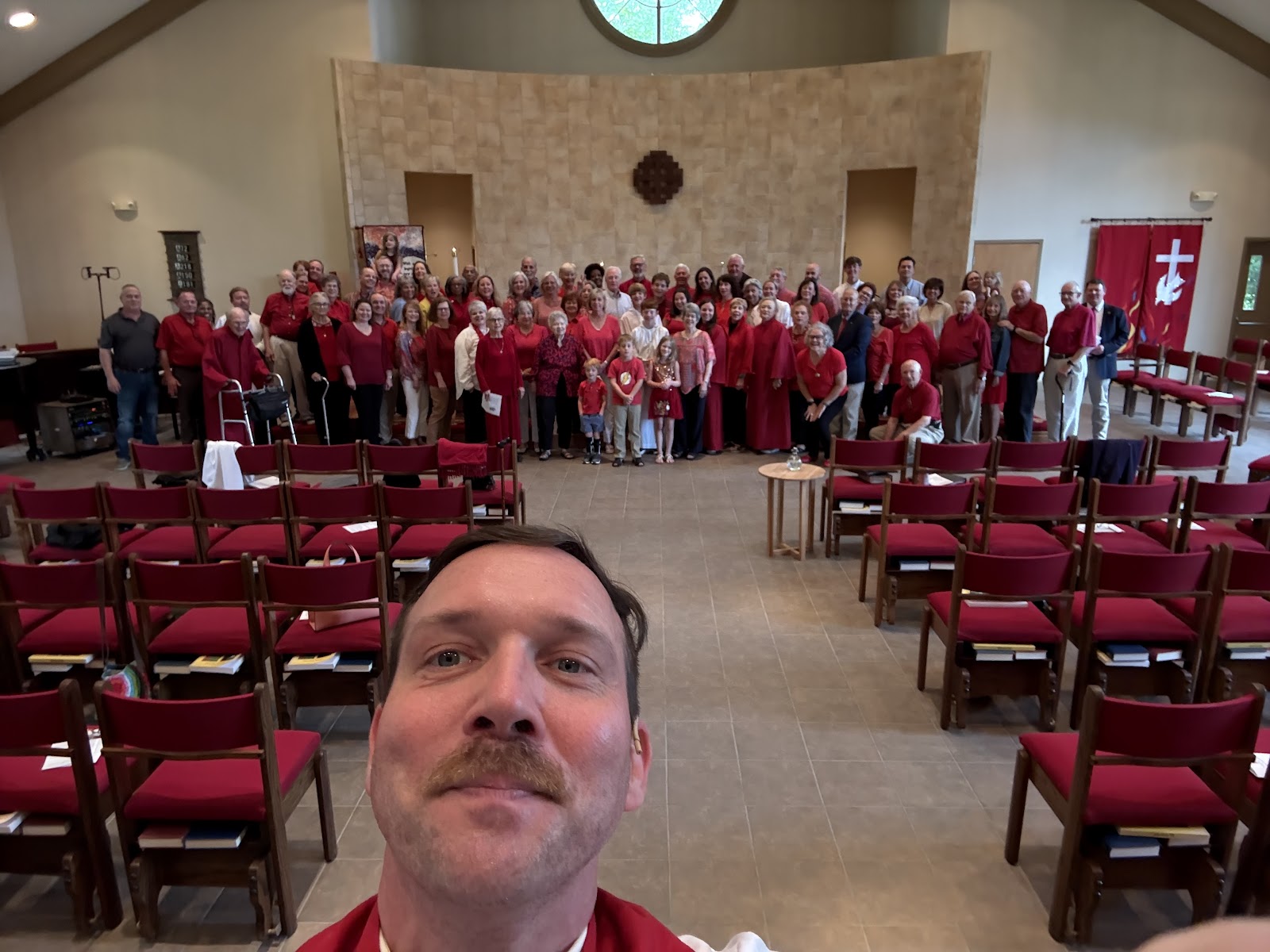
A Pentecost Selfie at Holy Apostles


Acts 2:1-21

Psalm 104:25-35, 37

Romans 8:14-17 

John 14:8-17, (25-27)


©2025 The Rev. Seth Olson


This sermon was preached on Pentecost Sunday at the Episcopal Church of the Holy Apostles in Hoover, AL. Video of the sermon may be found here


Holy God, let my words be your words—and when my words are not your words, may your people be wise enough to know the same. Amen.


Happy birthday to you. Cha cha cha!

Happy birthday to you. 

Happy birthday Mother Church,

Happy birthday to you!


I tried to bring candles, and no not the ones already on the altar, but the Holy Spirit keeps blowing the little ones out. Okay, I kid, but…


Today, Pentecost is a day full of wind, fire, confusion, and—as Peter helpfully points out—supposed pre-noon intoxication. And that’s just the opening verses of Acts. 


Today is the moment when we celebrate the Spirit bursting onto the scene not as a polite suggestion, but as a rush of violent wind and divided tongues of flame. It’s holy. It’s chaos. It’s Holy chaos. And somehow, in that chaos, people hear clearly in their own native tongue.


In Bible Study earlier this week, we recalled that this story is the undoing of what happened at Babel. When all the people of the earth all spoke the same language, which sounds lovely; however, it was highly problematic. For, as Genesis 11:1-9 informs us, the people attempted building a mighty tower to make a name for themselves, avoid being scattered—which God had commanded them “fill the earth”—and reach (beyond) heaven. Why? It's not quite clear, but some think it was to exert control over who gets into heaven. What happened?


The tower collapsed. The efforts failed. But, here on Pentecost we observe a throughline. Like Jesus undoing the denials of Peter on the beach, which we read earlier in Easter, here the Spirit brings back together these people from across the world. And yet, they keep their individual identity, still they can hear through the mighty power of not Google Translate, but the Holy Spirit!


It's as though the Spirit doesn’t just stir the pot—it lights it on fire and tosses it out the window. And, truth be told the Spirit is wild like that. God is wild like that.


I had a moment a few years ago that I think of every Pentecost. It wasn’t a wind or a fire. It wasn’t even very dramatic. It was just a breath.


It happened during an ordinary Tuesday. I was feeling worn down. Emails piling up. Laundry left unfolded. Parishioners in pain. Children growing faster than I could process. I sat down in a chair in the corner of our living room, not to pray—just to be still. I didn’t say a word. I just sighed.

And in that sigh, something happened.


Not a dove descending. Not a voice from heaven. But in that moment, a sense of peace washed over me—not like a solution, but like companionship. I felt held. It was as if the very air in my lungs was whispering: “You are not alone. I am with you.”


Jesus calls the Spirit the Advocate. The Greek word here is Paraclete, which literally means “the one called alongside.” The one who shows up. Who sighs with us. Who intercedes with sighs too deep for words, as Paul says elsewhere.


The Spirit is not just fire and frenzy; the Spirit is breath. In Hebrew, the word is ×¨×•×— (ruach or roo’aak). It even sounds like a breath. And like breath, the Spirit is steady. Unrelenting. She’s ever pulsating within our mortal being. 


And the Spirit is ever present within our Holy Scripture, too. Like in Psalm 104, which reads, “You send forth your Spirit, and they are created; and so you renew the face of the earth.” That may sound familiar to anyone who has gone through Cursillo—precisely because that piece of the Psalter is quoted within the prayer invoking the Holy Spirit. “Send forth your Spirit and we shall be created and you shall renew the face of the earth,” is almost a direct quotation and just think about what that is saying: the Spirit’s mission is not just creation, but also re-creation. Renewal. She didn’t simply move over the face of the Deep at the beginning of Genesis, she renewed those weary ones on the first Pentecost, and she’s here now (and I heard she’s bringing tacos and ice cream).


Yes, the Spirit is not done. God is not finished. And if you’re here today wondering whether God still shows up—wondering if there's anything left to breathe into the dust of your soul—then I have good news: Pentecost isn’t a one-time event. It’s a daily reality.


Sometimes I think we imagine the Spirit like a wind turbine out in the desert—powerful, yes, but distant, industrial, mechanical. What Scripture offers is more like this: the Spirit is the wild breath of God, as close as our next inhalation, as unpredictable as a summer storm in Alabama, as fierce as wildfire and as intimate as a whispered name.


Now I know that sounds poetic, but it’s also terrifying. Because if the Spirit is wild, then we can’t control it, like those ones wanted to do at the Tower of Babel. The uncontrollable nature of God’s Spirit unsettles us. We like to know the plan. We like to keep things orderly—thank you very much, The Book of Common Prayer. But the Spirit doesn’t follow our rubrics—those little italicized instructions.


As one preacher said: “The Holy Spirit will not be boxed, bottled, or booked in advance.” The Holy Spirit is more jazz than classical—improvisational, collaborative, and full of unexpected grace notes. 


That’s the kind of God we have. A God who breathes into locked rooms where disciples cower in fear. A God who sets shy fishermen on fire with courage. A God who whispers peace—not in the absence of trouble, but right in the middle of it.

Jesus told the disciples, “Peace I leave with you; my peace I give to you. I do not give to you as the world gives.” This isn’t Hallmark peace. It’s not spa-day peace. This is hard-earned, crucified, and risen peace. It’s the kind of peace that keeps showing up when everything else falls apart.


Friends, I don’t know what kind of Pentecost you’re hoping for. But I know what kind we need.

We need a Pentecost that breaks open our tightly sealed agendas.
We need a Pentecost that speaks to our divided tongues and reminds us we are still one body.
We need a Pentecost that breathes new life into the weary, the grieving, the burned out, and the fed up.

So breathe, Church.


Take a deep breath—like right now.
That breath is a gift.
That breath is a promise.
That breath is the Spirit.

And God’s Spirit is wild enough to help us wherever we journey next.

So, Come Holy Spirit fill the hearts of your faithful, kindle in us the fire of your love, and through your work help us to renew the face of the earth. It may be the Church’s birthday, but we are nothing without the gifts of the Spirit. Amen. 

Sunday, June 9, 2019

The Spirit: God’s Gift For All

We call Pentecost the Church's birthday, but it's a day about more than just cake and taking a picture.
© Seth Olson 2019
June 9, 2019—The Day Of Pentecost


Happy birthday to you,
Happy birthday dear Church,
Happy birthday to you.

If you didn’t know already Pentecost is the Church’s birthday. Yay! Hooray! This year the Church turns 1,986 years old… give or take a few years. [Whispered: We can say the Church is only 1,984 years old so as not to insult the Church.] Each year we commemorate the Church’s founding by remembering the story of the Spirit coming down on the Day of Pentecost. This was when the followers of Jesus got to work building the Church. We’ll talk a bit more about Pentecost in a moment, but what else do we do to celebrate the anniversary of the Church’s birth?

All over the world today people are dressing in red. It’s a fiery color that helps us to remember the gift of the Spirit, which ignited the post-resurrection Jesus movement. Some churches, like our own have special liturgical banners or utilize the symbol of the dove or a fire—again to remember the Spirit. Lots of churches take pictures together—we’ll do that after the service, so stick around and head outside right after this service ends. All Saints does something else too, which I had never heard of until I arrived here. We have cake—and lots of it! Every month of the year gets its own birthday cake—AWESOME!

Now each of these different elements really does make today feel like a festive birthday party—right? Like at other parties we dress up in something special. Like at other parties we take a picture together. Like at other parties we eat cake. And, all of this is great, but what about the presents? I mean birthday parties usually have some gifts, no? Well, oddly enough even though we are celebrating the birthday of the Church, it is the Church who is passing along a gift that God gave to us long ago on that fateful Pentecost day. We heard about this gifting in today’s reading from the Acts of the Apostles. Now before you ask, no, the Church is not just re-gifting the same old thing. Let us explore in more depth the day of Pentecost and how God’s presenting of the Spirit was and is a gift for everyone!

The story we heard from the Acts of the Apostles was not actually the original day of Pentecost. Pentecost was the name for a Jewish Festival called the feast of Weeks or Shavuot. This big day was the third of three great feasts in Judaism. It was called the feast of Weeks because it was the seventh week after the Passover—a week being seven days and all, this feast happened after a week of weeks had passed—just like our own Pentecost. On this monumental day many people came to Jerusalem because it was a harvest celebration when people would give their first fruits over to God. Something we too talk about in the Church as we are called to be sacrificial, proportional, first-fruits givers. This celebration of Pentecost was also more importantly the commemoration of the giving of the Torah, the Ten Commandments to Moses.

What better day could there have been for God to impart the Spirit than this day? For this was when so many in Jerusalem were celebrating Moses descending from Mount Sinai with the guidelines for righteous living that would set this people apart as God’s own. So, this Pentecost in the story from Acts when the Spirit descended was not the first Pentecost, but it was an expanding of what was already being celebrated. For when God gave this present (to the Church on its birthday) God through the Spirit was embracing all people as God’s chosen people. Everyone was called, everyone was welcomed, everyone was met right where they were. Don’t believe me? Let’s look at what the Spirit did on that Pentecost Day long ago.

The story opens with all the disciples being together. You might be thinking that’s just twelve men, including Matthias who just replaced Judas, and they were simply waiting for the Holy Spirit to come since Jesus had promised it. And, you might be right. However, there is at least one scholar who believes that when Luke writes, “They were all together in one place,” he meant all the followers of Jesus. This would have meant that hundreds of people were gathered together (in a house). [1] Whoa! That’s a lot of people and it completely changes what the Spirit’s movement and the imparting of the gift of tongues looked like. Can you imagine our whole congregation gathering together and the Spirit descending and gifting us with the ability to share God’s Good News of transformational love in as many different languages and dialects as people present?

But, that’s not all. If in truth, there were so many of Jesus’ closest followers gathered together on this Pentecost Day, then in that number would have been not only men, but also women and children! This helps us to truly see that God’s gift of the Spirit—this birthday gift for the Church—was meant not simply for some, but for all. These who received the ability to speak God’s good news in new languages and new dialects were not receiving the gift of tongues, which we hear about elsewhere in the New Testament. They were not speaking in some spiritual jargon only detectable by someone God designated to decipher. Rather, these ones whom God’s Spirit had given the ability to speak were doing so in many different languages. We might question why would God do something like this?

For years preachers—including myself—have said that this was a moment, which undid what happened at the Tower of Babel. You may recall that story from the Old Testament when God scattered the peoples of the earth giving them many different languages because together they had tried to build a tower to enter heaven to glorify themselves. If on the Day of Pentecost God had united everyone with one tongue that would be a reversal of what happened at Babel; however, God decided not to unite people with one language. Instead, God’s Spirit utilized the diversity of languages to speak to the many people of Jerusalem. Beneath this decision by God exists a profound truth of who God is and who God calls us to be.

When God used those many different tongues to speak in many different languages God was intentionally reaching out not to pilgrims who were in the city for the feast of Weeks, but immigrants who for one reason or another may have been stranded even enslaved in the city of Jerusalem. As subjects of Rome they would have been required to speak Greek, the official language of the Roman military. So, God could have spoken in Greek to all those immigrants. Instead though God’s Spirit enabled those followers of Jesus to share the Good News of Christ’s redeeming love in the native tongues of those who would have certainly felt lost, alone, and even persecuted.

We do not know exactly what those disciples shared with the people of Jerusalem. But knowing that God was using men, women, and children to reach out to those who would have felt alien and lost helps me to see that the gift of God’s Spirit is intended for everyone, everywhere. On this birthday of the Church (and always) God gifts us with the Holy Spirit. That dynamic force which inspires us to step outside of our comfort zones to share the Good News of Christ’s redeeming love with those outsiders who need it most. As we are given this gift from God, how will each of us in turn share it with others? How will we gift those whom we meet with this same love we receive? What might that look like?

I believe it looks like Joel’s vision, which Peter quoted in this lesson from the Acts of the Apostles:
Young and old, men and women are to share of God’s love.
We are to have visions and dream dreams of what that love looks like in our communities.
We are to envision what heaven on earth looks like in all its terrifying beauty.
And we are to help save each other’s lives. Yes through prayer, but also by serving those who are struggling to find relief.

Happy birthday Church! May we give to others the great gift of Christ’s love, which we have received through God’s gifting of the Spirit. Amen.

------------------------------
[1] Margaret P. Aymer "Acts 2:1-21" in Feasting on the Word, Year C, Vol. 3, eds. David L Bartlett and Barbara Brown Taylor, Louisville, KY: Westminster John Knox Press, 2010, 15-17.