Showing posts with label Epiphany. Show all posts

Sunday, January 12, 2025

Epiphany People

You've heard of Easter People, but what about Epiphany People?

Isaiah 43:1-7

Psalm 29

Acts 8:14-17

Luke 3:15-17, 21-22


©2025 The Rev. Seth Olson


This sermon was given at the Episcopal Church of the Holy Apostles. A video of this message may be found here. 


Loving and Beloved God, may my words be your words and when my words are not your words may your people be wise enough to know the same. Amen. 


On this first Sunday after the Epiphany, we celebrate the Baptism of Our Lord. This day draws us deeper into the manifestation of God’s glory in Christ, a theme that began with the arrival of the Magi at Epiphany and continues throughout this liturgical season. The readings and prayers before us today open a door to understanding what God is doing in Christ, not just for Israel but for the whole world—and how we are invited to join in Christ’s mission and ministry.


Let us begin with the voice that echoes over the waters in Luke’s Gospel account. The people are gathered in anticipation, wondering if John the Baptist might be the Messiah. John quickly dispels that notion, pointing instead to one who is greater. “I baptize you with water,” he says, “but one who is more powerful than I is coming; I am not worthy to untie the thong of his sandals. He will baptize you with the Holy Spirit and fire.” And then, in a moment of divine revelation, we see Jesus baptized, the heavens open, the Holy Spirit descend like a dove, and the voice of God proclaim, “You are my Son, the Beloved; with you, I am well pleased.”


This proclamation signals something extraordinary: God’s presence is being made manifest in a new way. Jesus, fully human and fully divine, steps into the waters of the Jordan not to be cleansed but to cleanse, not to be claimed by God but to claim us for God. In this act, Jesus inaugurates his public ministry, revealing that he is not just Israel’s Messiah but the Savior of the world. It is a pivotal moment, one that invites us to consider our own baptism and the covenant we share with Christ.


Isaiah’s prophecy provides a powerful backdrop to this event. “Do not fear, for I have redeemed you; I have called you by name, you are mine,” God declares. These words, spoken to Israel in exile, are now spoken to all who enter the waters of baptism. In baptism, we are named and claimed by God, sealed by the Holy Spirit, and marked as Christ’s own forever. This is not just a personal promise but a communal calling—to participate in God’s mission of restoration, healing, and reconciliation. What does this look like?


One way of answering that question is seeing that the Season after the Epiphany highlights three transformative moments: the Magi worshipping the Christ child, the voice of God calling Jesus “My Beloved Son” at his baptism, and the transfiguration when Jesus’ full glory is revealed. Together, these stories tell us that the light of Christ is not to be hidden but shared, that God’s glory is for all people, and that we are called to reflect that light in the world.


As I was reflecting on today’s themes, I found myself drawn to a phrase coined by a dear friend and colleague, the Rev. Charles Youngson, who calls our baptismal promises “the job description of a Christian.” Think about that for a moment. Our Baptismal Covenant is not just a liturgical moment; it’s a blueprint for how we live as followers of Jesus. When we promise to “seek and serve Christ in all persons” and “strive for justice and peace among all people,” we are embracing the work of Epiphany—shining a light on what God is doing in the world.


And what is God doing? God is still sharing the glory of non-competitive transcendence, unconditional love, self-giving service, unending joy, and peace beyond understanding. These are not mere abstractions; they are the fruits of lives transformed by grace. And they are not meant to be hoarded but shared. We are called to be light-bearers, people enlightened by the Epiphany, revealing alongside Christ what God is up to even now. We're called to see the light in one another, too. 


Thomas Merton, a 20th-century Trappist monk, writer, theologian, and mystic depicted this beautifully when he wrote, “I was suddenly overwhelmed with the realization that I loved all those people, that they were mine, and I theirs, that we could not be alien to one another even though we were total strangers. It was like waking from a dream of separateness.” This realization, which happened in downtown Louisville, KY is a most fitting moment of Epiphany—a season where we are reminded that in Christ, we are made one. Baptism draws us into this oneness, this interconnected web of divine love that binds us to God and one another.


In just a moment we will renew our baptismal vows, and when we do, I invite you to listen to these promises anew. Hear them as both invitation and challenge. How might you, in your own life, embody the light of Christ? How might you reveal God’s glory in the ordinary and extraordinary moments of your days? Perhaps it’s in offering a word of kindness to a neighbor or coworker, advocating for justice in your community or school, or simply being present to someone who is struggling. Whatever form it takes, know that you do not do this work alone. The same Spirit who descended upon Jesus at his baptism empowers and sustains you in your journey.


As we step into this new year, let us remember that we are not only Easter people, marked by the joy of resurrection. We are also Epiphany people, called to illuminate the world with the light of Christ. To be guided and embolden by our Loving God who sends us forth to proclaim, by word and example, the good news of God in Christ—especially that we are all God’s beloveds in Christ.


Let us be Epiphany people, beloved in Christ, and eager to share his light with the world. Amen.


Sunday, January 5, 2020

What We Have To Give

This corny cartoon isn't the only thing wrong with how we tell the story of the wise men, but what is the message of their coming truly about?

© Seth Olson 2020
January 5, 2020—The Second Sunday after Christmas

There once was an Episcopal priest from New England who was visiting his wife’s relatives in rural Mississippi. It was the week after Christmas. Driving through the town the priest from up north was happy to see a Nativity scene still up even though it was the eleventh day of Christmas. The care and attention put into this particular Nativity scene made it so beautiful that the priest decided to stop, get out of his car, and examine it more. (By the way, if you are wondering, this is the sort of dorky things that priests do while on vacation.)

Upon closer examination the priest was surprised—not because of the shining Angel Gabrielle, nor the placid Virgin Mary, nor the stalwart Joseph, nor even the calm baby Jesus—no, the priest was surprised to see the three wise men wearing firemen’s helmets. Baffled by the magi’s appearance, the priest walked into the church office. 

Once inside he introduced himself, and in his thick Boston area accent asked, “Why are the three wise men in your beautiful nativity scene wearing firemen’s helmets?” At this question, the church administrator became quite upset with the priest. Disappointed she exclaimed, “You Yankees! You never did read or understand the Holy Bible!”

After trying to explain that he was himself a minister, the woman at the desk started digging around her shelves. As she did the priest told her that no firemen appear in the Bible, but the administrator persisted and finally found a copy of the holy book. She frantically flipped through its pages. Turning to the appropriate chapter and verse, she pointed her index finger at the right passage, then pushed it into the priest’s face. “Look! It says it right there, ‘The three wise men came from afar…’ ”

(BOO!!! That’s a terrible joke!!! And a joke about fire at All Saints… come on!)

Even if I tried to give up dad jokes this New Year, it would be impossible. You can take the dad out of the dad joke but you cannot take the dad joke out of the dad. I apologize. While we have no confession at this service, I assure you I will certainly seek God’s forgiveness for putting you through that. Speaking of being put through things, how about these wise men?

They came from the East. They traveled across many different lands. They were guided not by a map, but by a star. They dealt with the terrible and violent King Herod. Finally, they found the Christ child. But, after giving him the gifts, they couldn’t even go home the same way because of Herod. So, what is this story truly about? 

Yes, the part of the magi is an awesome addition to the nativity pageant. Sure, the wise men coming from the East gives us an intriguing angle to the Christmas story. Of course, seeing their dutiful traveling to worship the Christ child inspires many a Christmas carol. However, the story of the magi is not simply something sentimental, rather it is a story that points us to the Epiphany when Christ was made known to the world and it is a story that challenges us to wonder, “What do we have to give to Christ?” Before exploring the Epiphany and what we might offer to Christ, let’s take a closer look at some of the often missed details of the Gospel story about the three kings. 

First, like the three firemen in the story earlier, there is no mention of three kings in the Holy Bible. What? GASP! The text never states that there are three visitors from the East. We interpret that there were that number because these foreigners brought three gifts—gold, frankincense, and myrrh. What about these gifts? 

The gifts of gold, frankincense, and myrrh weren't just random things these visitors brought. Gold represented a kingly gift, as Jesus is the true king, not only of the Jews but of Creation. Frankincense represented a spiritual gift, and it is still used as incense to symbolize our prayers and praises rising up to the throne of heaven (wherever it mystically resides). Myrrh was a stranger gift. It would have pointed to the sacrificial gift that Jesus the Christ would later give to us. Myrrh was used to anoint the dead, and so for poor Mary she might have already seen this bittersweet gift as a foreboding sign of the life her child would lead. So this is why we think there were three of them, but we do not know the actual number of visitors, we also do not know if they were kings. 

The text literally calls these visitors magicians. What? Again, GASP! Now, this is not like we are substituting a visit from Queen Elizabeth for Penn and Teller, or Prince William for David Blane. Modern-day illusionists are not the type of magician of which this text was speaking. Still, these visitors from the East were different. Some scholars believe they were not monotheistic, nor were they part of the People of God. The magi (short for magician, by the way) took their cues from the splendor of Creation rather than the rigors of the Law, the Wisdom, and the Prophets. They may have even initially been pagan… GASP, a third time! 

Sometimes we cringe or grimace when we hear the word pagan. Culturally we have been conditioned to link it to people who do not believe in God. People who are godless heathens who are out to destroy the good work being done by Christians. However, the whole point of the Epiphany is that Christ is made known not only to God’s Chosen People—the people of Israel—i.e. not us—but also to the whole world—i.e. that is us. So while they may or may not have been three in number, and they may or most likely were not kings, and they could or could not have been pagan, these visitors from the East still do point us toward the Epiphany, and what we might give to Christ.

The Epiphany is a celebration of Christ’s light, life, and love being manifested to all people in the whole world. So, it is no wonder that the Magi are the poster boys of this celebration. For, if pagan magicians from the East could observe a star at its rising, follow it for 1,000 miles, deal with a dubious politician all so that they might deliver gifts and pay homage to God incarnate, who just so happens to be an infant, then that means God is able to work on everyone, everywhere. 

So, this is the truth about the Epiphany, it is a season when we recognize God’s eternal, unconditional, and limitless love in Christ reaching to the ends of the earth. That is the epiphany that we want the whole world to have—the moment when everyone jumps up and down in their proverbial lab coats shouting, “Eureka, I’ve finally discovered it for myself. God’s grace has hit me! Now, I’ve got to share it!” And this gets us to what we have to give.

One of my favorite Christmas hymns is “In the Bleak Midwinter.” It’s last verse begins: 
What can I give him, poor as I am? 
If I were a shepherd, I would bring a lamb
If I were a wise man, I would do my part

I’ll finish the verse in a moment. What can we give Christ poor as we are? If we had been shepherds we would have brought our lambs for the young holy family to have. If we had been magicians from the East we would have brought gifts of gold, frankincense, and myrrh. If we had been Mary and Joseph we would have cared for the baby Jesus. However, we are not any of them. We might not be poor in worldly standards, but we are poor in opportunity to be with Jesus in the way the shepherds, the wise men, or Mary and Joseph were. We do not live 2,000 years ago. We cannot travel to Bethlehem to actually see the babe lying in the manger. We are us, right now, so what do we have to give?

The last line of “In the Bleak Midwinter” points us to a gift we do have to offer regardless of when or where we live. That line reads, “yet what I can I give him—give my heart.” That’s the gift we can give to Jesus, and it is the gift our entire being yearns to give. Christ Jesus is Emmanuel—God who is with us. We may not give gold, but we give worth to Christ who is our king. We may not burn frankincense here, but we offer up our prayers and praises to Christ who sits enthroned at the Father’s right hand. We might not bring myrrh, but we celebrate Jesus as the Savior who came to free us from our sins. And in these ways we give our gifts of praise and thanksgiving to Christ, we give our selves, our souls and bodies to borrow the words from our Rite I Eucharist.

So, as we celebrate this Epiphany story—a moment when God’s eternal, unconditional, and limitless love was manifested in all the whole world, may we also see the many opportunities we have to give our hearts again to Christ. Jesus laid down his life to show us what that sort of giving looks like. May we know that in Christ Jesus’ sacrifice on the cross we are loved infinitely by God. May we always and everywhere give our hearts to God as God does to us. And may we share that same self-giving love with the whole world. Amen.

Monday, March 4, 2019

The In-Between

This week we find ourselves in-between:
-We (in Central Alabama) are in-between natural seasons, the calendar may say March, but it feels like we are in the dead of winter…
-Perhaps, we in-between seasons in our personal lives (more on that in a moment)…
-And, we are even in-between church seasons…

We have not yet started Lent, but Christmas and Epiphany are in the rearview mirror, and we are about to leave this year's long Season after the Epiphany. Most probably already know what Christmas is (the Incarnation of Christ in Jesus), and even may know that Epiphany is that moment when God became manifest to the whole world in Christ Jesus (see: the story of the Wise Men and the Baptism of Jesus), but Lent (as you may not know) is the 40 day season that leads us penitently to our holiest days during Holy Week and Easter. The last Sunday before Lent begins we hear of Jesus’ Transfiguration up on a high mountain, which was the case yesterday. This story is a familiar one that tells of Jesus taking his inner circle of disciples (Peter, James, and John) on a prayerful retreat, but instead of quiet they receive visions of Moses and Elijah as well as the overshadowing cloud of God. So what about the in-between nature of this week? 

Looking ahead to this coming Sunday, we will discover Christ Jesus (much earlier in the synoptic Gospel accounts) being cast out into the wilderness by the Spirit and there in the desert he must overcome temptations. A little closer at hand, tomorrow night we celebrate Shrove Tuesday or Mardi Gras when historically people got rid of all those tempting items in their pantries, homes, and even lives to prepare for the Pilgrim Journey that is Lent, which starts on Wednesday.

So right after Fat Tuesday we "celebrate" Ash Wednesday when we are reminded of our mortal nature—we are dust and to dust we shall return. We are also invited into a holy observance of Lent. Some people take on new prayer practices, while others get rid of something that they believe takes them away from God. So, to say the least this week in the life of the Church is an in-between time. It's a week when we jettison the last gleaming remnant of the Season after the Epiphany and put on the proverbial sackcloth and ashes, but not before indulging in pancakes, crepes, beignets, or maybe some form of cajun food on Tuesday night.  

This sort of in-between time can feel disorienting—corporately and individually. My instinct in topsy-turvy moments like this is to grab onto any nearby, bolted-down object, like I’m on a capsizing ship; however, today in the glow both of my first Sunday at All Saints' Homewood and the Transfiguration, I hear an invitation from God simply to be. Can I just be, can you just be, can we just be even when we are in the midst of transitions and transformations? 

What is going on in your personal life? Maybe you have just lost a friend or a loved one and are in the midst of grieving. Maybe you have recently moved but you do not quite feel at home. Maybe you are struggling with the weather or an illness or just feeling disconnected from loved ones, yourself, or even God. Maybe it is something else, like the changing liturgical seasons. And maybe you are like me, and so you try to grasp onto some belief, some practice, some person, or something else in the midst of change, as though these things will bring us to safety. However, in the in-between-ness that is life—for life is always shifting and changing and undergoing transformation—the only constant is God. 

And, strangely what I am figuring out slowly and with many trip-ups and mistakes along the way is that what God wants from me is not for me to figure it out or to get over any negative emotion or to make myself feel at home, or anything else I must do or achieve or earn, but rather God simply wants me to be. God wants me to be with Christ like Peter, James, and John were with Christ Jesus up on the high mountain. God wants me to be with Christ like the disciples were with Christ Jesus healing the child in the story after the Transfiguration ended. God wants me and us to be with Christ today and on Shrove Tuesday and on Ash Wednesday and through Lent and everyday. 


St. John's Church, Decatur
Recently moving from the beloved community of St. John’s Church, Decatur to the beloved community of All Saints’ Church, Homewood has me feeling like I am in-between. My wife, son, and I closed on a house, but we await renovations, so we’re camped out with my family in-between spaces. At church while some remodeling here is being completed I don't yet have an office, I am working in-between spaces. In my ministry my well-worn routines and practices are being reworked as I learn new things, new church rhythms, and drive a new way to work. I am learning to be with God and fellow children of God in the in-between.

All Saints' Church, Homewood
At times I get inpatient and feel frustration, as I want to grab onto a silver bullet, some snake oil, or a cure all, but the truth is whether it is a great overshadowing cloud, people clamoring for healing, the devil beckoning with temptations, or simply shear silence what remains constant through all these in-between times is God. Always God is and always God yearns for us to be with God through Christ and the Spirit. Amen.

Wednesday, May 31, 2017

Flip It


Jesus has only be ascended for six days, we have not even left the season of Easter, and already our attention shifts from the Paschal Season of the Resurrection to the waiting and watching of the Nativity cycle. I almost feel like the Church resides as some great sea being tugged at by two different moons: Incarnation one moment, Resurrection the next, birth one moment, death/rebirth the next. So, even on this day at the tail end of the Easter season, we look to the pregnancy of Mary and the visitation she made to her cousin Elizabeth; today we celebrate the Visitation of the Blessed Virgin Mary.

Like any well-worn—or better said well-heard—story we may not notice the strange particularities. Rather, we comfortably float over the odd details focusing instead on the overarching beauty of pregnant cousins visiting and Mary singing a song of God’s Kingdom not unlike Hannah’s in 1 Samuel. Today though, the relationship between these cousins has captivated me. Their unfolding connection—both obvious in the text and hidden between the lines—points to the striking truth that the Blessed Virgin Mary carried in her womb the One whom God sent to save the Universe by flipping it on its head.

Before we even get to this story, let us back up a chapter or two in Luke’s telling of the Good News. Previously in the story an angel visited Elizabeth’s husband Zechariah, he doubted the messenger, and the angel struck him dumb until the birth of their child. Elizabeth’s pregnancy links so intimately with Mary’s own conception that Luke uses the former’s gestation timeline as a marker for when Gabriel came to tell Mary the surprisingly good news. “In the sixth month” is a reference to Elizabeth’s pregnancy. Luke thus intimately intertwines the two holy women and their holy offspring, but this only begins to point out their association.

Next, within the astonishing announcement from Gabriel when Mary felt perplexed by the angel’s words what seemingly convinced her to say, “Here am I, the servant of the Lord: let it be with me according to your word,” had everything to do with Elizabeth’s pregnancy. Elizabeth and Zechariah had not been able to conceive previously, but through God’s transforming power they did. Mary found out of this news through a divine messenger, and seemingly as soon as Gabriel left, she quickly departed too, as she went to deepen her connection with Elizabeth.

We find ourselves now at the beginning of today’s Gospel lesson, when Mary set out to visit Elizabeth. The two women lived about seventy miles away from one another, and having earlier this year traveled with a pregnant woman in her first trimester Mary’s voyage stands out as extremely difficult. Moreover, in those days unmarried women did not travel alone in public, but seemingly the strong-willed Mary did! Without too much effort we can easily observe God flipping the male-dominated culture on its head with Mary, the bearer of the Mighty One traveling alone for several days—unaccompanied by a male family member. Go Mary! Go God! Once Mary reached her destination, the cousins’ connection provided another opportunity for God’s power to reroute worldly authority.

Elizabeth’s and Mary’s interaction exemplifies how God’s Kingdom works. Like I stated at the beginning this story sounds so familiar that we may overlook some critical details, including how the cousins say hello to one another. From the perspective of the world Elizabeth holds all the power. Elizabeth was the wife of a priest, an elder relative of Mary, and a woman six-months pregnant, which beats a lowly, unwed, teenage woman with child any day of the week; however, that does not match the story. Although Mary very kindly greets her elder cousin, a sign of admiration, Elizabeth’s response points to her mutual respect of Mary.

When Mary greeted Elizabeth the unborn baby John the Baptist leapt in his mother’s womb and the Holy Spirit filled the elder cousin. Elizabeth thus cried out, “Blessed are you among women and blessed is the fruit of your womb” signifying Mary’s stature. Elizabeth could not even believe that Mary had come to see her cousin, “And why has this happened to me, that the mother of my Lord comes to me?” What great respect these two women showed to one another. The greetings conclude with Elizabeth blessing Mary as she recalls the fulfillment of what Gabriel spoke to her.

We may wonder, “What might we learn or celebrate from this interaction?”
Mary and Elizabeth do not allow differences in power, age, or distance to dictate the respect that they bestow upon one another. In our baptismal vows we promise to respect the dignity of every other human being. The Kingdom of God does not run on the same economy as the world, nor does it play by the same rules of power differential in which things like light skin color, maleness, high education level, and affluence will allow one to dominate someone the world deems as lesser. As Mary points out in the song we call the Magnificat, “[God] has scattered the proud,” “brought down the powerful,” and “sent the rich away empty,” while “[God has] lifted up the lowly,” “filled the hungry with good things,” and “helped his servant Israel, in remembrance of his mercy.” Mary and Elizabeth get this notion for they mutually share love, respect, and hospitality with one another.


How will you like these courageous bearers of God’s love flip the power-hungry world on its head? How will you work with God to build the love-hungry reign that these women and Jesus initiated? How will you be like Mary and Elizabeth?
x

Wednesday, January 6, 2016

Epiphany: When the Rest of the World Gets It

An Epiphany meme found on www.reddit.com
Today is Epiphany! YAY! The Wise Men finally reached their destination. As a child the Sunday closest to Epiphany was when we did the full Nativity pageant. Sure on Christmas Eve we had some fun with Mary, Joseph, and the baby Jesus; however, it was not until later that we brought out the full cast. I loved playing the part of the Innkeeper the most, as the lines were short and I got to sit in a pew by myself; however, I also loved being one of the Magi. As much as today is about the Wise Men, we often can confuse their presents with the deeper significance of their presence at the side of Jesus and his mother.

Yes, this is the day when three guys triangulated the city of Bethlehem with a star that led them to the baby Messiah and his mother, but it was also the precise instant that persons outside the Chosen People of Israel came to see, gift, and worship the Incarnate God in the person of Jesus. THIS IS A BIG DEAL! For thousands of years the tribes of Israel had worshiped the One God, but it was not so clear that anyone else cared or "got it." And yet, in this moment three men who practiced a completely different religion that focused far more on stars and the natural world than a monotheistic interpretation of God traveled from afar to be with this new born king.

Epiphany is the celebration of the rest of us getting it. Jesus had come to his people and according to John's Gospel account the people did not recognize him (1:11). So for another people to come, see, and worship him as God opened up a completely new possibility for the saving work that Jesus did. This was not just something confined to one group, one tribe, or one religion. This was the event that uncorked the beautiful saving embrace of all people.

Those in the Eastern Orthodox Church celebrate this as the most high moment of what is called the "Nativity Cycle" that is Advent, Christmas, and Epiphany. They can easily relate to the ones from the East, so this makes sense that they love this day. Although we in the U.S.A. are not from the East we are Gentiles like the Magi. So, this is our day to celebrate salvation coming to us as well! Those in the Eastern Orthodox Church do not just confine Epiphany to a remembrance of the Wise Men though, they (and we with them) celebrate different moments of other people getting a glimpse of Christ's coming in Jesus, most notably the Baptism of Jesus and Jesus' first miracle at a wedding reception in Cana.

Today is the day when all people are invited to get the miracle of Christmas. We are invited to dwell fully in the mystery of Emmanuel: God with us. The Divine comes to earth to save all people. Today we go with the Wise Men to see the mother and child. We watch as Jesus rises from the River Jordan and hears God's voice calling him "My beloved Son." We celebrate heartily as Jesus transforms water into wine. This is the day when we get invited to be part of God's people, as we recognize the transformative power of the Incarnate One.

Wednesday, January 7, 2015

EUREKA

Audio of sermon can be found here: http://s3.amazonaws.com/dfc_attachments/public/documents/3201704/Olson_010715_Wed_Noon_Eureka.MP3

Have you ever had a “eureka moment”? You know what I am talking about, right? When something clicks into place for the first time. A time when something becomes clear that was not so clear just a moment ago. Where does it come from?

I got curious about the word itself. Eureka has become an English word, but originally it meant something a little different in the Greek. “I found it,” that’s what eureka means, and the great mathematician Archimedes gets credit for first saying it. Of course, the moment when he said it is more fascinating to me. Archimedes stepped into a bath tub when he realized that the water level rose as his body’s mass sunk beneath the surface, thus he discovered the law of water displacement. Only a mathematician would shout out loud, “I FOUND IT! EUREKA!” when discovering a law in the bathtub.

Have you ever had a eureka moment? A moment when something becomes apparent for the first time. Maybe it was when you first fell in love with your spouse. Perhaps it was that time when you first fell out of love with someone. A eureka moment could be when you happened upon your life’s great passion, or when you came to connect with God in a deeper way.

Yesterday in the Church we remembered a collective eureka moment, the day of Epiphany. Epiphany is another old word that means revelation or manifestation, and it is the time when we celebrate the Incarnate God in the person of Jesus being revealed as messiah to a people outside of his own tradition. This is our collective eureka moment. We most closely connect the Epiphany with the story of the Magi, three wise men from the East following a star, so that they could bestow gifts upon a child savior, but strangely enough today’s story is another Epiphany moment, another eureka!

A professor in seminary once wondered aloud about today’s gospel lesson. She said, “What does it say about John’s gospel account that the first of Jesus’ miracles that he writes down is turning water into wine at a wedding feast in Cana?” “Is he a drunk?” I thought. “Does John just really love wine? Maybe he’s a big proponent of preparing for wedding feasts?” Of course, what my professor was going for is that Our God is abundant and loves to celebrate with us. Hold onto those two revelations from this story for a moment because we need to explore what happens between Jesus and his mother to fully observe this epiphany.

The way that John records this story strikes me as peculiar, at least upon first reading. “There was a wedding in Cana of Galilee, and the mother of Jesus was there.” John needs for us to know that Mary is there. Then he tells us that Jesus and his disciples were there. “When the wine gave out,” the story continues with a twist in the plot introducing us to some drama, Mary says, “They have no wine.” At this moment I am struck that Mary takes on someone else’s problem. This is not her son’s wedding. She could have left this problem alone, but instead she turns to Jesus.

Now, I am not opposed to taking our problems to Jesus, but I do not think that is the eureka moment. This is not what we are seeking to find. Jesus responds to his mother almost coldly, “Woman, what concern is that to you and to me? My hour has not yet come.” If I talked to my dearest darling mother in this way, I would get at least a death stare if not worse. Yet, what Jesus does here is fascinating. He does not urgently panic about what to do, nor does he immediately coddle his mother or the stewards or the bride and groom. His mother also does not get defensive about how Jesus speaks to her, instead she simply says, “Do whatever he tells you.”

Mary has faith in her son that he will do the will of God. Jesus though is not a magic eraser, he’s not Mr. Fix-it, nor is he some magician who waves a wand over the problems of the world. That is not why God became incarnate.

Jesus was a Jewish man, but for him to ask the servants to fill the jars of purification with water was a big no-no. In this moment he reveals a true miracle: Yes, it is turning water into wine! Yes, it is producing enough wine to open up a Galilean winery! Yes, it is helping the celebration of two people coming together in marriage to continue late into the night! Yet, it is even more than this. Jesus transforms the rite of purification into a moment of celebration. Jesus initiates his ministry with this first miracle not to solve a problem that is not really a problem, but to show that He is God and our God is a God of plenty and festivity.

This is the eureka moment! We have found God and Our God is not just here for purification, but for celebration. Our God is not just here for fixing problems, but for responding to even our small concerns with great richness. And our response to this Epiphany should be following mother Mary’s words, “Do whatever he tells you.” In this time of year when we recognize God’s manifestation as Savior of all people let us observe God’s abundance, celebration, and presence all around us and even within us.

Monday, January 5, 2015

Mary, Spiderman, and Jesus... And the Wise Men!

Audio from the Epiphany Burning of the Greens Service: http://s3.amazonaws.com/dfc_attachments/public/documents/3201672/SJ_Epiphany_Eve_2015_Olson.MP3

Tuesday, March 25, 2014

The Annunciation of Our Lord Jesus Christ to the Blessed Virgin Mary (or simply TAoOLJCttBVM)

Have you started your Christmas shopping yet? We are only nine short months away from the big day! Before you know it retailers will be exchanging their Cadbury eggs for candy canes, the holiday songs will start filling stores with cheer, and we will wait expectantly for Jolly Ol’ Saint Nick to come down the chimney. We can laugh at this, but my grandmother, Nangy, often would tell me excitedly on our way to the beach in the summer that she had finished all her Christmas shopping. I would snicker, but pretty soon I realized that she was being serious.

The commercial and secular versions of Christmas tend to infuriate me; however, I appreciated that my Nangy would spend months thinking about how she would celebrate the birth of God into this world with her family. My grandmother’s desire to get ready for Christmas year round encourages me to ponder more deeply this moment when Mary begins preparing to bear God Incarnate into this world. What was it like for Mary to encounter Gabriel?


There is a piece of altar artwork that hangs in the Uffizi Gallery in Florence, Italy. The golden backdrop that Simone Martini employed presents an immaculate setting for the very first moment of Gabriel’s conversation with Mary. Carefully examining the artwork shows that the angelic messenger’s words are visually depicted on the wooden piece; the original Greek words fly from Gabriel’s mouth towards Mary. Less careful examination is required to see that Mary does not want anything to do with the messenger of God.

In this Gothic era painting, Gabriel kneels at Mary’s feet. Mary bends away from the angel’s words. Gabriel looks longingly at this highly favored lady. Mary pulls a veil to cover her ears from the greeting, and she looks away from the winged creature. Highly praised as Martini’s masterpiece, this artistic vision perfectly captures the skepticism that envelopes the start of Mary’s journey. When Gabriel speaks, “Greetings favored one! The Lord is with you!” I cannot help but hear his message in the tone of a telemarketer calling at the most inopportune moment, “Grrrreeetings favored one! YOU are theeaaa BIIIIIGGG WINNER! The Lord is with you!”

Mary’s journey begins with apprehension, as she is perplexed by Gabriel’s words. She ponders all these things in her heart and wonders what sort of greeting this might be. The angel not wanting to be denied continues his persuasion, "Do not be afraid, Mary, for you have found favor with God,” then he promises her son, Jesus, will be great, the Son of the Most High. Mary knows there has to be a catch, "How can this be, since I am a virgin?" The protestation of Mary seems a completely human response. How often do we turn God away with our excuses? I do not have the time, the money, or the strength to do this God. Yet, Gabriel continues, “The Holy Spirit will come upon you, and the power of the Most High will overshadow you; therefore the child to be born will be holy; he will be called Son of God. And now, your relative Elizabeth in her old age has also conceived a son; and this is the sixth month for her who was said to be barren. For nothing will be impossible with God."


It is in this moment that everything changes. It is in this moment that something clicks within Mary.
A fresco of the Annunciation completed by Fra Angelico depicts this moment. Gabriel announcing something deeply personal to Mary, that her barren cousin will bear a child, shifts the trajectory of our relationship with God. Mary instead of leaning away, angels towards the angel. She mimics Gabriel’s posture. It is in this moment that Mary says yes. She takes the impossible with God. “Here am I, the servant of the Lord; let it be with me according to your word.”

For nine months she would possess within her the Incarnate God. What a mysterious time for Mary! And, what a mysterious time for us! God desires for us to bear Jesus into the world. God speaks to us urging us to bring Christ into this aching existence. Christmas is not just a season that we celebrate in December, the Incarnate God comes to us every day! Let us be ready for Christ’s coming, not just with candy and music, but with open hearts, expectant souls, listening ears, and excited spirits. Amen.

Monday, January 6, 2014

Epiphany: The Magi Finally Made It

When did it happen? Thanksgiving? The weekend after Thanksgiving? Did you wait until Christmas? Or, did you make it until today? When did the magi, the three wise men from Matthew 2:1-12, make it to your manger scene? Maybe you were tempted like me to put up your Creche scene this last weekend. Yet, today is the day. Only twelve long (and cold?) days after the birth of the Christ child these three strangers from the East show up to greet Jesus with gold (oh boy), frankincense (okay), and myrrh (what the heck is that?). That seems like an awfully long time to wait around a barn full of animals to me. Of course, I think I am missing the point here.

Today is Epiphany, which means "Manifestation" or "Appearing." Yes, it is the day on which the Church celebrates the magi visiting the Christ child and his family. Yet, we might be limiting ourselves if we think that this alone is what this day that is all about.

First, let's get this out of the way, in Matthew's account, the only place where we find the Magi, Jesus is not born in a manger. He is born in Bethlehem, but there is no mention of any barn or shepherds, although there are some angels.

Next, in many parts of the world today is the peak of the Christmas celebration. Epiphany follows the 12 days and nights of Christmas. It is seen by many, especially those in the Eastern Church, as the culmination of the Nativity season!

Also, those in Greece, Egypt, Russian, and else where do not just focus upon the wise men today. Epiphany (which means "Appearing" remember?) is a celebration of God's most fitting, clear manifestation in this world (aka Jesus of Nazareth) and people outside of Jesus' family recognizing it.* Today the Church at large also celebrates two other stories of God's appearing in the world and people actually noticing it. For some reason seeing God is hard for us to do, like when no one stopped to listen to world famous violinist Josh Bell playing a wealth of classical pieces on a $3.5 million violin in the metro station of Washington D.C. (Click here for the story.)

One of the other (Non-Magi) stories is of Jesus being baptized and others seeing the Spirit descending upon him like a dove, and the other is of Jesus' miracle of turning water into wine in Cana. Both of these stories helped people around Jesus to know that God is with us in the world. The trouble is that we often do not stop to recognize that God is being made manifest all around us.

Today we can move the magi and we can think that they finally made it to the Christ child, but the message of Epiphany is that God is made known to us in the world. Our challenge is to continue to recognize Christ being made manifest in the world. Will you stop and hear the music or will you rush on by?

*For some reason the church does not consider the story of the shepherds an Epiphany moment, perhaps because one understanding of Epiphany has been "Christ's appearing to the Gentiles," and the shepherds were part of the people of Israel.

Wednesday, November 6, 2013

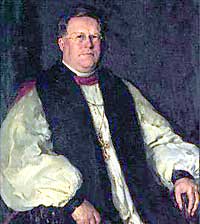
William Temple: "The personality of every man and woman is sacred."

Archbishop William Temple (photo credit: http://satucket.com)

I have a confession to make. For as long as I have been a Christian, I have only been to church on Christmas one time. Whew, do I feel better! The year was 1993 and I wasn’t even ten years old yet. My family had been in London for most of the month of December on what was the best vacation of my childhood. Seeing so much history, culture, and art sparked within me an endearing love for all things English. To make thingseven better for Christmas holiday we traveled down to Canterbury to stay at a little bed and breakfast and to attend Christmas service at Canterbury Cathedral.

When my family walked in for church on Christmas day, I did not know the importance of the Cathedral: it is the center of worship in the Episcopal/Anglican world, it is the seat of the Archbishop of Canterbury, it is a historic site where Thomas Becket was martyred in 1170 and subsequently a place of pilgrimage. I did not realize all this on that Christmas morning. All I knew was that we were going into a very long service on Christmas day that was going to keep me from playing with my new toys. Yet, even as an overly-hyperactive child, I was blown away by what I heard and saw on that holy morning.

According to my mom, who keeps a meticulous journal, the 11:00AM service was a Mozart-Coronation-Mass Eucharist with Archbishop George Carey preaching. The choir was enchanting. The procession and the vestments were exquisite. The congregation was profoundly reverent. Even through the veil of my youthful inattentiveness I could tell that God was present, God had come to be with us.

One thing I do not remember well is the sermon from that day. In my memory I can see Archbishop Carey dressed in elaborate vestments, preaching with humble conviction, but I do not know what he said. Maybe he preached on the shepherds and the angels, or maybe he talked about Mary and Joseph. Probably though, he spoke about the Nativity Event, that is God comes to be with us.

Not too long before Archbishop Carey occupied the bishop’s seat at Canterbury, there was a man who not only talked about this, but also lived out his entire ministry showing to all whom he met that God became incarnate in the person of Jesus of Nazareth. William Temple was the 98th (or 99th depending on what resource one consults) Archbishop of Canterbury, and today, November 6th, we remember him in the Episcopal Church. He served as archbishop in the tumultuous years of the Second World War, but throughout his life he was an inspiration showing that God comes to be with us.

To say that William Temple was a preacher’s kid would be an understatement. His father, Frederick Temple, was a bishop and became the Archbishop of Canterbury when William was 15. Perpetually a believer with very few doubts, though William never had a rebellious stage or conversion experience, but rather he lived out his faith from a very early age. Knowing that God had come to dwell with humanity enlivened his ability to relate to all whom he met. His brilliant mind also enabled him to empathize with those from very different backgrounds than his own. “He wrote that in Jesus Christ God took flesh and dwelt among us, and as a consequence ‘the personality of every man and woman is sacred’” (Holy Women, Holy Men 668). This belief permeated throughout all his interactions enabling him to bring people from different political and ecumenical backgrounds together.

As he rose to prominence in the Church of England, moving into higher positions of leadership it seemed inevitable that he would one day be a bishop. Yet, when he was the rector at St. James’s Picadilly, he retired so that he could focus upon helping the laity to achieve more power within the church. For eight months he worked tirelessly to get an Act of Parliament passed so that church members and not politicians made the big decisions in the church. After it was eventually passed, he went back into the church and soon became bishop.

When he was appointed Archbishop of Canterbury, England was at war with Germany. In a bold act during the summer of 1944 during Operation Overlord, Temple visited the Allied troops fighting in Normandy, being the first Archbishop to “go to battle” since the Middle Ages. He was not one to shy away from getting politically involved and often was able to bring two opposing sides together by summarizing their points better than either side could do on their own. He denounced Nazism as idolatry, but advocated for humane treatment of Germans preaching against vengeance. He was an advocate of negotiated peace, but gained criticism for not condemning carpet bombing in Germany. Archbishop Temple died of complications with gout from which he suffered his entire life, before the conclusion of the war.

In all things Temple was one who lived out of the reality that God came to dwell with humanity. He treated all as if they were Jesus Christ himself. We who celebrate his life today are challenged to do the same. God came to earth and that makes the personality of all sacred. Let us so live that we might see each other as the bearer of Christ’s light in this world.