
Showing posts with label Joseph. Show all posts

Sunday, December 18, 2022

Waking Into God’s Dream


This week's Gospel is not only about Joseph's dream—it's also about waking up.


Isaiah 7:10-16

Psalm 80:1-7, 16-18

Romans 1:1-7

Matthew 1:18-25

 The Rev. Seth Olson © 2022

Emmanuel, God with us, let my words be your words, and when my words are not your words, let your people be wise enough to know the same. Amen.

“I can’t do it,” said the little voice. I looked down at the six-year-old boy beside me. The genuine perplexity with which he said, “I can’t do it,” made it just about impossible for me to be upset. Of course, it was only the first day of camp, and pretty quickly I learned that whatever I asked this child to do—put on shoes, get ready for the pool, make his bed, brush his teeth—whatever I asked, the reply was always the same: “I can’t do it.”

By Tuesday, my feeling that this little one was a cute child of God had melted into thinking that perhaps this was a Job situation, and I was being tested by God Almighty. Only 15 years-old, at the time, I did not have a firm grip on my emotions (do I now?). So, as the camper kept saying, “I can’t do it,” my patience wore thinner and thinner. To top it off, the entire cabin of twelve children had seemingly caught this “I can’t bug,” as they all joined in the negative chorus.

Kevin Denson was the other leader in my cabin. We had been campers together for a few years, so we had a good rapport with one another. As we sat down on Tuesday evening, he looked as tired as I felt. So, I asked him, “What should we do?” His response was as malicious as it was brilliant, “Maybe we could use a devotion.” Of course, I thought, “We could turn to the Word of God to force misbehaving children into shaping up.” I know, I am not proud of what I did, but desperate times call for desperate measures.

That very same night we turned to verses in Scripture to illustrate our point. God does not want us to respond by saying “No, I can’t,” rather we are to say I can. Philippians 4:13 reads, “I can do all things through Christ who strengthens me.” “For God all things are possible,” Mark’s Gospel account proclaims. We hammered home our message by saying, instead of telling us I can’t do it, say I can, for God helps us to do all things.

Really, even though we had bad intentions the message was a good one. And, perhaps it was our brilliant teaching, but more likely it was that by Tuesday all the campers were exhausted. Hiking, horseback riding, canoeing, swimming, games, and singing—it all wore the campers out such that they fell fast asleep. At least, for a while.

What you may not know about the camp where I grew up is that the bathrooms are a short walk from the cabins. To teenage me that was nothing, but to a six-year-old in the middle of the night it must have felt like a lengthy trek. Now, sometime around two o’clock in the morning, the boy who had started the, “I can’t do it” movement came and knocked on my door. Half awake, I sat up in my bed. “Buddy, what do you need? It’s really late.” He responded, “I can. I can go to the bathroom.” By which, he really meant I can’t go to the bathroom, at least not without a leader. I got a little teary-eyed as I found my bathhouse sandals. This sweet little child of God had tried his best to understand our message. He tried to stay positive and to say, “Yes, I can with God’s help,” even if he could not.

So often we think of Advent as Mary’s season of “yes,” but today’s Gospel lesson depicts Joseph as a profound model of “I can do this” with God’s help. Joseph, does not get a lot of publicity, but he is a model of faith, an example of trust, and a righteous man, or at least he becomes one with God’s help! Yet digging deeper reveals that this story is not just about Joseph affirming God’s call, it is about us—you and me, this community—taking part in God’s YES! So, let’s take a look closer.

In those days, betrothal, like that between Mary and Joseph, was a legal and binding contract made between the elders of families. Mary and Joseph may not have had much say in this process. Then, when Joseph discovered Mary was with child, he would have been right within the law, according to the book of Deuteronomy (22:23-27), not only to dismiss his betrothed quietly, but also to put her to death, as she had broken the contract. This is an instance of what is legal, what is ethical or Godly being worlds apart! Yet, Joseph planned to say, “I can’t do it,” in a respectful manner. Then, everything changed.

“Just when Joseph resolved to [dismiss Mary quietly], an angel of the Lord appeared to him.” At the start of the dream, the angel identified Joseph, as the Son of David, which put some historical perspective around this. This correct identification also meant that God knew exactly who Joseph was. God intervened into Joseph’s life to invite this Son of David into something different.

The beginning of Matthew’s Gospel account reads like a beta version of Ancestry.com, which is amusing, except that so many of the members of David’s line did not adhere to the way of God—did any of them? Even David didn’t. There were troubling women in Jesus’ ancestry primarily because there were unfaithful men in his lineage. Bathsheba’s wrong doing was because of David’s own, Tamar’s was a result of Judah’s, and Joseph could have added to that, but he did not.[1]

If you know anything about generational trauma this tiny step is huge. Joseph stopped a cycle. Do we hope for something more from Jesus’ earthly father? Of course! Still to dismiss Mary quietly was a start, or more correctly stated, it was an opening that God utilized.

In this opening, the angel first invited Joseph to live without fear. Yes, it’s easier said than done. And yet, without fear Joseph could then hear the messenger say that this child was not ill-conceived but conceived by the Holy Spirit. God’s Spirit came to bear life in Mary in this unique way. Once his trepidation waned, Joseph could hear God’s good news—that this child within his betrothed was holy.

As the dream continued, Joseph learned that he was to name this child Jesus. While this was nothing novel in Jewish history, as Ishmael, Isaac, Solomon, and Josiah all had their names revealed to their family in dreams, God was doing something new here! The angel indicated what was meant by this name.

Jesus, or Joshua in Hebrew, means Savior. He would save his people from their sins. The child within Mary would wipe away the disconnection, the wrong, and the hurt that kept people from God, from each other, and from their truest selves. This was good news in a good dream, but we cannot live merely in dreams.

Perhaps the most unremarkable bit of this passage is that Joseph woke up. However, he did more than simply opening his eyes. In Advent, we sing songs like, “Sleepers Wake,”—“When we hear the heralds singing,
and in our hearts new joy is springing; we wake, and rise up from our gloom; for our Friend comes down all-glorious.”[2] This sounds like Joseph who woke up to see not a dream but God’s truth. With God’s help, Joseph made the impossible dream come true! The “I can’t do it” in the nighttime turned into the “I can” of the morning.

You might be saying, “Okay, so why is all of this important to me?” or “This is all so crazy, why did it happen this way?” Could God have come into this world in another way? Certainly! Who are we to limit the Creator of the Universe? Matthew though, added a prophecy to help interpret this passage.

Isaiah, the prophet, foretold of this miraculous birth. Yes, Joseph was to name him Jesus, but the child would grow into Emmanuel, which means “God is with us.” The reality that Joseph awakened into was God is with us! The God of all Creation came to be with us! At the end of Matthew’s Gospel account, Jesus reiterated this truth saying, “I will be with you always, even to the end of the ages.” God comes to be with us—in Creation, in stillness, in relationship, in song, in Scripture, in worship, in dreams, but in the person of Jesus, God shows us the fullness of what it means for God to dwell with us. In response, we are called to be like Joseph, and maybe that sounds like a low bar.

However, Joseph could have said no to this dream. Joseph could have dismissed Mary. Joseph could have even had Mary put to death. Yet, he listened not to his ancestry, but to the messenger of God. We too are asked to be open to what God is calling us to do and who God is calling us to be. Joseph said I can do this with your help, God. The way in which God responded was by coming to be with Mary and Joseph. We too are invited with each other’s help, with God’s help to heal generational wounds, to dream with the Spirit, and to awaken, so that we might make God’s dream a reality!

Advent is a season of Mary’s yes, and it is a season of Joseph’s yes. This means it’s a season of YES AND! It’s a time for healing AND for dreaming. It’s a chance for us to wake up AND make the dream come true. It’s a season of bearing Christ AND being with those who do! This Advent, I wonder, how is God transforming your “I can’t do it” into “I can with God’s help”? I wonder, what is God’s dream for you, for All Saints, and for this community? I wonder, in what ways are you awakening to the truth of Emmanuel? As we move ever closer to the Season of the Incarnation remember that God is with us then, now, and even unto the end of the ages.


[1] Joy J. Moore, “Fourth Sunday of Advent Year A.” on Sermon Brainwave Podcast. [released December 10, 2022. Accessed December 13, 2022. https://podcasts.apple.com/us/podcast/sermon-brainwave-876-fourth-sunday-of-advent/id1538186845?i=1000589921282].

[2] “Sleepers Wake.” In Hymnal 1982. Words: Philipp Nicolai. Translation: Carl P. Daw Jr.. Music: Wachet auf, melody Hans Sachs, adapted by Philipp Nicolai; originally by Johann Sebastian Bach.

Sunday, December 22, 2019

Little Moments: God Is With Us

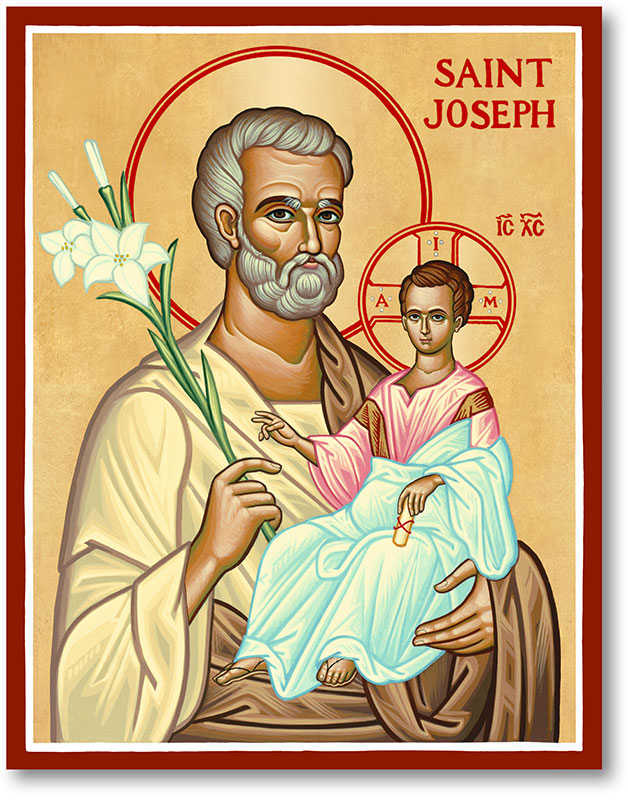
An Icon of St. Joseph holding the Christ Child


© Seth Olson 2019
December 22, 2019—The Fourth Sunday of Advent


It does not take much to change a life: A word softly spoken by a doctor. The welcome aboard email from a new company. A plummet in the market. The vibration of a phone on the night stand, and the 2 AM conversation that follows. A chance encounter. A smile. A friendly “hello.” Our lives can change in an instant. Whether we are ready for these changes—hoped for or dreaded, expected or out of the blue—whether we are ready for these changes is a completely different story. In these moments of upheaval, we are not alone though. We always have God. We have each other, of course. And, as evidenced in today’s Gospel lesson, we have the example of faithful ones who went before us, people like Joseph.

In the Church we talk a lot about Joseph’s wife Mary—and rightfully so! We sang a version of Mary’s words, “The Magnificat” during our Lessons and Carols service last Sunday. We heard part of her story then too. The angel Gabriel visited Mary announcing that she would bear the Son of God through the power of the Holy Spirit. The ability for this faithful person to say “YES!” to God even though it really complicated her life truly inspires us. Therefore, we remember Mary. We highly regard her as the God bearer or the theotokos and the Mother of God. Oftentimes though we overlook Mary’s husband.

However, today we recall the moment—or really moments—that changed Joseph’s life. In those days, betrothal was a big thing, a problematic thing too. Family elders would pull the strings of engagements—instead of the people actually involved in the relationships. There is no getting around the shameful truth that women were seen as property before they were seen as people. Being seen as such it would not have been surprising to pursue a harsh punishment, if say Joseph found out that Mary, his betrothed, was pregnant with another’s child. According to the Law, handed down from Deuteronomy, Joseph could have even had Mary stoned to death. However, that was not who Joseph was. He was a righteous man. Still his response to the news was not completely positive either.

Upon hearing that Mary was pregnant, Joseph planned to dismiss Mary quietly. Essentially he was going to null the marriage contract as privately as possible. We do not discover in Holy Scripture what the conversation was like when Mary told Joseph her news, or if she was the one to tell him at all. The news of a pregnancy is surprising enough. When Joseph discovered that Mary was pregnant with someone else’s baby, it was one of those life-changing moments. And, after regaining some composure—Joseph set about to null the marriage contract. Then, something else happened. Another—even more profound—existence-altering instants transpired.

While Joseph was sleeping, God contacted Joseph directly. To put it in a modern analogy God direct-messaged Joseph, the Lord DMed Joe which sounds like the plot to the CBS show, God Friended Me. In this vision from Matthew, God employed a messenger to change the course of Joseph’s life. The angel said, “Joseph, son of David, do not be afraid to take Mary as your wife, for the child conceived in her is from the Holy Spirit.”

Three things about this message from God. First, this messenger knew who Joseph was. Knew his story. Knew his people. Knew his lineage. God knew Joseph (and God knows us too). Second, the angel essentially said, “Joe, don’t panic. Keep calm and carry on.” This is, of course, easier said than done. However, when an angel says something those words carry more significance than a normal dream. Finally, the message to Joseph is as simple as it is clear—this is God’s child.

Let me pause here for just a moment. Imagine being in Joseph’s shoes—or sandals. You have just discovered that your betrothed is not pregnant with someone else’s child, but is pregnant with God’s child. Of course, there has to be some panic. Scratch that, there has to be some shock! “How can this be happening?” is the PG version of the question running through Joseph’s head. Still, he had to comprehend on some level, God chose this. Not only for Mary, but for Joseph as well. His part in this was massive. He had to be faithful, meaning, he had to trust God like Mary did. He had to say, “YES!” like Mary did.

Time-in! Joseph was then given a task by the angel. “You must name this child Jesus,” the messenger told him. This is the Greek translation of the Hebrew name, Joshua. What does Joshua mean? The angel said, “he will save his people from their sins.” Now, dear friend what you may not know is that right before this Gospel story for today began, Matthew opened his telling of the Good News with a list of names. Sounds pretty boring right? Sounds like these names have nothing to do with the name of Jesus? Well, these names trace backwards through generations of God’s People. Not all of them were commendable or even decent folks. Sure, some were, but none of them carried out what the angel is proposing here. Joseph’s soon-to-be-adopted son would save his people from their sins. Who are these people? Spoiler alert: the whole arc of the Good News of Christ expands this definition from God’s Chosen People of Israel to all peoples. This means Jesus saves us too.

Now Joseph awoke from his dream. Impressive, right? But then he did something more. He actually followed the instructions of the angel. Have you ever woken up from a dream and said, “Let’s live this thing out!”? I mean not the dream when you are paranoid because you forgot your clothes and now you are preaching a sermon in your pajamas… no, you haven’t all had that reoccurring dream?
Right, good me neither. Joseph’s dream though was not some random amalgamation of experiences his subconscious was still processing. No, it was, according to Matthew, a vision from God, a direct message from the Creator of the Universe. And because of this Joseph said yes. He took Mary as his wife, he supported her as she bore the child, and he named him Jesus.

So, all of this is beautiful, and perhaps it is even inspiring to us. Maybe we leave here thinking that when something tough is happening we can be faithful like Joseph. But, say we don’t have a vision from God? What if we aren’t as faithful as Joseph? Is there more that is actually going on here in this Christmas story? And yes, I know we are in Advent, but the Lectionary people let a Christmas story into our quiet season of preparation—make no mistake about it…Jesus is already born in this Gospel lesson!

Why this story of the incarnation matters to us though has everything to do with those little moments that change our lives—those instants when the proverbial toothpaste comes out of the tube and there is no way it’s going back inside. All of us more than likely will have a few of these moments in our lives—a proposal, a pregnancy test, a miscarriage, a birth, a divorce, a new job, a move, a retirement, a death, and so many others. In these moments, yes we have faithful examples. In these moments, yes we have each other. But most importantly, in these moments, we have God.

God is here. Not in some ethereal kind of way. No, God became incarnate. God became flesh and dwelt among us to peek ahead to John’s Christmas text. As Isaiah foretold and Matthew retold, “Look, the young maiden shall conceive and bear a son, and they shall name him Emmanuel,” which means “God is with us.” Now, Joseph named him what the angel told him to name him, not what scripture says; however, there’s a bigger picture being revealed here.

God is with us. Jesus was born. He breathed the air we breathe. He lived in the same world we live in. He cried as a baby—I don’t care what our Christmas hymns say—he was fully human and humans cry. He had human needs, he did human things, he ate, he drank, he danced, he laughed, he looked, he smelled, he tasted, he heard, and he felt. And in all of that in every bit of him being a human being he made every bit of our mundane, everyday life holy. Yes, all of it.

And what is more the one who was (and still is) Emmanuel—God is with us—had little moments that changed the course of his life. Whether in the synagogue the Temple, or the carpentry shop; on the road, at the market, or at home; on the shore, out at sea, or up a mountain, Jesus had life-changing moments too. So he made our existence-altering instants holy as well. Then, he took part in moments when he said or did something, or he was who he was and those moments changed other people’s lives too.

Jesus, the one who saves us from our sins, saves us still. Emmanuel, God who is with us, is with us not just in the Christmas card moments—when everything looks shiny and happy and bright. But, our God is with us in the messy moments, the life-changing ones, just like God was with Mary and Joseph, as they navigated the challenging circumstances of Jesus’ birth. God is with us in the little moments when our lives change forever because through the incarnation of Christ in the person of Jesus, God came to be with us at all times and in all places. So no matter what season of life we are in, no matter what little moment awaits us today, tomorrow, or in the future, may we trust God, like Mary and Joseph trusted God, for God is with us always. Amen.

Wednesday, July 12, 2017

The Payback of Grace

The story of Joseph and his brothers always blows me away. I remember as a tween—that odd age between childhood and adolescence—when my parents dragged me to see a community theatre production of Joseph and the Amazing Technicolor Dreamcoat. Even though I tried to not like the story because I had all those pre-teenage hormones making me extremely irritable, I could not help but love the show. I was so impressed with it that I made my sister burn me a CD copy of the Broadway production’s rendition. “It was red and yellow and purple and gold…” those words still get stuck in my head occasionally.

Well, today we find ourselves a little further along in the story of Joseph and his brothers than the bit about the coat of many colors. A famine persisted everywhere in the known world. Joseph’s brothers were sent to find food if they could. Joseph had been set over all the food as a trusted advisor and governor appointed by Pharaoh himself. Strangely though Joseph did not immediately show himself to his brothers, but at first he made them wait in anticipation. Did they actually get food to survive? Did the brothers save their people? Were Joseph and his brothers reconciled? All of these and more questions unfold as this story from Genesis climaxes. Something from today’s reading though stood out to me as odd.

After Joseph’s brothers had agreed to leave one brother—Joseph would eventually choose Simeon from among them—the brothers said something that we might simply pass on by without another thought. “They said to one another, ‘Alas, we are paying the penalty for what we did to our brother; we saw his anguish when he pleaded with us, but we would not listen. That is why this anguish has come upon us.’” If you do not recall the other brothers were jealous of Joseph and so they threw him in a hole, took his coat, and made it seem as though he was dead. In fact, they really did leave him for dead, but he was rescued and taken off as a slave to Egypt. Rueben wanted to defend his own actions, but in the end all of them were guilty. However, what stands out as strange comes in that these brothers attribute their current lot in life to something they did years ago—something horrible, yes, but still an event from deep in their pasts.

Perhaps you do not find this moment peculiar. The brothers linking one event in their lives and a current misfortune does not actually sound unlike what many people often do. I have heard friends, family, and even sometimes my own inner thoughts, which say, “You are getting this [positive or negative thing] because you did this [positive or negative thing].” Is this not a natural human tendency? Do we not all struggle sometimes with this belief that all of what we get in life is a result of what we have earned for ourselves in some form or fashion. Well, God’s love and life in the reality of that love does not work that way.

In the person of Joseph we see the compassion and love of God exemplified in this moment. As his brothers insist that they deserve their fate of famine, Joseph turns away from them to weep for he cannot stand to hear these words. Even though they abandoned him Joseph gracefully yearns for them to be made whole. We may think he could have revealed himself immediately, but to get his whole family back to him he felt that he must enact the rest of his plan. Still, what strikes me is that Joseph even then could see that life was not about getting what we deserve. God does not wish to punish us for what we have done.


Human beings may be inherently flawed in a multitude of ways, but God’s overwhelming love as exemplified in Joseph and ultimately represented in the person of Jesus helps us to see that true life is not an eye-for-an-eye endeavor. We may very well do awful, terrible, no good, very bad things to one another and to ourselves, still God’s grace points to the truth that the One who creates, redeems, and sustains all does not want to punish us. God wants us to be forgiven, released, reconciled, and redeemed! This is the story of Joseph, the story of Jesus, and this is our story too. May we feel the payback not of past events, but of the grace of God!
x

Sunday, January 1, 2017

What's In A Name?


“What’s in a name? That which we call a rose/By any other name would smell as sweet.” Juliet says this to Romeo in Act II, Scene ii, lines 1-2 of Shakespeare’s Romeo and Juliet. These words stand out as such memorable lines that they have made their way into our common parlance. It has been awhile since I read that play, but I do remember that as these star-crossed lovers fell for each other this line pointed to the fact that despite them having different last names from feuding families they were nonetheless in love. So, this question wonders should a name matter in a thing like love? Juliet, in this way, summarized the central struggle of all of Romeo and Juliet with a simple question. Today, like Juliet, I too ask, “What’s in a name?”

On this day every year we celebrate not just New Year’s Day, but also the Feast of the Holy Name. In the Jewish tradition on the eighth day of a newborn boy’s life the child would have been taken to the Temple to be circumcised, dedicated to God, and given a name. This is the day when Mary and Joseph gave the little baby from our Nativity story the name Jesus, but what’s in a name?

Let’s start with Luke where we are today. Before Mary conceived of this child the angel Gabriel said to her, “Do not be afraid, Mary, for you have found favor with God. And now, you will conceive in your womb and bear a son, and you will name him Jesus. He will be great, and will be called the Son of the Most High, and the Lord God will give to him the throne of his ancestor David.” The child’s name will be Jesus, but there is more to it than just that. He will be great, the Son of the Most High (another way of saying God), and he will come to fulfill a hope of the Jewish people that had been around since David vacated the throne: to have a fulfilling ruler! There is more to this name than just how it sounds or whether or not other children could rhyme it with some insult. What about another Gospel account’s perspective?

My New Testament professor in seminary warned against mixing the Gospel accounts together. The Rev. Dr. Cynthia Kittredge would say, “Don’t make Gospel stew.” With all due respect professor it’s a lovely day for stew and, I would like to phone a different gospel account because while Luke lets us know of Jesus’ dedication ceremony, we do not discover everything we need to know about his name.

Unfortunately, Mark’s and John’s accounts of the Gospel do not speak of how Jesus was given his name. However a couple of Sunday’s ago we heard the story from Matthew’s Gospel of an angel visiting Joseph in a dream. The angel said, “Joseph, son of David, do not be afraid to take Mary as your wife, for the child conceived in her is from the Holy Spirit. She will bear a son, and you are to name him Jesus, for he will save his people from their sins.’ All this took place to fulfill what had been spoken by the Lord through the prophet:
‘Look, the virgin shall conceive and bear a son,
   and they shall name him Emmanuel’,
which means, ‘God is with us.’
From Matthew’s perspective the child of Mary was to be named Jesus, but he also had this connection with the term Emmanuel.

We hear of the name Emmanuel, which means God with us. This name gives us hope that we have a God who will stand by us no matter what! This was the name foretold by Isaiah. There is also though the name we often take for granted, the name Jesus. In its original tongue it would have sounded more like Joshua, and that name means God for us. This too is profound. What Joseph dreamed points to the truth of our God Incarnate in Jesus: God is both for us and with us!

The Franciscan priest and spiritual leader Richard Rohr sent out a Christmas video on the morning of December 25th. His main theme in this message falls directly in line with this revelation of the meanings of Jesus’ Holy Name or holy names. Rohr explained in the video that we have for centuries been completely focused on the Almighty aspect of God’s nature.[1] This is true. God is almighty! And yet, at Christmas what is made clear to us in a baby born to unwed parents, in a manger, with lowly shepherds being the first visitors is that God is also all-vulnerable. Jesus was both Almighty and all-vulnerable. Jesus is both Jesus that is God for us (Almighty) and Emmanuel, God with us (all-vulnerable).

On the eighth day of his life our Lord was given the name Jesus. He was a vulnerable little child with parents who were not even married yet. He had to rely upon them even though he was the one through whom all creation came to be! This is what we celebrate today. That the God of all creation came down to be for us and with us. He had a mighty and yet also vulnerable way of being, just like the rest of us. What’s in a name? Despite what Juliet says, I would say a great deal rests in a name! Especially in the Holy Name of Jesus.


[1] Rohr, Richard. The Continual Incarnation. December 25, 2016. https://cac.org/the-continual-incarnation-2016-12-25/ (accessed Janauary 1, 2017).