Showing posts with label Mary. Show all posts

Sunday, December 22, 2024

Magnifying the Lord

"My soul magnifies the Lord" said Mary the Godbearer


Micah 5:2-5a

Hebrews 10:5-10

Luke 1:39-45, (46-55)

Canticle 15 (or 3)


© 2021-2024 Seth Olson


Emmanuel, God with us, let my words be your words and when my words are not your words, let your people be wise enough to know the same. Amen.


I grew up attending St. Andrew’s Parish in Southside Birmingham. Unique in its high church “smells and bells” style of worship—and its radical sense of hospitality—after going to church with friends, I realized my church was… different.


For example, we didn’t have a Christmas pageant on Christmas Eve. There was a very brief children’s play with only Mary, Joseph, and baby Jesus on the night before Christmas. Instead at Epiphany when the wise men showed we would tell the full story of Jesus’ birth. Year-after-year I wanted to play the same part—not Joseph, nor shepherd, nor a wise man, but the inn keeper. Odd, right?


You may recall when Mary and Joseph traveled to Bethlehem for the census there was no room for them in the Inn. The innkeeper appears nowhere in the story but is implied. Why did I want to play this negative character? Maybe this is something to take to my therapist. As I have reflected on my penchant for this part, a few reasons why I liked it emerge.


First, the innkeeper only had the one line, “Sorry, there’s no room in the inn.” Even after almost 30 years I nailed it! Second, I got to sit in a pew all by myself so that when Mary and Joseph walked down the aisle knocking as they looked for a place to stay, I could deny their request. Which gets to the final and most convicting reason why I enjoyed this role. The innkeeper got to deny the Holy Family, including the prenatal Jesus, a place to stay.


Oomphf! This is what the innkeeper did, right? The man who owned the inn denied them access to a room. Except, in the Epiphany pageant at St. Andrew’s, the innkeeper had a stable that he let Mary and Joseph use, so maybe there is redemption in the Inn (#dadjoke #priestjoke). Regardless, if we back up in the story as Luke tells it, before Mary and Joseph went to Bethlehem, right after the Angel Gabriel visited Mary, we find two figures who did not deny God a place to stay, but instead welcomed Christ in exemplary ways.


In today’s good news, we experience something wholly different from a denial of Christ—today, we encounter a story utterly holy dripping with the power of God’s spirit. Two pregnant women and their visceral, feeling-soaked, prophetic conversation take center stage. Mary’s visit with Elizabeth shines a spotlight on the great hope of all who follow in the Way of Christ. What is that hope? We will get there, so keep listening, but first, let us go to the Judean hill country.


Today’s gospel story opens with “In those days,” harkening back to “the days of King Herod”[1] mentioned earlier in the story. Even though we might expect God to be moving amongst the powerful, the angel Gabriel had just visited not the palace, but Mary, a lowly servant of God. Truly, Gabriel had been busy. 


Earlier in Luke, God’s messenger visited Zechariah as he offered incense in the Temple. Gabriel told the priest that even in his wife’s old age, Elizabeth would have a child, and they were to name him John. Being the stubborn priest that he was, Zechariah questioned God’s messenger. What happened next might have been why Elizabeth and he were finally able to conceive a child—Gabriel made Zechariah unable to speak until the child was to be born. The priest had to be quiet, and maybe he finally listened to his wife. Next thing you know, Elizabeth was pregnant with John the Baptist. 


Fast forward in Luke’s account to find Gabriel announcing that Mary would bear a son as well. The angel told her, this child would be the Son of the Most High God. Even with two thousand years between this news and us, it still strikes me as shocking! Gabriel told Mary this unbelievable announcement and solidified the claim by informing her that her relative, the once barren Elizabeth, was now pregnant. Mary unlike Zechariah did not question this surprising report from God’s messenger. Instead, she said, “Let it be unto me according to your word,” then headed for the hill country and Elizabeth, which gets us to today’s story.


I imagine Mary and Elizabeth embraced sweetly—the two holy children leaping within their mothers’ sacred wombs. Immediately from Elizabeth a blessing broke forth upon Mary—blessed are you among women, blessed is the fruit of your womb, blessed is she who believed that there would be a fulfillment of what was spoken to her by the Lord. The elder pronounced a three-fold beatitude upon Mary. The third of which might have been a veiled insult at her husband Zechariah who like many willful priests did not immediately believe what God’s messenger was saying.


Mary upon hearing Elizabeth’s words, proclaimed some of the loveliest and most challenging words in all of Holy Scripture. She replied with what we know as The Magnificat—named such for the first line—My soul magnifies the Lord. The first few lines are all about Mary’s state of blessedness that Elizabeth was describing:


My soul magnifies the Lord, and my spirit rejoices in God my Savior, for he has looked with favor on the lowliness of his servant. Surely, from now on all generations will call me blessed; for the Mighty One has done great things for me, and holy is his name.[2]


Don’t stop paying attention here. Yes, these beautiful beginning bits focus on Mary’s blessed nature, but then the Theotokos, the God-bearer, announced a prophetic description of blessing. In it, she told us who God was, is, and always will be—and who we are called to be in response.


[God’s] mercy is for those who fear him from generation to generation. He has shown strength with his arm; he has scattered the proud in the thoughts of their hearts. He has brought down the powerful from their thrones, and lifted up the lowly; he has filled the hungry with good things, and sent the rich away empty. He has helped his servant Israel, in remembrance of his mercy, according to the promise he made to our ancestors, to Abraham and to his descendants forever.[3]


Mary, the bearer of God’s Son, pronounced a truth she intimately knew. She was blessed not just because she bore God’s Son, but also because she knew God’s way: 


·      Mercy for those who lovingly hold God in awe.

·      Separating those who take pride in themselves alone.

·      Dethroning the powerful, while exalting those society overlooks.

·      Filling the hungry, telling the rich they’ve already had their fill—inviting them to share?

·      Holding the people of God in a merciful embrace forever.


This is God’s way, and it is to be ours too!


Elizabeth’s geriatric pregnancy opened her eyes to see her relative in a new way, such that she could pronounce a blessing upon Mary. Mary’s out-of-wedlock, divine pregnancy gave her the courage to see herself as blessed and to point out God’s countercultural ways. Far from denying God a place to stay—these women prepared God mansions in which to dwell. We are called to do the same, which leads us to the ultimate hope, which I hinted at earlier: 


All of us, no matter who we are, what we’ve done, where were from; all of us regardless of our gender, skin color, age, nationality, sexual orientation, ability, or social status; all of us are called to make room for Christ and to bear Christ into this world, and we do this best by living into the virtues set forth in Mary’s prophetic words.


The great theologian, philosopher, and mystic Meister Eckhart wrote it far more eloquently than I ever could:


We are all meant to be mothers of God. What good is it to me if this eternal birth of the divine Son takes place unceasingly, but does not take place within myself? And, what good is it to me if Mary is full of grace if I am not also full of grace? What good is it to me for the Creator to give birth to his Son if I do not also give birth to him in my time and my culture? This, then, is the fullness of time: When the Son of Man is begotten in us.[4]


In this season be it our care and delight to prepare a place for Christ to dwell—not just in a manger but in us. May we be blessed like Zechariah and be quiet, so that we might hear God. May we be blessed like Elizabeth and see the blessings of others, so that we might exalt one another. May we be blessed like Mary and bear Christ in ourselves, so that God’s reign thrives in our time, place, and culture! 


May our souls magnify the Lord. Amen.


[1] Luke 1:5

[2] Luke 1:47-49

[3] Luke 1:50-55

[4] Meister Eckhart, Be Mothers of God retrieved on the Catholic Storeroom. http://www.catholicstoreroom.com/category/quotes/quote-author/meister-eckhart-1260-1328/ [accessed December 18, 2024].

Sunday, December 24, 2023

God Wants Into Your Life!


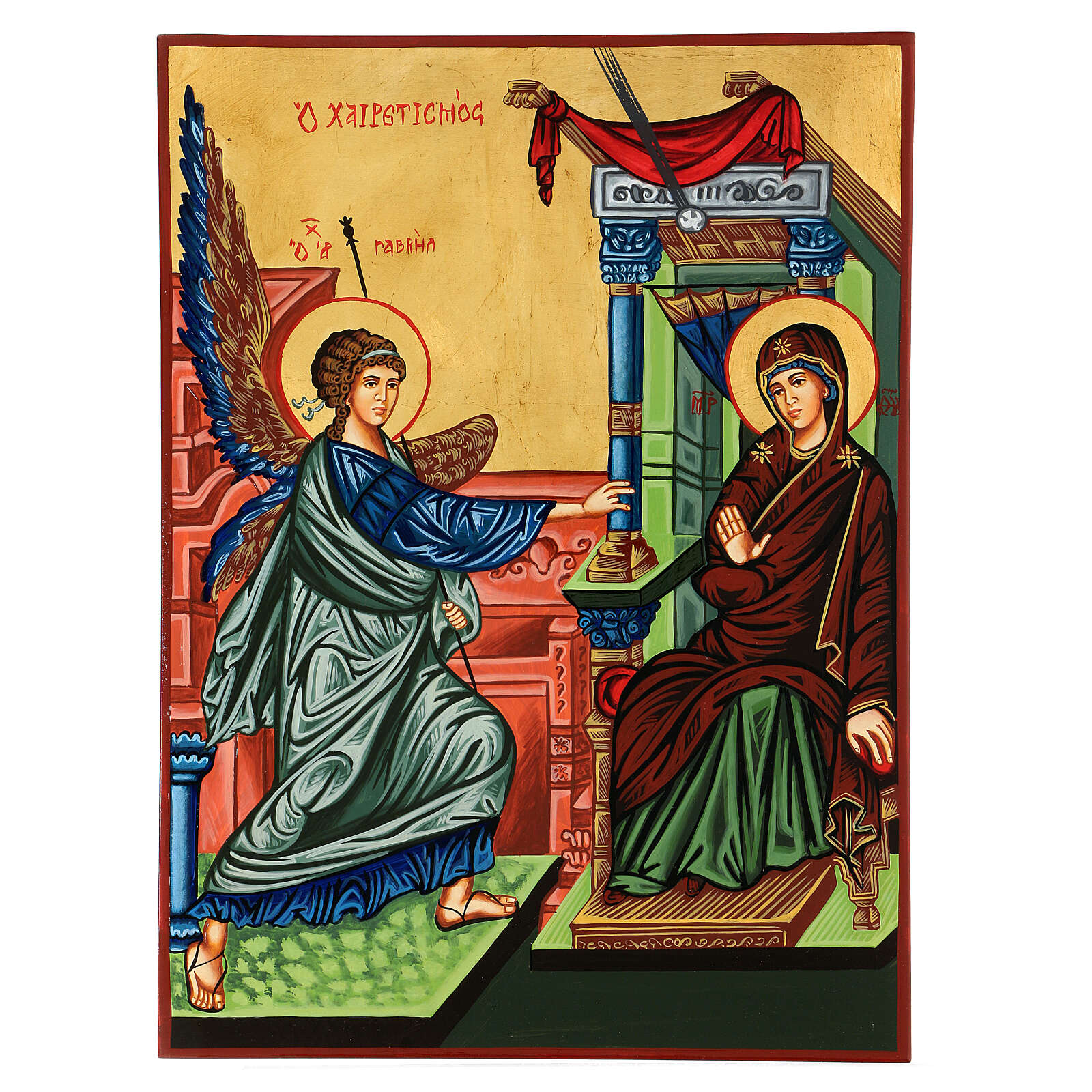
An Icon of the Angel Gabriel visiting Mary


2 Samuel 7:1-11, 16

Canticle 15

Romans 16:25-27

Luke 1:26-38

©The Rev. Seth Olson 2023

It is tempting to overlook the Fourth Sunday of Advent and this story of Gabriel visiting Mary. In the case of this Gospel lesson, perhaps that is because we hear this story so often, or maybe it’s because we are already focused on Jesus’ birth, or it could even be that we are distracted by the many things clamoring for our attention on Christmas day.

It’s also tempting to ponder some odd things about Mary—thinking too highly of her—that she is a god herself—or too lowly of her—that she was only acting under God’s control. These temptations might lead us down some difficult paths: idol worship in the former case or viewing God as a coercive puppet master in the latter case. It might be that we don’t believe in the supernatural at all—Angels? Virgin births? Come on! But, even if we hurdle these temptations—boredom, idol worship, vilifying God, and believing in the unbelievable—there is one more temptation surrounding this story.

As we listen to this all-too-familiar tale, if we are to hear it, believe it, and take it seriously, we may still relegate its power by thinking that this was the type of event that only happened far away and long ago. While all of these temptations teeter on the edge of danger, this last belief may very well cause us the most damage: God merely intervened in ancient human history—centuries back, half a world away. This isn’t illogical.

When we look around at our world, we can easily think that God no longer meddles in human affairs. At this time of year news outlets publish their most noteworthy stories of the last twelve months. One does not have to scroll through many to see some devastating trends: deadly wars, political gridlock, abuse scandals, environmental crises, and the threat of existential annihilation. This does not even touch on personal challenges such as crumbling relationships, debilitating diagnoses, financial hardship, substance abuse, or mental illness. When reading today’s Gospel lesson through the lens of our corporate and individual lives, no one would blame us for believing that God entered human history long ago and left the chat around the year 33 such that we humans have created the mess in which we currently persist.

And, so we may rightly wonder: Why did you leave us, God? Where are you in all this? Won’t you help us to make this world more like your dream and less like the nightmare it often is?

As you ponder these questions, I invite us into trying something different. Let’s step back from this familiar story, and use our imaginations to hear this story of God and Gabriel and Mary with new ears, so that we might hear something new, which leads us not into ancient story, but into something happening right now. If we delete the search history in our minds about this story, maybe we will hear it speaking to us directly.

Listen to the following and notice if it sounds at all familiar: a crumbling world, a people yearning for something more, and a lowly individual. All this checks out, right? It sounds like my life. Add in one final piece—God who is so in love with the created universe that instead of sitting on the sidelines the Divine enters into the story, not to control it, but to have compassion—that is to suffer with us. Friends, this is not the story of long ago, this is the story of right now. God intervening in the life of Mary points to God coming into the lives of all humans throughout time. This is so much more than just an unusual tale we tell at this time of year.

Back long ago the hope of the People of Israel had been clearly articulated for not just centuries but millennia: a Messiah who would come to set all people free—The People of Israel AND the People of Palestine, Jews and Gentiles, all people! However, if one waits long enough for something without it happening one may very well start to believe that even though something was promised it will never happen—at least not in one’s lifetime. Not only this, but during Mary’s day Israel struggled through a difficult, if not unfamiliar, predicament.

Once again, another nation ruled over Israel. Like during Assyrian and Babylonian captivities before, the anticipation of salvation via a Messiah may have been a stated hope, but it certainly did not appear a likely scenario. And yet, under Roman occupation God chose to intervene in human history—even in a moment when it was a great hope, the infinite becoming finite was completely unexpected. This is not just history though—it’s the current reality.

Now, in this uncanny year when the Fourth Sunday of Advent is also Christmas Eve, it would have been easy for us to overlook all of this, in favor of prematurely moving to the manger. But, how can we celebrate God entering into this world at Bethlehem without the story of Nazareth? It would be like viewing the empty tomb without the last supper, the betrayal, and the crucifixion of Jesus during Holy Week. Yes, we are going to time travel a bit and go through nine months of Mary’s pregnancy by the 11 o’clock service. And yet, in this moment we are still walking through the Advent Season, as we anticipate, wait for, and even expect the Coming of Christ. In Advent we remember Christ fulfilling the law and the prophets through Jesus, we look ahead to Christ fulfilling all things at the end of days, but with all this looking around we might just miss what Christ fulfills right now.

Mary’s story provides us the key to unlocking a glimpse of God entering into our reality in this moment—even if things seem so dire or bleak. Mary trusted that a Messiah would come. She understood that God would make all things whole. Her song the Magnificat gives us a glimpse into her heart and her hopes. She yearned for those things for which God yearns, the lowly becoming exalted and the exalted becoming lowly—the hungry fed and the full sent away empty. And yet, she believed all of this against the backdrop of war, destruction, oppression, inequality, and illness around her. Does this sound familiar?

One of those most basic calls that we hear during this season of Advent is something Mary models for us: Slow down, be quiet, and listen for God. God promises to come back to us. God tells us that Christ will come again. God bids us to keep awake. Still, somehow we manage to create in our lives more and more opportunities not to listen. It’s like we are people who do not want to hear any spoilers from the newest binge-worthy show, and so we run around with our fingers plugging up our ears, yelling, “Lalalalalalala!” Except, this is not a Hollywood plot we are missing—it is GOD!

Mary gifts us with a template for unstopping our ears, removing the scales from our eyes, and experiencing God intervening in human history right now! Before you think that you are not like Mary—think again. Mary was a female in an age that saw women as property, she was lowly. Mary was related to a temple priest and betrothed to a man from the royal line of David, she was powerful. She was faithful and yet she questioned the messenger of God. Mary was a human being—complex and complicated—just like you and me.

When God sent Gabriel to her though, she had a choice. God did not coerce her into being a hapless vessel of His bidding. Even through perplexity and questions God invited Mary to bear the Divine into humanity. God’s omnipotence became particular in Mary. God’s almightiness became vulnerable in the womb of Mary. God’s infinite love became enfleshed within Mary. This is not simply about Mary having a baby—it was about her bearing Christ into this world, something all of us are called to embody.

At a time when everything appeared dark and lost God chose Mary to bear the Savior of all things into this world. We know through the Gospel that Jesus’s life, death, and resurrection rerouted existence forever; however, God did not stop moving then. As soon as God chose Mary and Mary chose God all of humanity began to shift. We have not fully realized this transformation yet, but even now God is on the move. In Mary’s yes God inaugurated a reign that sanctified even the most lowly and mundane of human occurrences. The life of Jesus, which made all things holy began with a woman saying, “Let it be with me according to your word.”

God wants into your life to bring healing and health, salvation and sanctification, mercy and grace, transformation and reconciliation, peace and love. Like a momentous earthquake God shook Mary’s existence, but those shockwaves crash throughout our lives too. Will we notice God coming into our lives? Will we hear God’s message saying, “Greetings favored one! The Lord is with you.”? Will we say with Mary, “Here am I, the servant of the Lord: let it be with me according to your word.” God yearns to dwell with us, to heal this hurting world, and to make this life more like the dream it can be instead of the nightmare that it often is.

Even if the following is hard to believe, may this be the last and perhaps most important thing I have ever said from this pulpit: nothing will be impossible with God!

Sunday, December 18, 2022

Waking Into God’s Dream


This week's Gospel is not only about Joseph's dream—it's also about waking up.


Isaiah 7:10-16

Psalm 80:1-7, 16-18

Romans 1:1-7

Matthew 1:18-25

 The Rev. Seth Olson © 2022

Emmanuel, God with us, let my words be your words, and when my words are not your words, let your people be wise enough to know the same. Amen.

“I can’t do it,” said the little voice. I looked down at the six-year-old boy beside me. The genuine perplexity with which he said, “I can’t do it,” made it just about impossible for me to be upset. Of course, it was only the first day of camp, and pretty quickly I learned that whatever I asked this child to do—put on shoes, get ready for the pool, make his bed, brush his teeth—whatever I asked, the reply was always the same: “I can’t do it.”

By Tuesday, my feeling that this little one was a cute child of God had melted into thinking that perhaps this was a Job situation, and I was being tested by God Almighty. Only 15 years-old, at the time, I did not have a firm grip on my emotions (do I now?). So, as the camper kept saying, “I can’t do it,” my patience wore thinner and thinner. To top it off, the entire cabin of twelve children had seemingly caught this “I can’t bug,” as they all joined in the negative chorus.

Kevin Denson was the other leader in my cabin. We had been campers together for a few years, so we had a good rapport with one another. As we sat down on Tuesday evening, he looked as tired as I felt. So, I asked him, “What should we do?” His response was as malicious as it was brilliant, “Maybe we could use a devotion.” Of course, I thought, “We could turn to the Word of God to force misbehaving children into shaping up.” I know, I am not proud of what I did, but desperate times call for desperate measures.

That very same night we turned to verses in Scripture to illustrate our point. God does not want us to respond by saying “No, I can’t,” rather we are to say I can. Philippians 4:13 reads, “I can do all things through Christ who strengthens me.” “For God all things are possible,” Mark’s Gospel account proclaims. We hammered home our message by saying, instead of telling us I can’t do it, say I can, for God helps us to do all things.

Really, even though we had bad intentions the message was a good one. And, perhaps it was our brilliant teaching, but more likely it was that by Tuesday all the campers were exhausted. Hiking, horseback riding, canoeing, swimming, games, and singing—it all wore the campers out such that they fell fast asleep. At least, for a while.

What you may not know about the camp where I grew up is that the bathrooms are a short walk from the cabins. To teenage me that was nothing, but to a six-year-old in the middle of the night it must have felt like a lengthy trek. Now, sometime around two o’clock in the morning, the boy who had started the, “I can’t do it” movement came and knocked on my door. Half awake, I sat up in my bed. “Buddy, what do you need? It’s really late.” He responded, “I can. I can go to the bathroom.” By which, he really meant I can’t go to the bathroom, at least not without a leader. I got a little teary-eyed as I found my bathhouse sandals. This sweet little child of God had tried his best to understand our message. He tried to stay positive and to say, “Yes, I can with God’s help,” even if he could not.

So often we think of Advent as Mary’s season of “yes,” but today’s Gospel lesson depicts Joseph as a profound model of “I can do this” with God’s help. Joseph, does not get a lot of publicity, but he is a model of faith, an example of trust, and a righteous man, or at least he becomes one with God’s help! Yet digging deeper reveals that this story is not just about Joseph affirming God’s call, it is about us—you and me, this community—taking part in God’s YES! So, let’s take a look closer.

In those days, betrothal, like that between Mary and Joseph, was a legal and binding contract made between the elders of families. Mary and Joseph may not have had much say in this process. Then, when Joseph discovered Mary was with child, he would have been right within the law, according to the book of Deuteronomy (22:23-27), not only to dismiss his betrothed quietly, but also to put her to death, as she had broken the contract. This is an instance of what is legal, what is ethical or Godly being worlds apart! Yet, Joseph planned to say, “I can’t do it,” in a respectful manner. Then, everything changed.

“Just when Joseph resolved to [dismiss Mary quietly], an angel of the Lord appeared to him.” At the start of the dream, the angel identified Joseph, as the Son of David, which put some historical perspective around this. This correct identification also meant that God knew exactly who Joseph was. God intervened into Joseph’s life to invite this Son of David into something different.

The beginning of Matthew’s Gospel account reads like a beta version of Ancestry.com, which is amusing, except that so many of the members of David’s line did not adhere to the way of God—did any of them? Even David didn’t. There were troubling women in Jesus’ ancestry primarily because there were unfaithful men in his lineage. Bathsheba’s wrong doing was because of David’s own, Tamar’s was a result of Judah’s, and Joseph could have added to that, but he did not.[1]

If you know anything about generational trauma this tiny step is huge. Joseph stopped a cycle. Do we hope for something more from Jesus’ earthly father? Of course! Still to dismiss Mary quietly was a start, or more correctly stated, it was an opening that God utilized.

In this opening, the angel first invited Joseph to live without fear. Yes, it’s easier said than done. And yet, without fear Joseph could then hear the messenger say that this child was not ill-conceived but conceived by the Holy Spirit. God’s Spirit came to bear life in Mary in this unique way. Once his trepidation waned, Joseph could hear God’s good news—that this child within his betrothed was holy.

As the dream continued, Joseph learned that he was to name this child Jesus. While this was nothing novel in Jewish history, as Ishmael, Isaac, Solomon, and Josiah all had their names revealed to their family in dreams, God was doing something new here! The angel indicated what was meant by this name.

Jesus, or Joshua in Hebrew, means Savior. He would save his people from their sins. The child within Mary would wipe away the disconnection, the wrong, and the hurt that kept people from God, from each other, and from their truest selves. This was good news in a good dream, but we cannot live merely in dreams.

Perhaps the most unremarkable bit of this passage is that Joseph woke up. However, he did more than simply opening his eyes. In Advent, we sing songs like, “Sleepers Wake,”—“When we hear the heralds singing,
and in our hearts new joy is springing; we wake, and rise up from our gloom; for our Friend comes down all-glorious.”[2] This sounds like Joseph who woke up to see not a dream but God’s truth. With God’s help, Joseph made the impossible dream come true! The “I can’t do it” in the nighttime turned into the “I can” of the morning.

You might be saying, “Okay, so why is all of this important to me?” or “This is all so crazy, why did it happen this way?” Could God have come into this world in another way? Certainly! Who are we to limit the Creator of the Universe? Matthew though, added a prophecy to help interpret this passage.

Isaiah, the prophet, foretold of this miraculous birth. Yes, Joseph was to name him Jesus, but the child would grow into Emmanuel, which means “God is with us.” The reality that Joseph awakened into was God is with us! The God of all Creation came to be with us! At the end of Matthew’s Gospel account, Jesus reiterated this truth saying, “I will be with you always, even to the end of the ages.” God comes to be with us—in Creation, in stillness, in relationship, in song, in Scripture, in worship, in dreams, but in the person of Jesus, God shows us the fullness of what it means for God to dwell with us. In response, we are called to be like Joseph, and maybe that sounds like a low bar.

However, Joseph could have said no to this dream. Joseph could have dismissed Mary. Joseph could have even had Mary put to death. Yet, he listened not to his ancestry, but to the messenger of God. We too are asked to be open to what God is calling us to do and who God is calling us to be. Joseph said I can do this with your help, God. The way in which God responded was by coming to be with Mary and Joseph. We too are invited with each other’s help, with God’s help to heal generational wounds, to dream with the Spirit, and to awaken, so that we might make God’s dream a reality!

Advent is a season of Mary’s yes, and it is a season of Joseph’s yes. This means it’s a season of YES AND! It’s a time for healing AND for dreaming. It’s a chance for us to wake up AND make the dream come true. It’s a season of bearing Christ AND being with those who do! This Advent, I wonder, how is God transforming your “I can’t do it” into “I can with God’s help”? I wonder, what is God’s dream for you, for All Saints, and for this community? I wonder, in what ways are you awakening to the truth of Emmanuel? As we move ever closer to the Season of the Incarnation remember that God is with us then, now, and even unto the end of the ages.


[1] Joy J. Moore, “Fourth Sunday of Advent Year A.” on Sermon Brainwave Podcast. [released December 10, 2022. Accessed December 13, 2022. https://podcasts.apple.com/us/podcast/sermon-brainwave-876-fourth-sunday-of-advent/id1538186845?i=1000589921282].

[2] “Sleepers Wake.” In Hymnal 1982. Words: Philipp Nicolai. Translation: Carl P. Daw Jr.. Music: Wachet auf, melody Hans Sachs, adapted by Philipp Nicolai; originally by Johann Sebastian Bach.