 |
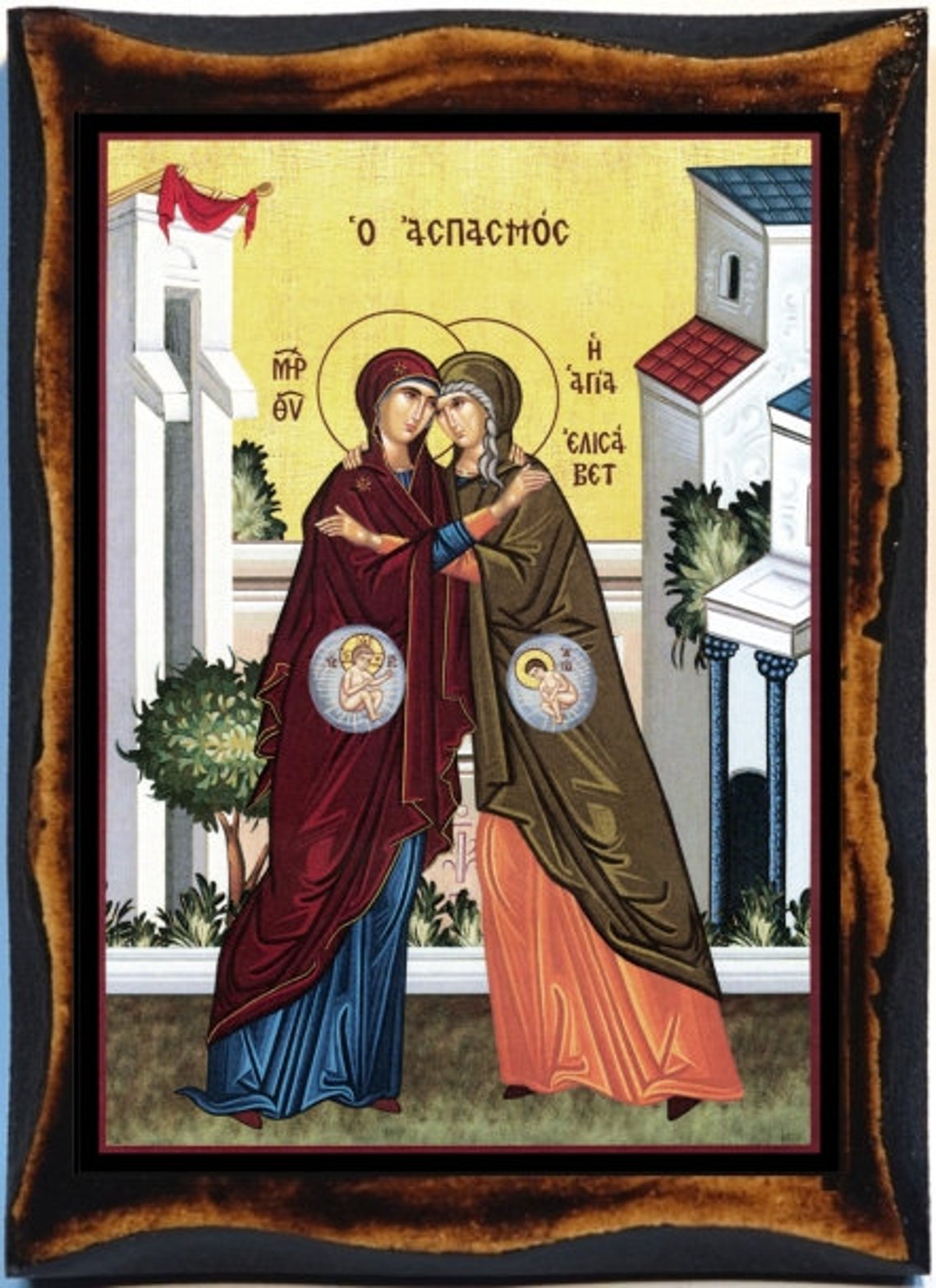
| An icon of the Visitation of the Theotokos, the God-bearer |
© 2021 Seth Olson
Video of this sermon may be found here.
Emmanuel, God with us, let my words be your words and when my words are not your words, let your people be wise enough to know the same. Amen.
I grew up going to a one-of-a-kind Episcopal Church—St. Andrew’s Parish in Southside Birmingham. Unique in its high church “smells and bells” style of worship—and its radical sense of hospitality—after going to church with a couple of my friends I realized my church was… different.
Instead of having a normal children’s Christmas pageant on Christmas Eve, St. Andrew’s had a very brief children’s play with only Mary and Joseph on the night before Christmas. “Why?” you might ask. Well, because at St. Andrew’s we waited until Epiphany when the wise men showed up to tell the full story of Jesus’ birth. Every year in the Epiphany pageant growing up I wanted to play the same part—not Joseph or a shepherd, nor a wise man or an angel, but rather the inn keeper. Odd, right?
If you are unfamiliar with this part in the Nativity story, Mary and Joseph had to go to Bethlehem because of a census that was being taken at the time. Joseph had to return to his family’s hometown. While the innkeeper appears nowhere in the story, this part is implied when Luke wrote “because there was no place for them to stay in the inn.” Why did I want to play this negative character? Maybe this is something to take to a therapist. As I have reflected on my penchant for this particular part, a few reasons emerge as to why I liked playing the innkeeper so much.
First, the innkeeper only had the one line, “Sorry, there’s no room in the inn.” Even after almost 30 years I nailed it! Second, I got to sit in a pew all by myself so that when Mary and Joseph walked down the aisle knocking as they looked for a place to stay, I could deny their request. Which gets to the final and most convicting reason in hindsight as to why I might have enjoyed this role. Could I have wanted to play the innkeeper because I got to deny the Christ child a place to stay?
Oomphf! This is what the innkeeper did, right? This man who owned the inn denied Jesus’ family access to a room. Except, in the Epiphany pageant at St. Andrew’s the hotel owner had a stable that he let Mary and Joseph use, so maybe there is redemption in the Inn (#dadjoke #priestjoke). Regardless, if we back up in the story as Luke tells it, before Mary and Joseph went to Bethlehem, right after Mary was visited by the Angel Gabriel, we find two figures who did not deny God a place to stay, but instead bore the Holy Spirit, God, and Christ in exemplary ways.
In today’s good news, we experience something wholly different from a denial of Christ—instead we encounter a story utterly holy—dripping with the power of God’s spirit. Two pregnant women and their visceral, feeling-soaked, prophetic conversation take center stage. Mary’s visit with Elizabeth shines a spotlight on the great hope of all who follow in the Way of Christ. What is that hope? We will get there, so keep listening, but first, let us go to the Judean hill country.
Today’s gospel story opens with “In those days.” This phrase harkens back to “the days of King Herod”[1] mentioned earlier in the story, even though we might expect God to be moving amongst the powerful, that is not what we find. Case in point, the angel Gabriel had just visited not the palace, but Mary, a lowly servant of God. Gabriel had been busy.
Earlier in Luke, God’s messenger visited Zechariah while he was offering incense in the sanctuary of the Temple. Gabriel told the priest that even in their old age Zechariah and his wife Elizabeth would have a child and they were to name him John. Being the stubborn priest that he was, Zechariah questioned God’s messenger. What happened next might have been why Elizabeth and he were finally able to conceive a child—Gabriel made Zechariah unable to speak until the child was to be born—the priest had to be quiet, and maybe he finally listened to his wife. Next thing you know, Elizabeth was pregnant with John the Baptist.
Fast forward just a bit in Luke’s account, and we find Gabriel announcing to Mary that she will bear a son as well. The angel told her, this child will be the Son of the Most High God—even with two thousand years between this news and us, it still strikes me as shocking! Gabriel told Mary this unbelievable announcement and solidified the claim by informing her that her relative, the once barren Elizabeth, was now pregnant. Mary unlike Zechariah did not question this surprising report from God’s messenger. Instead, she went with haste to meet Elizabeth, which gets us to today’s story.
When Mary entered Zechariah’s home, we can imagine the priest just silently raising his hand to wave hello, while Mary and Elizabeth embraced sweetly—the two holy children leaping within their mothers’ sacred wombs. Immediately from Elizabeth a blessing broke forth upon Mary—blessed are you among women, blessed is the fruit of your womb, blessed is she who believed that there would be a fulfillment of what was spoken to her by the Lord. The elder pronounced a three-fold beatitude upon Mary. The third of which might have been a veiled insult at her husband Zechariah who like many willful priests did not immediately believe what God’s messenger was saying.
Elizabeth pronouncing these blessings get me wondering—did Elizabeth’s late-in-life pregnancy give her new vision? Elizabeth greeted Mary with what many recognize as the beginning of the Hail Mary. “Hail Mary, full of grace, the Lord is with thee.”[2] Did Elizabeth’s own state of blessedness open the eyes of her heart to see Mary’s true nature. This makes sense. Don’t we more easily behold blessings in others when we are open to God blessing us?
Regardless, Mary inspired by Elizabeth’s words, sang some of the loveliest and most challenging words in all of Holy Scripture. She replied with what we know as The Magnificat—named such for the first line—My soul magnifies the Lord. The first few lines are all about Mary’s state of blessedness that Elizabeth was describing:
My soul magnifies the Lord, and my spirit rejoices in God my Savior, for he has looked with favor on the lowliness of his servant. Surely, from now on all generations will call me blessed; for the Mighty One has done great things for me, and holy is his name.[3]
We often might stop paying attention here. Thinking how beautiful Mary’s words are. Yes, the beginning bits of this canticle are about Mary’s blessed nature, but then the Theotokos, the God-bearer, announced a prophetic description of blessing. In it, she told us who God was, who God is, and who God will always be—and who we are called to be in response.
His mercy is for those who fear him from generation to generation. He has shown strength with his arm; he has scattered the proud in the thoughts of their hearts. He has brought down the powerful from their thrones, and lifted up the lowly; he has filled the hungry with good things, and sent the rich away empty. He has helped his servant Israel, in remembrance of his mercy, according to the promise he made to our ancestors, to Abraham and to his descendants forever.[4]
Mary, the bearer of God’s Son, pronounced a truth she intimately knew. She was blessed not just because she bore God’s Son, but also because she knew God’s way:
- Mercy for those who lovingly hold God in awe.
- A strong scattering of those who take pride in themselves alone.
- Dethroning the powerful, while exalting those on the fringes of society.
- Filling the hungry, telling the rich they’ve already had their fill—inviting them to share?
- Holding the people of God in a merciful embrace forever.
This is God’s way, and it is to be our way too!
Elizabeth’s geriatric pregnancy opened her eyes to see her relative in a new way, such that she could pronounce a blessing upon Mary. Mary’s out-of-wedlock, divine pregnancy gave her the courage to see herself as blessed and to point out God’s countercultural way. Far from denying God a place to stay—these women prepared God mansions in which to dwell. We are called to do the same—this is the ultimate hope, which I hinted at earlier! All of us, no matter our gender, our skin color, our age, our sexual orientation, or our ability, all of us are called to not only make room for Christ, but also to bear Christ into this world—to live into the virtues set forth in Mary’s prophetic words.
The great theologian, philosopher, and mystic Meister Eckhart wrote it far more eloquently than I ever could:
We are all meant to be mothers of God. What good is it to me if this eternal birth of the divine Son takes place unceasingly, but does not take place within myself? And, what good is it to me if Mary is full of grace if I am not also full of grace? What good is it to me for the Creator to give birth to his Son if I do not also give birth to him in my time and my culture? This, then, is the fullness of time: When the Son of Man is begotten in us.[5]
In this season be it our care and delight to prepare a place for Christ to dwell—not just in a manger but in us and this world. May we be blessed like Zechariah and be quiet, so that we might hear God. May we be blessed like Elizabeth and see the blessings of others, so that we might exalt one another. May we be blessed like Mary and bear Christ in ourselves, so that God’s reign thrives in our time, place, and culture! Amen.
[1] Luke 1:5
[2] Hail Mary found on the Vatican News. https://www.vaticannews.va/en/prayers/the-hail-mary.html. [accessed December 19, 2021].
[3] Luke 1:47-49
[4] Luke 1:50-55
[5] Meister Eckhart, Be Mothers of God retrieved on the Catholic Storeroom. http://www.catholicstoreroom.com/category/quotes/quote-author/meister-eckhart-1260-1328/ [accessed December 19, 2021].
