Showing posts with label Paul. Show all posts

Sunday, September 7, 2025

Life in the Soil of Discipleship

Are you following Jesus in the midst of a challenging life or are challenges arising in the midst of following Jesus?

Jeremiah 18:1-11
Psalm 139:1-5, 12-17
Philemon 1-21
Luke 14:25-33


©2025 The Rev. Seth Olson


This sermon was preached on September 7, 2025 at the Episcopal Church of the Holy Apostles in Hoover, AL. A video of the message may be found here


Holy God, may my words be your words and when my words are not your words, may your people be wise enough to know the same. Amen. 


Holy Apostles, let me just say it from the start: this Gospel lesson is a doozy. It’s one of those moments when you half-expect me to stop reading, look up at you all, and say, “Wait, do we really want to keep going with this ‘Good News’?” Jesus tells the crowd, “Whoever comes to me and does not hate father and mother, wife and children, brothers and sisters—yes, even life itself—cannot be my disciple.” Yo, Jesus who soured your wine? Who burnt your bread, buddy? It appears that Our Lord is coming in hot.


This instruction to hate is not exactly the stuff of inspirational posters. It’s not the message one should take to this year’s Thanksgiving dinner: “Pass the turkey, Mom… also, Jesus told me to hate you now.” Awkward, right?!


But, this passage is here, which brings us to a larger question: how do we read Holy Scripture? It might be tempting, but as faithful followers of Jesus we don’t get to skip the challenging verses, we don’t soften them, nor do we pretend they aren’t there. Instead, we do what disciples have always done: wrestle with the difficult stories, pray for God’s wisdom, and ask each other what God is saying to us here and now. And sometimes—thanks be to God—together we receive deeper understanding and even get to laugh along the way.


A further insight about how we engage Holy Scripture before refocusing on this particular passage. As ones who follow the Revised Common Lectionary, over the course of three years on Sundays we get most of the books of the Bible. This means that if you show up for 156 straight Sundays you’re going to have heard the good, the bad, and the ugly parts of our most sacred text. We cannot hold all of it together without some of it contradicting itself. Our work, with each other and most importantly with God’s help, is to carefully discern how Holy Scripture molds, shapes, and directs our lives. 


Think of it this way: We cannot take a cafeteria line approach to reading the Bible where we pick and choose what we want to follow. Instead, together we use our hearts, souls, strength, and yes our MINDS to determine what the Spirit is saying to us the Church through the Living Word of God. 


This means we take the Bible far too seriously to simply take it literally. It’s not an instruction book—it’s a series of varying books about God’s love affair with Creation, specifically human beings. And, it requires the love of Christ (self-giving, sacrificial, extravagant, eternal, and unconditional), it requires this love to serve as the interpretative key. Without Christ’s love it’s not going to make sense! Now, back to our passage, which seems to be lacking in love.


Jesus gives us two little parables about “counting the cost.” A man about to build a tower first sits down and figures out if he has enough to finish it. A king about to go to war first checks whether he has the soldiers to stand a chance.


I’ve built a few things in my life—not towers, mind you, but Ikea bookshelves. Even with those, I usually end up with a few pieces left over and a slightly lopsided shelf that looks more like modern art than storage furniture. If even Ikea requires counting the cost, what do you think about the cost of following Jesus? 


What Jesus is saying is clear: discipleship (being a student of His Way of Love) is not something you stumble into by accident. Maybe it starts that way, but eventually it takes intention. It takes sacrifice. It takes putting him at the center, so that everything else in your life—family, work, money, politics, even your identity—lines up around him.


Now, that we understand those mini-parables a bit more, what about that “hate your family” line? Jesus is not giving us permission slips to bail on family dinners or to ignore our kids’ soccer games. The Greek word here could be rendered “love less than.” It’s a way of saying: your ultimate loyalty belongs to God. Even the most precious human relationships cannot outrank the call of discipleship, and I always think it’s important to point out: one way to love God is to love your family well. They aren’t mutually exclusive!


So, no Jesus isn’t anti-family. He’s pro-clarity. He’s saying: be clear about what’s first. If the Great I AM is first, then everything else finds its rightful place afterward. (Watch this from Stephen Covey about "Big Rocks First" for a visual example of this!)


And, here’s where this hits home. You don’t need me to tell you that life is complicated. I look out at this congregation, and I know:

  • Some of you are caring for aging parents, juggling doctor’s appointments, prescriptions, and your own fatigue.
  • Some of you are living in the tension of strained or complicated relationships.
  • Some of you are raising children in a world that feels less certain, less safe, than the one you grew up in.
  • Some of you are working so hard just to make ends meet, and wondering if it will ever get easier.

And in the middle of all this, here comes Jesus with his cross, saying: “Follow me.”


But, when we go about our lives in this way, we are living out of order. For the heart of this Gospel message is this: You aren’t following Jesus in the midst of all these challenges, as though your life is primary and Jesus is the side project. No—the challenges arise in the midst of following Jesus.


Maybe it seems like a slight shift, but it makes all the difference. My mom used to have a shirt, by the way it read: Do you have change for a paradigm? This shift means that discipleship is not something we squeeze in around the edges of our busy lives. Discipleship is the soil in which our lives grow. It’s the ground we stand on. Everything else—our families, our work, our challenges—sprouts up from that holy soil.


That means the tough stuff isn’t proof that you’re doing it wrong. Life is hard. And, that difficulty is simply part of life in the soil of discipleship. Following Jesus doesn’t exempt us from hardship. But it also isn't the last word!


Take Paul’s letter to Philemon today. Paul is writing from prison, urging Philemon to receive Onesimus—a runaway slave—not as property, but as a brother in Christ. Whoa, that’s a costly word! That wasn’t the way of the world—Paul was upending social norms, disrupting economic stability, and challenging Philemon to see his life not through the lens of Roman law but growing from the soil of discipleship.


This, friends, is exactly what we are trying to live into together as a congregation right now, in this soil of discipleship. We’re entering into a season of envisioning—asking who we are, what values shape us, and what mission God is calling us to in the next three to five years.


It might be tempting to think: “Once life calms down, once the budget is easier, once we all agree on everything—then we can get serious about following Jesus.” But that’s not how it works.


The Gospel says: we don’t wait for the perfect conditions. We start here, now, with the lives we actually have. Walking the Way of Love is not something we tack on after the fact. Discipleship is the ground on which we build.


So as we dream together—about values, vision, and mission—we’re not inventing something new from scratch. We’re tending the soil that’s already beneath us. We’re asking: what does it look like to live more deeply into our identity as students of the Divine, the Incarnate One we call Jesus?


And, y’all want to know the really good news? The challenges you carry—caring for parents, raising kids, navigating brokenness, making ends meet—these don’t mean you’ve failed at discipleship. They are indicators that you are engaging in tilling and tending to that soil, so that something remarkable will grow with God’s help.


Think about it like gardening. If you’ve ever planted vegetables, you know: some years the plants thrive, other years they wither. Sometimes you get blossoms and no fruit. But the soil is still the soil. And so, persistent gardeners keep at it—composting, watering, weeding—because they know eventually the soil yields abundance. 


So too with us. Following Jesus is about tending the soil of our lives. Some seasons are lean. Some are abundant. But the soil is still holy. And God still scatters seeds in our soil.


Now, does this mean it’ll all be smooth sailing? Hardly! If you think discipleship is easy, try putting together a piece of Ikea furniture with your family. That’ll test the holiness of your soil right quick.


But the good news is that Jesus walks this road ahead of us and with us. He carried the cross first. Now He shows us that the way of sacrifice is also the way of life, the way of love, the way of hope.


And if Jesus can redeem the cross, then surely he can redeem our family struggles, our weariness, our loooong meetings, and yes—even our half-built Ikea purchases.


So friends, let’s not get spooked by this Gospel’s intensity. Let’s hear it for what it is: Jesus calling us to clarify our lives. To make him the soil in which everything else grows.


Let’s count the cost together—not to scare ourselves away, but to remember the amazing gift of what we’re being invited into: life with God, life in Christ, life rooted in love that no challenge, no hardship, no brokenness can uproot.


And as we take up our envisioning work, may we do so with that same clarity. We don’t follow Jesus in the midst of our challenges. These challenges arise in the midst of following him. And that shift makes all the difference.


So, let’s follow. Let’s have change for our paradigm. Let’s dream. Let’s live as students of the Divine, the Incarnate One, who is our soil, our center, our life.


Amen.

Wednesday, May 16, 2018

It Is More Blessed To Give Than To Receive

If a four-year-old understands the blessing that comes with giving why don't we?
“It is more blessed to give than to receive.” Paul uttered these words in today’s lesson from the Acts of the Apostles. He said them before he left the people of Ephesus. Of course, these are not Paul’s words, they are Jesus’. And, I bet we have all heard them before.

Sometimes we say Jesus’ words slightly differently though, as we pronounce, “It’s better to give than to receive.” This saying pops up when we talk to children about Christmas or a sibling’s birthday. While it’s only one slight difference, changing this part of the sentence matters critically. Jesus said it’s more blessed to give, and we say it’s better to give. We could simply say Jesus was right because he was Jesus, but there is more to the difference than that.

Being better is not a bad thing. We seek to become better all the time in our lives; however, a competition-driven worldview that seeks only betterment misses the mark. This was not what Jesus said. Instead he spoke of the grander blessing, which comes from giving.

Blessings do not always make us feel good. And, in truth when we give, it’s not about us having a positive emotion. Instead, it’s about participating in the Divine life. It’s about God having more of a stake in our lives. God gives us everything we have, so if we are to be like God we too must give. This is the blessing of which Jesus spoke. But, what does this look like?

There are many, many examples in our world. Despite what we see on the evening news about the greed of politicians, corporations, and even many churches, the blessing of giving continues all around us. Here are a couple of examples from the last couple weeks.

In South Carolina a teenager’s act of kindness was caught on video and it went viral. Sofi Cruz Turner surprised her classmate Jahiem by buying him new shoes. Jahiem had hinted that he needed a pair of sneakers, so Sofi used money from her job to give a gift to her friend and classmate. If you think it is profound that a high schooler understands Jesus’ words clearly, just wait.

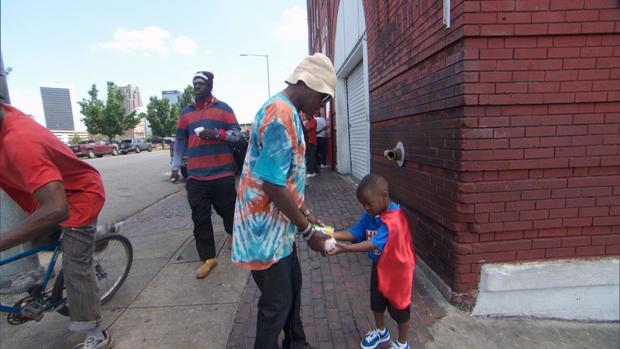
A four-year-old boy in Birmingham, AL named Austin Perine thinks it’s his superpower to feed the homeless. Austin, or President Austin when he is in his super alter ego, decided that he does not want any toys or gifts or allowance for himself. Instead, after hearing that there are homeless people in the world, he has asked his parents to designate those funds to buying food—food that he will hand out to people who often go without. When he passes out the sandwiches he always has the same line, “Don’t forget to show love.” Wow!

What’s striking about these examples are the responses from all involved. It’s more blessed to give than to receive. When we say this, we attest that a blessing comes from giving, but there is more. What I see in these gifting moments is that those who give freely are transformed by giving—and so are those who receive freely. Why is that?

When we give, we are actively being like God. God gives us all that we have.  When we give what we have away, we are acting like God and I believe we are transformed more and more into the likeness of God. Now we don’t have to do this for God to love us, but when we are gracious and generous we are blessed because we are being like God. So what are some ways we might practice this?

There are a multitude of ways to feel the blessing of giving. We can give time to others by volunteering with outreach partners like the Free Clinic, the Neighborhood Christian Center, or the Committee for Church Cooperation. We can give talent by using our skills to serve on non-profit boards, to help with our youth or children, or to serve on a guild that assists with worship. We can give our treasure to the work of God in this world whether it is here at St. John’s or another organization that is building up God’s Kingdom. And, there is a profound campaign that makes me think of the transformational power of both giving and receiving.

The new Poor People’s Campaign has garnered some attention over the last few days. The intention of this movement relates to the blessing of Jesus and the vision of God’s economy. For too long poor people have suffered in this country, unable to get out of a cycle of poverty. For too long those who live in economically depressed areas have not had ample opportunities to make a living wage. For too long people of all different backgrounds have struggled to attain vocational or job-related education. For people of color and women this has been even worse. As they have had to work twice as hard to get half as far. This Poor People’s campaign asks us as people of privilege to receive the blessing of giving as we offer our voice to the voiceless.

If we truly believe it is more blessed to give than to receive, if we trust Jesus, then we must move away from the idea of scarcity and all out competition at every turn. Jesus bids us to see in his words and his example that hoarding things and dollars and opportunities leads to a shriveled up existence. This way does not lead to blessings. It is more blessed to give than to receive. Because when we do we are like Our God who is always generous, gracious, and giving.

We all know it is better to give than to receive, but Jesus tells us the deeper truth: it is more blessed to give than to receive. How will you give of what God has given you? How will you experience the blessing that is being like Our God? How will you help God to create a society and an economy that is based not on scarcity, but on giving?

Wednesday, April 18, 2018

Passionate About Bread

Delicious bread... What about the bread of life?
This sermon was preached at St. John’s Church, Decatur, AL on the Third Wednesday in Easter. The lessons used were the following:

Acts 8:1b–8
John 6:35–40

When I was a child I loved bread so much. I would save whatever roll or toast or croissant or biscuit was on my plate until the very end. My obsession over bread was so well known in my family that they often made fun of me for it. They thought it was funny how I saved my bread for last or made subsequent trips back to the kitchen not for more of the main course, but for a side roll. I wonder sometimes if I have that sort of passion for the bread of life. Do you? Do we?

We find ourselves during this Third Week of Easter in the midst of John 6, which is all about bread. The bread of life to be more specific. We will hear this chapter again for five weeks this July and August. By the end of that time, we may all be too stuffed to hear any more about the bread of life. But, at this moment, when we are less satiated by glorious gluten, Jesus being the bread of life tastes fresh. So, if I am passionate about that bread—if I do not merely consume the Body of Christ, but allow it to consume me and to transform me, what happens? Well, our story from the Acts of the Apostles gives us a couple of hints.

Yesterday we heard the story of Stephen’s martyrdom and today we heard the story of Saul’s persecution of the early Jesus movement—both point to how the bread of life not only feeds but transforms our selves, souls, and lives. Stephen heard the story of Jesus, he was transformed by the bread of life. He was called to distribute sustenance to the poor. In his death he relied on Jesus as his source of strength. And, even after his death, as Evan reminded me today, his grave would have been a place where early Church members shared Eucharist to commemorate and celebrate his life and his second-birth into heaven. Stephen’s life, death, and example point to the power that the bread of life can have on an entire community. What about Saul?

We may be familiar with the story of Saul, but how was he transformed by the bread of life? Saul, the pious of the pious among the People of Israel, devoted his life to being devout. When others stoned Jesus to death, they laid their coats at Saul’s feet. He was a persecutor of the early Church because it threatened his own Faith. Of course, all of that changed one day on the road to Damascus. There he was blinded by God, heard God’s voice, was healed by a Christian, and his life turned from a persecutor of Christ to one of his greatest evangelists. God gave Saul a new name Paul. Right then, his old life died and he was born again.

In this new life, Paul was nourished by the bread of life. Through consuming that bread he was transformed, and he became consumed by the Body of Christ. He articulated that image for us, such that we hold onto it to this day. Paul would eventually die his own gruesome death standing up for the very thing he had persecuted others for. This sounds very much like transformation. How did it happen? Through being nourished by the bread of life.

So, what about us? How will we be transformed by the bread of life? When we come to this table, when we approach the Good News of Christ Jesus, when we share in fellowship with others, when we give of ourselves to God’s work in this world, when we pray to God, when we dwell in silence with God, in all of these ways and many more we take in the bread of life. The changes that we may show are probably too numerous to name; however, we will look something like Stephen and Paul.

We will be filled with God’s Good News. We will share it in churches, in public spaces, and even to the powers that be. We will care for the weak and the outcast. We will feed others with the bread of life physically and otherwise. Wherever it is we go we can be fed by the bread of life. And wherever it is we go God will be there to transform us, just as God did with Stephen and Paul through Christ who was and is the bread of life.

Tuesday, March 27, 2018

The Foolishness of Preaching

Foolishness is an unlimited resource!


While I had every intention of preaching this sermon today at St. John's, Decatur a stomach bug hit my household and unfortunately this sermon will only be given electronically. The text which inspired today's sermon was 1 Corinthians 1:18-31 and in particular, "20 Where are the wise? Where are the legal experts? Where are today’s debaters? Hasn’t God made the wisdom of the world foolish? 21 In God’s wisdom, he determined that the world wouldn’t come to know him through its wisdom. Instead, God was pleased to save those who believe through the foolishness of preaching."


Foolishness is an unlimited resource. On Friday mornings when I am nearby a television I often find myself glued to ESPN, so that I can see Sportscenter’s “Not Top 10” list where (mostly) professional athletes crash and burn mightily. Sometimes it is a botched handoff in football, an errant throw from the outfield in baseball, or a superstar basketball player missing an easy layup or dunk. Of course, athletes do not have a monopoly on foolishness.

Politicians do not often find themselves unified on any issue, but it is hard not to see foolishness as a bipartisan affair. A former Republican Texas Governor infamously forgot the third agency he would cut if he were elected President of the United States. (Ironically enough he now serves as the head of the Department of Energy, which oversees the EPA—allegedly that third agency he forgot.) Not to be outdone, in the 2004 Presidential Election a former Democratic governor of Vermont, destroyed his entire campaign with a single un-presidential yell. Although athletes and politicians often seem daft, with their mistakes shining brightly in the spotlight, foolishness distinguishes itself as a trait that crosses all career paths and walks of life.

Simply typing in “Fail” on YouTube yields 75,900,000 videos. I did not have time to watch all of them, but suffice it to say the list of fools stretches to all walks of humanity: parents, children, news anchors, weightlifters, kite surfers, drivers, organists, and even a few preachers. Of course, I do not think this is what Paul had in mind when he wrote to the church in Corinth long ago. The version of 1 Corinthians we heard today was from the Common English Bible, a translation which we are utilizing throughout Holy Week. And, the words Paul wrote to the Church in Corinth struck me more profoundly in this different version.

Paul wrote, “In God’s wisdom, he determined that the world wouldn’t come to know him through its wisdom. Instead, God was pleased to save those who believe through the foolishness of preaching.” Paul was not speaking about foolish preachers who smash television sets with baseball bats, accidentally start their sermon by saying “Satan gave me this message!” or by crashing over in a casket as a sermon illustration. Yes, these all actually happened. Paul though was talking about how the world perceives the message that we as a people preach. And, just like in his own day, the message that we share so often sounds foolish to our surrounding society.

“The message of the cross is foolishness to those who are being destroyed. But it is the power of God for those of us who are being saved.” As we continue this journey of Holy Week walking with Jesus toward the cross that is ahead, we may wonder and worry about what lies ahead. Society around us tempts us to walk not in the direction of the cross with its suffering and shame, but instead towards comfort and convenience. Seeing the journey that Jesus walked seems to all the world like foolishness. But, to those of us who proclaim Christ crucified as our King, our Lord, and our God we see that way not as foolish, but wise.

As we look back on the life of Jesus we can easily say that we would have been wise enough to walk with him, but what about in our own day? If we knew nothing of who Jesus was and saw a man peacefully speaking the Truth of God’s reign to those in power we might very well shout to him, “Be quiet! You’ll get yourself killed.” With hindsight we may believe we know what God’s wisdom looks like, but can we see it in our own day? Will we proclaim it today? Will we preach it this week?

The world says, God foolishly sent Christ Jesus into a violent world, what did you think would happen? But, God’s foolishness outshines the wisdom of this world. All technology, economy, and academia cannot possess the foolish wisdom that God showed us in Christ Jesus. God's love endures, even as we act like fools. That is the wild message that we continue to preach as we walk together with Jesus to the cross. This is what captivated Paul long ago too.

When Paul wrote to that startup church in Corinth he was extending Jesus' invitation to walk with Christ toward the cross all the time, not just during Holy Week. The Roman cross stood out as a destructive torture device meant not only to kill but to humiliate. Paul and so many others foolishly (according to the world) followed Jesus on the way of the cross, and these followers have found their own crosses literally and figuratively. And yet, during all those times when what seemed so foolish to the world played out over time, God’s wisdom (of loving all) persisted. Even now we may believe that God is foolish to extend love to someone or some people, but we would be foolish to hold onto that belief. Instead, may we be fools for Jesus as we walk with him carrying our own crosses as we go.

Tuesday, June 27, 2017

Peter and Paul: United In Faith

“For the time is coming when people will not put up with sound doctrine, but having itching ears, they will accumulate for themselves teachers to suit their own desires, and will turn away from listening to the truth and wander away to myths” (2 Timothy 4:3-4).

We have come into an odd age in human history. Perhaps we have been here for more than a moment, but to me the shift feels sudden. We are no longer to agree upon truth or facts, nor can we all say together what is reasonable or logical. Instead, we have become impassioned creatures addicted to wild emotions, simple narratives, and tribal mentalities.

If you are liberal you may easily head over to “your” news channels, outlets, and websites. And, if you are conservative you may do the same with your news media. Social Media companies are having to release statements so that people know how to spot fake news. We de-friend or stop following people because they spout off a different belief system than ourselves. We have reached the time when people are not putting up with sound doctrine, for we all have itching ears and are accumulating for ourselves teachers that suit our own desires. Call it a silo or an echo chamber, but regardless these segmented areas of life feel awfully crowded, they are incredibly loud, and in the end I believe they provide only empty promises.

What I notice standing out about the trajectory of conversation and communal life in the United States revolves around a need for a simple narrative that proves one side right and another wrong. Thus, we all yearn for myths that explain away any sense of nuance or grey area. We occupy a zero-sum system in which no compliment may be paid to someone on the other side of an issue for fear that it would give that person some leverage. This way of existing makes me so disheartened. We have seemingly forgotten that we are not islands unto ourselves. Instead, we persist in digging our heels in deeper, as we exacerbate the problem of a binary worldview.

The first step in addressing any problem comes in acknowledging that we are in denial about having a problem in the first place. We have a problem in how we relate to one another across all the constructed boundaries of race, creed, color, gender, sexual orientation, socioeconomic status, or any other category. Of course, we are not the first to have this problem.

Today we celebrate the martyrdoms of St. Peter and St. Paul. Two men who gave their lives because they would not renounce their radical belief that a man named Jesus was the Son of God. In those days when the Roman Empire controlled where Peter and Paul lived one had to profess a belief that the Emperor was God or the Son of God. To believe anything else was treasonous and punishable by death. While we celebrate these two saints separately on different days in the Church Year, today we remember their collective self-sacrificing in the face of the temptation to keep on living by renouncing their belief in Jesus as the Messiah. Make no mistake this is what we celebrate today; however, another aspect of this day stands out.

Peter and Paul did not see eye-to-eye. They followed the same Lord, but went about their mission of spreading the Good News of Christ Jesus in drastically different ways. At times this meant that they butted heads. Their journeys took them on different paths. Often factious were created. And yet, in the end they both met the same fate—death by execution—in the same city—Rome—at the hands of the same Emperor—Nero. Seemingly the Scripture chosen for these two men—the words of Paul in his second letter to Timothy and words about Peter in John’s Gospel account—also share a theme, namely telling the Truth in the face of denial, persecution, and even death.

Paul wrote to Timothy to urge him onward in his ministry. Others would seek out teaching that merely led to proving their point. Paul understood something greater. The prolific Epistle writer knew that even if he had to face suffering what matters in the end is sharing the Truth, keeping the faith, and running with perseverance the race set before him. He would not deny the Truth. Peter had to learn this lesson in humiliating fashion.

When Jesus faced his torturous death Peter watched on from a distance. People questioned whether he was a follower of Jesus. In the face of these questions Peter denied his belief in Christ Jesus. John’s story of the undoing of these denials with affirmations of love help us to see the healing that took place and can take place when we acknowledge our disowning the Truth. In Christ denial is overcome through love. This is the hope that we must take forward.

Our world appears to be burning with a desire to separate, hate, and isolate. Many live in denial that we are all connected to one another. So we seek our own teachers to provide myths that fit how we see the world. Christ came to unite us. The cure for these sins that disconnect us from God and one another does not reside in proving others wrong or outsmarting one another or yelling louder than anyone else, but instead in loving one another as we serve and serve with those with whom we have disagreements.

Tuesday, February 14, 2017

Perfect

"Be perfect therefore, as your heavenly Father is perfect." This is the way that this coming Sunday's Gospel passage (Matthew 5:38-48) ends. On the surface Jesus appears to be calling his followers who were listening to this portion of the Sermon on the Mount into an error-free existence. To our modern ears we may believe that Jesus calls us too into a life without sin, but if we are being honest none of us is anywhere close to being without error or sin.

I do not have to go very far into most days before I am doing something that reminds me that I am NOT perfect. While I do not typically use this kind of language I work with someone who does, we are all miserable sinners. It's true, even if I also want to hold up the Biblical truth that we were made "very good" and we are "very good." Still would Amazing Grace be such a profound song that has stood the test of time without the lines, "Save a wretch like me," "I once was lost," as well as the claim of being spiritually and otherwise blind? So if we are anything but perfect why would Jesus challenge those listening to be perfect?

Being perfect as our heavenly Father is perfect does not require that we do everything a particular way walking through life afraid that we may make a mistake. This is not the seventh inning of a perfect game when we can not talk about what is transpiring for fear of jinxing the pitcher. Our Parent in heaven is blameless, without sin, and yet God's perfection has another element that we need remember when approaching what Jesus said. God's nature is completely fulfilled. In other words, in God's nature is absolute unto God's self!

It took us some time to get to this understanding as Christian people, and we express this completely unique completeness when we talk about the Trinity. Within God exists a community of love, self-giving, opening, making room for the other, and being vulnerable that is complete. God needn't rely on anyone but God; however, out of love God created all things, including us. When we rely upon the ways of the world or our own way we inevitably feel let down or incomplete. Jesus described these paths of stumbling saying "You have heard that it was said...", and whether it was anger, lust, or lying in last week's Gospel or vengeance, selfishness, or holding grudges in this week's this way is incomplete.

This authentic type of perfection calls us to rely completely upon God. We may not get our cloak back, but God will provide. We may lose friends who think we are not loyal to their cause, but God will provide. We may face hardship, struggle, persecution, or even death, but God will provide (and bring us into the fullness of life). This perfect way of God not only sometimes seems unappealing or difficult, but it also can seem so foolish. Paul wrote about this in this week's Epistle lesson. Strangely enough I think that life sometimes makes us fools, so that we may rely more fully not on ourselves, but on God. So as you go through your day look for the places where you are relying too much on yourself, and instead lean into God's fulfilling way. It may seem foolish, but God's perfect ways so often do.

Monday, June 13, 2016

No longer

The events of early Sunday morning in Orlando continue to upset me. Terrifying stories of club-goers texting their parents, as they feared for their lives, or running from Pulse not knowing if they would ever see their friends again seem so surreal. And yet, this is the reality of 2016 America. In this same reality people post messages on Social Media saying they knew this type of religiously motivated terrorism would happen, and even posts congratulating Omar Mateen because he killed LGBTQ people. How do I respond to this sickening, disgusting reality? 

At first, I just want to scream at it! To rage against it, or maybe even to speak to the violence in some manner that it could understand. Except I once heard noted Northern Irish theologian Peter Rollins speak about violence. He said that to respond with the force of violence is to end conversation, to stop dialogue from continuing. Screaming, raging, and using force cannot be my response, for it cancels furthering relationship even with those filled with hate.

My next instinct takes me to thinking on those and praying for those who were killed, injured, or scarred in some other way by Sunday morning’s events. While prayer is a deeply personal practice, I have seen some criticize both the shallowness and the hypocrisy of offering thoughts and prayers for those in Orlando. I think I understand the anger from these comments. Those who offer up hollow prayers or write that they are praying just so others will pay them attention frustrate me too. And, confusing is someone who condemns LGBTQ people in one breath and offers prayers up for them the next. Prayer though is not something that I do for others to see, instead it is something done behind closed doors between God and me. 

A prayerfully lived existence though leads beyond closed doors and into some place of action. The place that I end up this morning is remembering what Paul wrote to the Church of Galatia, “There is no longer Jew or Greek, there is no longer slave or free, there is no longer male and female; for all of you are one in Christ Jesus” (Galatians 3:28). These words are critical as to how I follow Christ Jesus. I am given a mandate to no longer view people through their outward appearance, their religious identity, their gender identification, their legal status, their sexual preference, or any other distinguishing characteristic that I or the world around me fixates upon in a given moment. Instead, I am called to see through the lens of Christ who welcomed the poor, the weak, the naked, the hungry, the stranger, the outcast, and any who was considered sinful or different by the prevailing culture. Through this lens reality looks different.

Jesus envisioned a different reality, an Ultimate Reality that caused the ridiculous cultural reality to cower and crumble. In the Ultimate Reality the vulnerable overthrow the fearful status quo, weapons are beaten into tools of creation, everyone has enough, respect abounds, and love exists in such abundance that it is hard not to see it everyone I look. The trouble in moments like right now is to remember that Jesus already initiated this Reality. It already exists! Prayer, solitude, a contemplative lifestyle, service, Divine Liturgy, and so much more in the Life of Christ all point to remembering this reality. This remembering is how I am called to exist. Remembering this is not easy and I feel the tension and the clashing between God’s dream and what is happening in this world. So, I will keep praying and remembering, but as I remember I will no longer...

Be silent when others express bigotry of any kind...

Condone such lethal weapons being so readily available to people who are known to be dangerous...

See people through the ridiculous reality of hatred, fear, culture, but instead view others through the lens of Christ.

We can no longer live in this ridiculous reality, may we remember God's Ultimate Reality of respect for all, protecting the weak, and loving everyone!

Wednesday, September 16, 2015

Can You See Now?

Sermon based upon 1 Corinthians 2:1-13

In a very astute observation Mary Hinkle Shore compares today’s reading from the letter of Paul to the Corinthians to an eye exam. Really, she likens all of what Paul does after his conversation to getting one’s eyes checked. She notes that when one goes to read the eye chart everything can become clearer or more blurry simply by the type of glass that is placed in front of one’s eyes. For Paul the glass that makes all things clear is Christ Crucified. I believe this is the event that shapes how we see the world too!

A few years back I had a conversation with a good friend. Even though we hold seemingly opposing views of God, he and I have the ability to share in intense conversations with neither of us getting offended. On that particular day he told me that he thought Christians today do not strictly live as followers of Jesus. Moreover, people who believe in Jesus also hold onto several other guiding principles. He stated thinking America is the only superpower, ascribing to one political party’s agenda, or even belonging to some group like the Masons could easily play a dominant role in living out one’s life. Looking at me he said, “You cannot possibly think that you identify primarily as a Christian.” It was a bold accusation!

How do I make sense of the world? What can I possibly say in the face of such a violent and tumultuous world? Where do I get my sense of direction in the hurricanes that blow through this life?

Paul, writing to a divided group of self-indulgent people in Corinth, made a way clear that illuminates a different path than the one obvious in his day. The worldly powers did not understand what Jesus came to do. They believed that he was dangerous. They thought he was misguided. They could see that if his message caught hold their power could slip away. Paul when he was Saul was very much a part of that group. He was a persecutor of those who followed Jesus. And yet, when he was blinded by God his vision became ever clearer not through a series of different glass lenses, but rather through the mystery of Christ Crucified.

Paul writes, “’What no eye has seen, nor ear heard, nor the human heart conceived, what God has prepared for those who love him’-- these things God has revealed to us through the Spirit; for the Spirit searches everything, even the depths of God.” In our world we can believe a lot of different things. We can so easily get swept up in other belief systems, but Jesus calls us to go with him into and through the mystery of the Cross.

I sometimes try to explain this mystery away, but this is not just a competing belief system, this is how I am to live my life. I believe we are called to follow Jesus by practicing resurrection with God wherever we are and wherever we go. To practice resurrection means that we lay down those things that are dying in our lives. We bury those things that no longer give us life and energy and vitality. In the tomb with Christ those things cease to exist in the way that we once knew them. These deaths are not easy, but require suffering and pain and grieving.

Somehow though the vision that Paul had is something that can allow us to see beyond the foolishness of this world and truly see what God calls us to see. Namely, we can perceive that the things that were being laid down are now being raised up. The valleys are being lifted up. The high places are being made low. And the way of God is being paved, not by some powers of this world, but by the mystery of Christ Crucified.

Tuesday, January 27, 2015

American Idol(atry): How Paul's Words to the Corinthians Speaks to American Culture

American Idol is not only a talent competition, it is also a helpful analogy for Paul's First Letter to the Corinthians.

Recently I have been watching too much television. My theory as to why I am doing this stems from the lack of sunlight during the winter months tricking me into seeking the artificial glow of devices big and small when the sun sets way too early for my liking. After running out of my favorite shows and without the life support that is the steady stream of college football, I turned to watching an episode of American Idol.

In its 14th season Idol has become a staple of Fox's primetime programming. I watched a lot of one of the early seasons when Ruben Studdard (a fellow native of the 205) won the competition, at least partially because of my friends and I dialing up the voting line. While I do not dislike the show, after watching the Voice, I am "over" American Idol. Still nothing else was on, so I watched an episode.

What I discovered perhaps more than anything else is that we have a serious "idol complex" (haha) in America. Sure, talented people audition for the show. Of course, people's back stories are awe-inspiring, if a little predictable. Yes, Ryan Seacrest's hair still looks great. However, the main point I took away focused upon the number of people going on the show to audition who were more excited to meet the talented hosts of the show than to potentially fulfill a dream of their own.

When I was a child I remember seeing a video on MTV that showed people actually fainting when they saw Michael Jackson at a concert. I did not and do not understand this, as much as I love his music, I cannot comprehend this response. Now, with the superfluous number of celebrities running around I would hypothesize that people would be less inclined to show this type of excitement when seeing a star; however, the opposite appears to be true. With the advent of social media and people's desire to show photographic or video evidence that they met someone our celebrity worshipping culture has created this societal urge to produce more and more talent to worship. Our idol worshipping might be at an all time high.

Now we all have idols that attract us like a moth to a flame (mine focuses primarily upon getting the latest gadgets), but what can a responsible Christian do in the face of American Idolatry? Our New Testament reading for this coming Sunday (a portion of Paul's First Letter to the Corinthians) focuses upon what a community of believers does when they observe people falling prey to following idols. The wisdom of Paul's words echoes into today's culture where our own churches face as many distracting idols as any other age in the history of Christianity.

Paul quotes from another source, perhaps from the Corinthians themselves, writing "No idol in the world really exists," for he believed "there is no God but one." He goes on to elaborate that even though none of these idols existed some members still got distracted by them. Even those who were previously idol-obsessed may have known that idols were not really God, but the practices that went along with worshipping idols led them down a dangerous path. We may think this is silly, but the food sacrificed to idols happened in a ritual that also involved concubines, shiny objects, and overindulgence of alcohol. A modern analogy would be a person in recovery who previously got drunk or high watching football games with friends going back to those same buddies to watch football. Maybe the football is not bad, but what about the other surrounding activities? Could this person avoid the temptation.

For the record, I have no problem with American Idol. I might like the Voice better, but my hold up comes when any activity (even keeping up with the latest technology) distracts us and even puts a stumbling block on the pathway to a closer relationship with God. Paul tells us that if we are committing some action that causes another member of our Christian community to stumble on this journey, then we must address this issue. We may even have to give up something we love, or at least not do it when it deters others from deepening their relationship with God. Good thing Lent is right around the corner, when we can root out those secret idols by taking on some new discipline. Until then, what idol is present in your community of faith that keeps on tripping people?

Wednesday, July 23, 2014

The Menu in the Kingdom of God

Leonardo DaVinci's "Last Supper"

What do you think the menu will be like in the Kingdom of God? Filet mignon, creamy garlic mashed potatoes, and a side salad full of fresh heirloom tomatoes? Homemade apple pie and vanilla ice cream for dessert? Perhaps in the Kingdom the meals are catered by Albany Bistro or Ruth Chris’ Steak House or preferably my favorite taco place in Austin, TX, Torchy’s Tacos!

We love talking about food in our culture. I, in particular, love talking about and learning about food. Where does it come from? How does it grow? Is it local? What nutrients are in it? How do I complement the flavor of squash? And so on and so on… My colleagues and friends know this about me and often will tease me when I start a new diet or swear off some product or another.

Our culture urges us to go too far with obsessing over how and what we eat. In the face of our obesity epidemic we swing on the pendulum in the other way. Think about all the different types of diets that have come into fashion recently: low-carb, low-fat, gluten-free, dairy-free, sugar-free, Atkins’, Paleo, weight-watchers, juice, local, organic, just to name a few. So hearing Paul’s words to the Romans today can poke a hole in the dieting balloon that I so often blow up in my own life.

Paul tells us, “Do not, for the sake of food, destroy the work of God.” Now we can take these words and run right into our complex societal issues around dieting shouting “See, I told you we don’t need to diet.” We can believe that Paul is telling us that we ought not to put food in the way of God’s work, and we would be right in doing this. And yet, there is more to what Paul is telling us about the good news of Christ Jesus and the building up of His Kingdom.

In Paul’s day issues around food were not about how food made one look, but it was instead about what food was clean and what food was unclean. Food that was unclean probably had historically caused some sort of problem within the Jewish community. Certain foods, most notably pig, might have been seen as a dirty food that would cause someone to get sick and potentially die. So that food was not seen as Kosher. Today Jewish perspectives on food are a bit different. Heck, there is even a Jewish-Scottish fusion restaurant in Los Angeles that offers bacon wrapped matzo balls.

In Paul’s day however, there was more than just unclean food. There was the communal perspective that certain food was not only dirty, but would also cause others to stumble. The Romans who heard Paul’s words were struggling in a multi-cultural city. They were Jewish-Christians who were living amongst pagans. Many of whom would have practiced strange rituals dedicated to local gods eating particular foods that were associated with those acts.

Paul knew this, and was warning those in this community to be careful about what you eat. Sure all things that God makes are clean, but you don’t have to rub it in around your neighbor who is struggling to avoid certain “gateway foods.” We might laugh at this, but think about a contemporary example. If you have a friend who struggles with alcoholism or to whom alcohol is gateway drug, then you probably, if you are building up the Kingdom of God, are not going to serve alcohol around your friend.

We can struggle with what we eat and drink, we can wonder if this certain food will make us look or feel better, and our society will always push onto us new fads, new superfoods, and new diets, but Paul urges us to think about how the meals we eat build up our communities. How our table time might enhance, continue, or destroy the good work that God is doing with and among us. It is not about what food is clean, it is not about what food is gluten-free or Paleo, it is about building the Kingdom of God.

“For the kingdom of God is not food and drink but righteousness and peace and joy in the Holy Spirit.” What is on the menu in the Kingdom of God? Righteousness, peace, joy, and the love that we share when feasting with one another. Amen.

Wednesday, March 26, 2014

1 Corinthians 8:1-13: Knowledge and Love

“’All of us possess knowledge.’ Knowledge puffs up, but love builds up.” The autumn of my junior year in college my world came crashing down around me. Classes were difficult, cross-country was painful, residential life responsibilities were exhausting, and to top it all off a girl that I thought I would marry one day was unfaithful. The fabric of my life felt as though it was ripping at the seams. Sewanee’s infamous fog rolled over the mountain and I could not help, but think this is fitting. Sadness clouded my life.

In this moment, I desperately looked for an out. Why was all this so difficult? Why was my life all of a sudden so unbearably hard? Why would God let this happen to me? I pointed my finger towards the heavens and for the first time in my life I began to wonder: Does God care? Does God love me? Does God even exist?

A few friends who also grew up in mainline Protestant churches were seeking the same bit of knowledge. Does God exist? As we were good students we began to discuss, wonder, and research together. We attended atheist and Christian lectures, we scoured the internet, and we hit the library stacks all in search of knowledge. I stopped going to church, as I was worried the religion of my youth was tainting my scientific, methodical pursuit of knowledge.

I am not sure if it was the running away from God, the breakup, the incessant pursuit of knowledge, or the busy-ness of my junior year, but during that time I felt as miserable as I have ever felt in my life. One day I sat down with a mentor to talk about this faith crisis. I let her know about my doubt, my pursuit of the Truth, and my anger at God. She very calmly held all my frustration with God. She told me to back out of my church based activities. She personified love in a very difficult time.

After the spring semester ended I left the Southeast for the first time in my life. With 34 other students and 4 adult leaders I trekked through the Southwest exploring National and State Parks. During the day there was a lot of knowledge: geologic features, flora and fauna analysis, reports on water use, oil extraction, early explorers, and even religious fanaticism. At night though there was something else. The leader of the trip a brilliant geologist sat around the campfire and pulled out his guitar. He would play songs from long ago that I had never heard. Then he would share a meal and drink a beer with a few students. Often he and I would sit and one night I asked him how he could believe in God and still hold onto his belief in God. He simply looked at me over the campfire, then looked up to the stars. I do not remember what he said or if he said anything. He too personified love in a difficult time.

Paul wrote to the church in Corinth warning them of the dangers that come with pursuing knowledge without love. Later in this letter he will say that without love our actions, no matter how noble or heroic are a noisy gong or a clanging symbol. Paul knew something that I could not comprehend in my immense sadness and emotional tumult. Knowledge puffs up, but love builds up.

The church in Corinth may have known that food cannot really be sacrificed to idols, my mentors may have known that I was just struggling in the moment, we may know all about our own personal relationship with God; however, what is important in our communal relationship with God is not what we individually know. What is of the utmost importance is our love for one another and our shared love of God. What does this look like?

It looks like my mentors letting me vent and be frustrated without trying to fill my head with more knowledge. Loving me into belief. It looks like abstaining from alcohol in front of the alcoholic. It looks like being gentle with fragile friends going through rough relationships. It looks like being firm with those who are overly proud.

Love builds up our community, yet it is not a simple kind of love that is one size fits all. The love Paul urges us to build with is contextual and requires that we still seek knowledge. We must know our neighbors, our fellow pilgrims on this earthly journey, so that we might love them well. Knowledge puffs up, love builds up, but knowledge with God’s love can build the Kingdom of God. Amen.

Wednesday, February 12, 2014

Romans 12:1-8: Who are you? What are your gifts? What is your place in the world?

“What do you think are your spiritual gifts?” was one question posed to the youth confirmation class this past Sunday afternoon. After a moment of pondering the question one high school student said, “I like to serve others and… music, I like to make music.” Another teenager piped up, “I think I am pretty patient.” Then one more said, “I love to work with kids.” “I am funny and I like to laugh with others,” another added. In the midst of what is a difficult time in anyone’s life, high school, the six youth involved in confirmation class showed immense maturity to take a critical look inside to wonder some big questions: “Who am I? What are my gifts? What is my place in the world going to be?”

Who are you? What are your gifts? What is your place in the world? These three questions have bugged me since I first heard them almost ten years ago. Eric Hartman, the dean of students at Sewanee was keen on asking these three introspective puzzlers to anyone who sought his counsel and even some who did not. So this past Sunday after we talked about spiritual gifts Kristin Hanson invited me to talk about my experience of discerning one’s gifts and a call to ordained ministry.

As I talked about spiritual gifts and ministry, I stumbled upon a Truth that I keep bumping into in my own life. No matter how hard I try to figure out my call right now, no matter how much work I put into discernment at this moment, no matter how exhaustive I am with discerning a vocation, I will still have to keep listening to figure out who I am, what my gifts are, and what my place is in this world.

In today’s epistle to the Church in Rome, Paul help us, or at least me, to know how it is that spiritual gifts are most effectively used. At this point in the early Church, the gentiles within the Church of Rome were boasting of their practices to the Jewish faction within the church. The gentiles did not follow the same rigorous code that the Jewish followers of Christ did, but instead of harmoniously coexisting, the gentiles rubbed it in faces of their Jewish brothers and sisters. As this is one of Paul’s last letters, it possesses some more advanced statements of his Faith in God, and he eloquently urges both sides to come together. By this point, twelve chapters into the letter, Paul is issuing an invitation not to one specific group but to all members of Christ’s Body. That exhortation extends to us. This is how we can best identify, understand, and use our spiritual gifts… together!

Paul presses hearers of this letter to come together, not focusing on what is happening in the world, but by discerning together the will of God. When we start to see what God is working right here in this world listening as a community, we no longer focus primarily on our individual needs or petty differences that keep us apart. We start to act as a body. It is as this body that we can start to answer, “Who am I? What are my gifts? What is my place in this world?”

Sometimes I think of the simplicity of picking up a coffee mug and then putting it back on a table. My biceps and triceps must work together along with all the smaller muscles in my forearm and all the tendons and ligaments in my hand and fingers. While this task might not drain my brain, I typically have to think about it and send some neural signals down my spine to my arm and fingers. It seems that only when the members do not work together do I ever even think about this task.

Each part of the body has a task to do. Each member has gifts that help to accomplish that task. We can withhold our gifts from one another, we can without our talents from one another, we can without ourselves from this corporate body, but with Paul, “I appeal to you therefore, brothers and sisters, by the mercies of God, to present yourselves (your bodies) as a living sacrifice, holy and acceptable to God, which is your spiritual worship.”

We will constantly ask, “Who am I? What are my gifts and talents? What is my place in the world?” While we will never have a permanent answer, by presenting ourselves to God as a living sacrifice, God uses our gifts together to bring healing, unity with God, and love to Creation. We each are given gifts through God’s abundant grace. We must be bold and share these gifts with one another, so that we can make this body stronger and allow Christ to work through us.

Who are you? What are your gifts? What is your place in the world?