Wednesday, January 7, 2015

EUREKA

Audio of sermon can be found here: http://s3.amazonaws.com/dfc_attachments/public/documents/3201704/Olson_010715_Wed_Noon_Eureka.MP3

Have you ever had a “eureka moment”? You know what I am talking about, right? When something clicks into place for the first time. A time when something becomes clear that was not so clear just a moment ago. Where does it come from?

I got curious about the word itself. Eureka has become an English word, but originally it meant something a little different in the Greek. “I found it,” that’s what eureka means, and the great mathematician Archimedes gets credit for first saying it. Of course, the moment when he said it is more fascinating to me. Archimedes stepped into a bath tub when he realized that the water level rose as his body’s mass sunk beneath the surface, thus he discovered the law of water displacement. Only a mathematician would shout out loud, “I FOUND IT! EUREKA!” when discovering a law in the bathtub.

Have you ever had a eureka moment? A moment when something becomes apparent for the first time. Maybe it was when you first fell in love with your spouse. Perhaps it was that time when you first fell out of love with someone. A eureka moment could be when you happened upon your life’s great passion, or when you came to connect with God in a deeper way.

Yesterday in the Church we remembered a collective eureka moment, the day of Epiphany. Epiphany is another old word that means revelation or manifestation, and it is the time when we celebrate the Incarnate God in the person of Jesus being revealed as messiah to a people outside of his own tradition. This is our collective eureka moment. We most closely connect the Epiphany with the story of the Magi, three wise men from the East following a star, so that they could bestow gifts upon a child savior, but strangely enough today’s story is another Epiphany moment, another eureka!

A professor in seminary once wondered aloud about today’s gospel lesson. She said, “What does it say about John’s gospel account that the first of Jesus’ miracles that he writes down is turning water into wine at a wedding feast in Cana?” “Is he a drunk?” I thought. “Does John just really love wine? Maybe he’s a big proponent of preparing for wedding feasts?” Of course, what my professor was going for is that Our God is abundant and loves to celebrate with us. Hold onto those two revelations from this story for a moment because we need to explore what happens between Jesus and his mother to fully observe this epiphany.

The way that John records this story strikes me as peculiar, at least upon first reading. “There was a wedding in Cana of Galilee, and the mother of Jesus was there.” John needs for us to know that Mary is there. Then he tells us that Jesus and his disciples were there. “When the wine gave out,” the story continues with a twist in the plot introducing us to some drama, Mary says, “They have no wine.” At this moment I am struck that Mary takes on someone else’s problem. This is not her son’s wedding. She could have left this problem alone, but instead she turns to Jesus.

Now, I am not opposed to taking our problems to Jesus, but I do not think that is the eureka moment. This is not what we are seeking to find. Jesus responds to his mother almost coldly, “Woman, what concern is that to you and to me? My hour has not yet come.” If I talked to my dearest darling mother in this way, I would get at least a death stare if not worse. Yet, what Jesus does here is fascinating. He does not urgently panic about what to do, nor does he immediately coddle his mother or the stewards or the bride and groom. His mother also does not get defensive about how Jesus speaks to her, instead she simply says, “Do whatever he tells you.”

Mary has faith in her son that he will do the will of God. Jesus though is not a magic eraser, he’s not Mr. Fix-it, nor is he some magician who waves a wand over the problems of the world. That is not why God became incarnate.

Jesus was a Jewish man, but for him to ask the servants to fill the jars of purification with water was a big no-no. In this moment he reveals a true miracle: Yes, it is turning water into wine! Yes, it is producing enough wine to open up a Galilean winery! Yes, it is helping the celebration of two people coming together in marriage to continue late into the night! Yet, it is even more than this. Jesus transforms the rite of purification into a moment of celebration. Jesus initiates his ministry with this first miracle not to solve a problem that is not really a problem, but to show that He is God and our God is a God of plenty and festivity.

This is the eureka moment! We have found God and Our God is not just here for purification, but for celebration. Our God is not just here for fixing problems, but for responding to even our small concerns with great richness. And our response to this Epiphany should be following mother Mary’s words, “Do whatever he tells you.” In this time of year when we recognize God’s manifestation as Savior of all people let us observe God’s abundance, celebration, and presence all around us and even within us.

Monday, January 5, 2015

Mary, Spiderman, and Jesus... And the Wise Men!

Audio from the Epiphany Burning of the Greens Service: http://s3.amazonaws.com/dfc_attachments/public/documents/3201672/SJ_Epiphany_Eve_2015_Olson.MP3

Sunday, December 21, 2014

Greetings Favored One

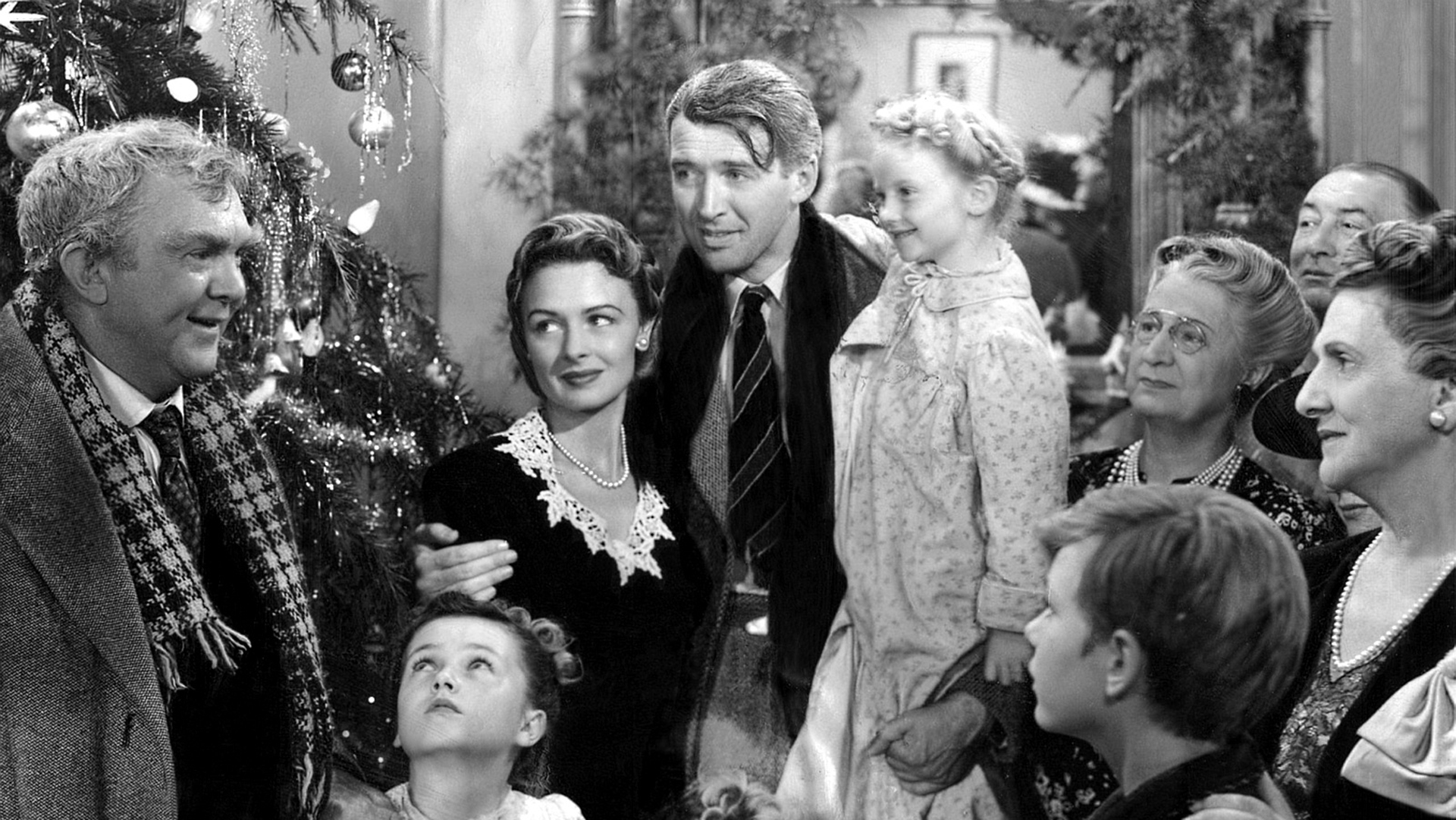
Frank Capra's It's A Wonderful Life (1946)
I love Christmas movies. I know we aren’t in Christmas yet, but I can’t help but watch them at this time of year. I’m sure the Liturgical police will issue me a citation, but I have a hard time not getting ready for Christmas by viewing some of my favorites. My friends in college would laugh at me because I could never make it through Love Actually without crying. When my family first saw Elf we laughed so hard that I thought we would be kicked out of the theater. That movie along with Rudolph the Red Nosed Reindeer and It’s A Wonderful Life all seem to be on a similar theme of the protagonist figuring out who he is and what is his place in the world.

My family tends to watch another movie along this same line over the Holidays, although this year we watched it around Thanksgiving. Perhaps you’ve heard of it, Harry Potter and the Prisoner of Azkaban? Harry Potter is a wizard. Maybe you already knew that. Now some of the film adaptations of J.K. Rowling’s books are pure garbage, but this one, at least in my humble opinion, does the fantasy writing justice. Without fail though whenever I watch this movie I cannot help but weep uncontrollably, even worse than watching Love Actually. Yes, I’ll admit it. I cry big alligator tears watching a movie about a teen wizard. Let me explain.

Harry Potter attempts to save Sirius Black and himself from dementors

Throughout this film Harry Potter, a teenage, orphaned magic maker finds himself chased by dementors. Dementors make one feel as though one will never be cheerful at all every again. These death-like creatures suck the happiness right out their prey. Typically they are used to keep prisoners held within Azkaban, the maximum security containment facility for the most heinous criminal witches and wizards. Yet, they have been summoned to protect Hogwarts, Harry Potter’s school.

All happiness and life itself begins to leave Sirius Black
The scene that makes me cry the most happens two times. A criminal named Sirius Black has escaped from Azkaban supposedly to find and kill Harry. The dementors have been called to keep Harry safe, but the truth emerges that Sirius never committed a crime and he escaped to protect Harry, his godson. Dementors suck so much joy from Harry and Sirius, as they chase them through the Forbidden Forest that for a moment life appears to leave Sirius. All of a sudden, Harry sees the shape of a stag made out of pure light and joy and life charge through the crowd of dementors sending them in a hundred different directions. Now why on earth would I cry about this scene?

Harry passes out from all that has happened. When he awakes he believes that his father, who had been dead for over a decade, came back to save Sirius and him. Harry had discovered earlier in the movie that his father could cast this stag-producing spell, so he thinkis his father must have produced it in the forest.

A twist occurs in the story that causes Harry and his friend Hermione to go back in time to rectify some things. Wouldn’t that be nice this time of year? So we see the exact same scene from a different vantage point. Harry waits and waits and waits for his father to come, but he does not appear. Finally Harry realizes that it wasn’t his father, but he himself who must cast the spell. He must send a beam of happiness to cast out the life sucking dementors. Now you might think I’m strange for crying at this point in the movie, but it’s probably not for the reason you think. I cry when I see this scene not because Harry saves the day, but for some other reason.

Harry Potter's Stag Patronus

We are here at St. John’s Church a mere four days from Christmas Day. Perhaps you have checked off everything on your to-do list. Maybe everything this year turned out exactly as planned. Possibly all relationships in your life are as bright as they seem to be on the Christmas cards we send to friends and family. However; things might not be exactly the way you had hoped they would be at this time of year. Things are left undone. The list has not been completed. The budget has been abandoned. Family members are angry. At a time when everything is supposed to be “merry and briii-i-i-ight,” you may feel sad, stressed, or like you will never be cheerful at all ever again.

At the Rite I service just before we receive Communion we pray what sounds like a dreadful prayer, the Prayer of Humble Access. It begins, “We do not presume to come to this thy Table, O merciful Lord,” we begin and often take an untimely breath here, which makes it sound like we are miserable scum. Some theologians might even tell you as much. “We do not presume to come to this thy Table, O merciful Lord, trusting in our own righteousness, but in thy great mercy.” We cannot trust in our own righteousness, our own right relationship with God, but we can trust in God’s mercy. The prayer continues, “We are not worthy so much as to gather up the crumbs under thy table, but Thou art the same Lord whose property is always to have mercy.” In a season of the year when I myself can feel so gloomy and overwhelmed and over budget despite all the advertisements that I should feel differently this prayer helps me to gain my bearings. It’s not about me, it’s about mercy.

Harry Potter did not feel worthy. He kept waiting on someone else to come and save the day. He was unsure of trusting in who he was and the abilities that he was given. We can believe just as much today, and a poor young woman so long ago might have felt the exact same way.

The virgin’s name was Mary. According to someone much smarter than I am, “She is young in a world that values age; female in a world ruled by men; poor in a stratified economy. Furthermore, she has neither husband nor child to validate her existence” (Luke Timothy Johnson; Luke, 39). I grew up in a church that had Mary everywhere: in front of votive prayer candles, on church hangings, and even in a chapel dedicated to her. So it is hard for me to remember that Mary came from NOTHING! She was worthless according to society.

She is unworthy, just like we might feel unworthy. And yet, God chose her not just to prove a point, but to bring salvation into the world. She did not know what to say when Gabriel came to her. We may not know what to say or what to do when God comes to us. We may believe that sinking feeling within us that we are unworthy; however, the story of Mary bearing God into this world proves to each and every one of us that we are not worthless.

Mary responds to God after her confusion wears off saying, “Here am I, the servant of the Lord, let it be according to your word.” You, like Mary are chosen. You are chosen to bring God into this world. God’s Spirit dwells with you just like it overshadowed Mary. In this season when so loudly you hear that you are not worthy until you get everything accomplished on our list, everything wrapped under the tree, and every relationship just like on a Christmas card God is trying to tell you something else. “Greetings favored one! God has found favor with you, do not be afraid, for the Holy Spirit is with you and you are called to bring Christ into this world.” You are chosen. God has made you worthy. Now bear Christ into the world!

In the name of the Father, the Son, and the Holy Spirit. Amen.

Wednesday, November 26, 2014

Mercy and Thanksgiving

What will you be doing in twenty four hours? Will you be frantically running around addressing the dressing, tending to the turkey and popping the pies into the oven? Will you have your feet propped up watching a full slate of football games? Will you be cutting out coupons and searching out deals in preparation for Black Friday?

You may not know, but tomorrow is Thanksgiving. It is a day when we remember the fellowship shared between the European settlers and the Native Americans way back in 1621. They may have had a meal together to celebrate the first successful harvest, but it was primarily a day of prayer giving thanks for continued life and all the blessings of new life for the Pilgrims in America. To answer my own questions from earlier I will gather with my family to overeat, watch too much football, but also hopefully to remember that primarily it is a day of giving thanks to God.

Sometimes things get in the way of giving thanks, not just football and cooking and couponing, but other more significant roadblocks on the path to appreciation. A few years ago while gathered around the Thanksgiving dinner table I found myself upset about how ungrateful one of my family members was. He grumbled about not liking turkey. He complained about politics (who wants to talk politics with their family?). He moaned about everything. Exasperated by the wave of whining I thought, and nearly said under my breath, God thank you for not making me like this bitter man, I’m thankful, I do my part in my community, and I go to church unlike him.

As I look back on the moment I am quite embarrassed by my “prayer.” While negative family members do not stand out on my Black Friday shopping list, my own reaction to this person caught me off guard. It also sounds eerily similar to a story from Luke’s Gospel account.

Two men went up to the Temple to pray. One was a Pharisee (well respected, law abiding, and a righteous man). The other was a tax collector (despised, disregarding the law, and a no good thief). While in the Temple, the Pharisee prayed, “’God, I thank you that I am not like other people: thieves, rogues, adulterers, or even like this tax-collector. I fast twice a week; I give a tenth of all my income.’ But the tax-collector, standing far off, would not even look up to heaven, but was beating his breast and saying, ‘God, be merciful to me, a sinner!’”

It’s not hard to see with whom I identify in light of my Thanksgiving day breakdown a few years ago. I feel so often like a Pharisee, but never more so than on that day. It’s wonderful to be righteous and to follow the religious laws we have, and yet what God desires is for us to come back to him when we stray, not religious correctness, and not competitive righteousness. So what do we do with grumpy relatives and what can we hope for in mean old tax collectors? I’m glad you asked.

In today’s gospel lesson we hear of the lovable little character named Zacchaeus. Zacchaeus though was not so adored by the people in Jericho. He was a conniving toll collector who would take much more than required. This was a man of great wealth, but he was not of great stature. When Jesus came to Jericho something compelled Zacchaeus to run ahead of the crowd, so that he could get a good seat in the balcony of his day. Then unexpectedly Jesus moves the crowd towards the tree where Zacchaeus was perching.

Then Jesus did something so stunning that it made the crowd grumble. Jesus told Zacchaeus that he was coming to eat at the tax collectors home. Zacchaeus’ response stands out to this day as a glimpse of what repentance looks like in action. He said, “Look, half of my possessions, Lord, I will give to the poor; and if I have defrauded anyone of anything, I will pay back four times as much.” He admitted that what he was doing wrong and he set out to make amends even if that made him a poor man.

Jesus ended this scene saying that salvation had come to Zacchaeus’ home, “For the Son of Man came to seek out and to save the lost.” A merciful tax collector climbed a tree so that he could spot the Savior coming. He gave away not a tenth of his income like the Pharisee but half of his possessions, and used his money to pay back those he had wronged. Yet all of this was more than worth it for Zacchaeus, for salvation and forgiveness had come to him in the person of Jesus.

Tomorrow is Thanksgiving, a day when many of us will overeat, watch too much football, and maybe remember our Pilgrim predecessors. However, true thankfulness begins at the intersection of our contrite hearts and God’s mercy-giving grace. The Pharisee’s mistake stemmed not from his gratefulness, but from his belief that he was better than the “sinners.” Jesus came to seek out and save the lost, which includes us. He desires to bring salvation from our broken ways. May Zacchaeus the tax collector serve as our model for our Thanksgiving Day. Let us pray:

Almighty God have mercy upon us, mold our penitent hearts, as you shaped the life and witness of the contrite tax collector, and may your Spirit enliven us always to give humble thanks for the loving redemption of Jesus Christ, Our Lord. Amen.

Wednesday, November 19, 2014

Thank You Notes


My favorite Church Season is Advent primarily because I love preparing and anticipating the coming of Christ. I don’t know why this is because I am not a patient person. It probably has something to do with the building of energy that leads all the way up to Christmas Eve. Everyone gathered together with so much warmth, love, and all those presents still to be opened! If there was a holiday that I could not stand growing up it was the aftermath of Christmas partially because everything had already been opened, and also due to another nagging annoyance.

From the time I was old enough to write my mother urged me (read: made me) sit down with a list of all of the presents I had received and from whom I had received them. Then, she not so gently persuaded me (read: made me) write thank you notes to all the gift givers. I loathed this task to the point that I didn’t want as many presents, so that I did not have to write as many thank you notes.

For years and years I dragged my feet on this chore, which expanded from Christmas presents to any gift received from a friend, family member, or neighbor. I did not understand why I was supposed to sit down and write a thank you note. I had told them thanks already. Wasn’t that enough? Did the people receiving the messages of gratitude even notice them? The never said anything about the notes!

Recently a medical group published an essay entitled, “Boost Your Health with a Dose of Gratitude”  which found links between mille
nnia of philosophical/religious wisdom on gratitude and healthy living. In other words, grateful people live healthier, longer, and happier lives. Perhaps my mother knew this little secret and she was trying to teach me that being thankful leads to a better bill of health. Yet, more exists to this story and in our lives than heartlessly writing words down on a meaningless thank you card.

Jesus was heading to Jerusalem by way of Samaria, a place of ill repute according to his people. As he passed through the Samaritan land 10 lepers came to him. Leprosy as a disease of those days should not be understated in terms of its impact. Those who had it or were suspected of having it would have been sent away from their spouses, children, parents, and even the entire community in which they lived. For Jesus to happen upon 10 lepers would have meant that these lonely, exiled, deserted souls bound themselves together in a sort of “misery loves company” commune.

They beg Jesus to heal them. Immediately the request is granted by Jesus. The incarnate Christ asks them to head to the priest who would have been the person to verify that they had indeed been healed (remember this was before modern medicine, so the rabbi would have been the medical and spiritual consultant of the day). All of them scurry off overjoyed by the new life that lay ahead of them. They can return to their lives! Yet, one of them a Samaritan, a despised one, thinks to turn back toward Jesus. The one-time leper bows before the Christ and offers his most sincere appreciation.

Jesus wonders why the others did not return, but never revokes his gift of healing. Rather, he says something peculiar to the Samaritan. “Get up and go on your way; your faith has made you well.” In this moment the one who turns back to Jesus receives something beyond what the others obtained. This one no longer a leper accepts a further blessing, another healing, and a fuller life moving forward than those who asked and received what Jesus offered.

Faith, according to Jesus, intricately connects to giving thanks. To have faith is to give thanks to the one who gives us everything including our healing. If we never learn to have a grateful heart or we refuse to give thanks we may still be healed, but we will never truly find the depth of our faith in Christ. What my mother was attempting to do when I was a child was not enacting torturous task of politeness, but rather to teach me that giving thanks is a part of my life within a community with other children of God and when we begin with gratitude we find a depth to our faith not otherwise obtainable.

Today I wonder for what are you grateful? Who might you thank for it? And, how will you turn to God to thank God for your renewed life?

Sunday, November 9, 2014

Keep Me Burning

You can find the audio for this sermon here, or by copying the following into your web browser: http://s3.amazonaws.com/dfc_attachments/public/documents/3199407/VN810273.MP3.

Close your eyes for a moment and imagine with me the most beautiful wedding you have ever witnessed. The church adorned with fragrant flowers, candles enlightening the space with such warmth, the groomsmen dressed to the nines, the groom anxiously waiting at the front of the church, the bridesmaids reflecting the bright radiance of young love, and if you listen closely you can almost hear the music of this special moment. [Foster plays a few notes of bridal entry music]

I truly appreciate Foster for helping me out with that one. You can obviously open your eyes now. In that time of thinking about the most beautiful wedding you’ve ever attended did the thought at all cross your mind of some mishap, misstep, or mistake in the ceremony? Probably not! Yet, every wedding I’ve ever attended had a moment in which something went wrong. These moments though seem to add some tenderness to the nuptials: The groomsmen almost forgetting their tuxedos. The bride’s hair falling down from the humidity. A rain shower forcing the reception into a cramped space. Or even the bridesmaids forgetting the oil for their lamps. Wait, what?

Jesus uses the tender moment of a wedding ceremony in today’s gospel to help us understand something about the Kingdom of Heaven. Yet, from our vantage point his message of what heaven is like comes off as harsh, scary, and hellacious. To better understand what Jesus means we need to know more about wedding customs of Jewish people two thousand years ago.

Just like today, marriages back then were fraught with emotion. Two families coming together to form a new family tends to expose the underlying tensions, strengths, and weaknesses of both the bride’s and the groom’s upbringings. Yet, unlike today, the ceremony would have begun at the home of the bride. As the bridegroom approached, the guests including the bridesmaids, would have lit torches, which we are reminded of in today’s ceremony when the bride and groom leave their reception accompanied by guests lighting sparklers. The festive occasion back then would continue with all the guests processing to the groom’s home where his parents would have been preparing a feast for the ages!

In today’s gospel lesson though something goes horribly wrong. The groom does not show up. Often the ceremony would have begun at sunset, but in this story dusk quickly fades to dark and the groom is nowhere to be found. Ha, you thought the best man forgetting the ring was bad, think about the groom being delayed for six hours. So instead of the festive occasion of heading towards the groom’s estate, the guests and the bridesmaids wait and wait and wait. Finally though they all feel drowsy and every one of them falls asleep.

“Look, here is the bridegroom,” someone shouts, “Come out to meet him!” To make it from the bride’s house to the groom’s house one would need a lantern at midnight, as there were no street lights or cell phones with flashlights built into them. To be prepared for such a situation would be wise certainly, but I am unsure if it would have been normal. It seems that these wise women would have been the girl scouts of their day, always being prepared.

So we know what happens next the foolish ones ask their wiser companions if they might borrow some oil, but the journey being long and requiring an abundance of fuel the wise ones say no. Desperately the foolish maids go seeking oil from a merchant. The likelihood of someone coming to the door at midnight for such a request seems more foolish than forgetting oil. In their hurrying around these women miss the procession and arrive once the doors to the party have long been shut. Even after knocking and crying out, “Lord, lord, open to us,” the opportunity has been lost. The master does not recognize them, saying, “Truly I tell you, I do not know you.” Keep awake therefore, for you know neither the hour nor the day.

We might have heard someone on the street corner yelling this last statement out, so that we might repent and turn away from our sinful ways. Many people believe the end of days, the rapture, will be scary. So they take keep awake to mean become paranoid, but interpreting Jesus’ parable in this way seems to miss the point and overlook the truth of Christ’s return.

The groom who represents the returning Christ comes late. Actually later than even any polite person could have been expected to wait, except those five wise women who packed the extra oil. We’ll come back to the oil in a minute. The foolish five ran off when they realized their sisters would not give them any oil. I wonder though why these fools did not just stay put. Even if they could not borrow oil, they could have borrowed the light of those who had the oil to keep on burning. Certainly the groom would have allowed them to enter if they were walking together arm in arm!

Still that is not how the story goes. The five fools go off in pursuit of oil to rekindle their lamps from some other source. Yet, I wonder if these women could have asked the groom for some oil to keep their fires lit. Again, this is not how the story goes.

We might hear keep awake and believe that we are to live a paranoid life looking for Jesus to pop out from behind every corner we walk around like a sort of holy jack-in-the-box. Yet, that is not what this parable indicates to us. The maids, all of them the foolish and the wise, fall asleep. The difference between them is preparing for the coming of the bridegroom, that and oil.

We need oil in our lamps to keep them burning. Give me oil in my lamp keep me burning, as the old song goes. We cannot get that oil, it seems, at the last minute from our fellow banquet-goers. However, I look around this church and I see oil everywhere I look. Not kerosene, nor something else flammable, not even olive or palm oil, but rather the oil of hope, the oil of peace, and the oil of love.

If you need oil for your lamp I believe that God has drenched us in it here at St. John’s. Whether it’s in practices of piety, prayer, study, outreach, spirituality, or some other Christian action this is a great place to fill up your lantern. Yet, no one can do it for you. Each of us must spend time daily replenishing our stores of oil.

So keep awake, or rather be aware of the light of Christ that shines within you. And take care so that you have enough oil to make it through the dark nights ahead, for we all have been invited to a heavenly banquet, but we know neither the hour, nor the day. Amen.


Thursday, November 6, 2014

Canoes and Cursing and Christianity Outside the Box

Sermon audio from yesterday: here or (http://s3.amazonaws.com/dfc_attachments/public/documents/3199298/VN810271.MP3)

While I will never advise to break many rules, I also do not like those people who follow rules so precisely that they can’t help but open their big mouths when others make the slightest error. There is of course a saying that if you do not like a trait in someone else it is because you possess that same characteristic. We can’t stand it when someone loses their temper with us thinking how she or he needs to control emotions, then we turn around and blow up at someone else. Or there is the classic, “I don’t ever want to be like my mother,” which turns into “I cannot believe how I am just like her now.”

I don’t like those people who follow all the rules because I tend to be someone who follows all the rules. When I was a kid growing up at camp during the summer I knew every tradition, every rule, and every guideline. Sometimes my counselors would even turn to me to get a particularly misbehaving child to follow the rules once more. Even though I was only seven or eight years old I couldn’t stand it when someone broke a rule, like the time I went canoeing with a truly juvenile leader-in-training.

For some reason as the rule abiding child I was I decided on this day to ride in the “dry” canoe. Other boats might engage in some splashing and even “tumping” the canoe, but not me. I did not want to walk around all afternoon wearing a wet bathing suit. Thus, I rode in the dry boat.

Well, one childish older camper who was supposedly learning to be a leader decided that it would be funny to break the no splash rule and he began to soak me and my counselor with nasty creek water. Something in me snapped. I began cursing like a sailor telling this so and so that if he didn’t stop I was going to do something with the canoe paddle that would not be pleasant.

To this day I do not actually remember this happening. I don’t recall what I said. I have pieced this much together from others though that I was so very angry and I let him know it. I could not stand that someone had broken the rules and in the process gotten me soaking wet. Nevermind that my response was to break all sorts of camp rules with the language I used. This is a Christian camp I’m talking about, and I was not using charitable words toward my neighbor.

I was and still can be so much like the leader of the synagogue. Unable to see that there is life beyond the rules. By no means am I advocating for an anarchist, lawless society; however, I do believe that Jesus calls us to see beyond what is mainstream, normal, or within the box. Jesus brings healing into the world in ways that we may never understand. That healing may even make us uncomfortable or change how we see God.

God wants us to receive His healing power regardless of the day of the week. Yet, when we cling too closely to following all the rules we can miss the joy of splashing around in a canoe. Jesus’ grace abounds in this world transforming our lives. We can chide others and ourselves for being open to that healing or we can take part in a little holy rebellion.