Sunday, September 22, 2019

God and Wealth


How do you serve both God and wealth?
© Seth Olson 2019
September 22, 2019—The Fifteenth Sunday after Pentecost—Proper 20 (Gospel Reflection Track)
Amos 8:4-7

Psalm 113
1 Timothy 2:1-7
Luke 16:1-13

Lord, let my words be your words, and when my words are not your words, let your people be cunning enough to know the same. Amen.

What’s your favorite board game or card game? As a kid, my family loved playing Scattegories. When I was in seminary, my friends and I often played Settlers of Catan. And at clergy conference, our Bishop, Kee is known to lead some pretty fun games of Poker. What’s your favorite?

If you Google the most popular board games of all-time, near the top of most lists is the classic Monopoly. I imagine most of us have spent several hours of our lives playing this game of strategy. The object of Monopoly is to own the most property and to become the richest player. Players lose one-by-one as they owe more than they can pay—after selling off the property to make payments to other players, the bank, etc. Monopoly, like Scattegories, Settler of Catan, or poker push us to put the game over relationships. And, Monopoly’s emphasis on accumulating property forces us to put money over our friendly or familial bonds.[1]

Does this sound at all familiar? When else have we heard about someone putting money over relationship? No, not any recent headlines, but in today’s Gospel story! 

Today’s bit of Good News—and it is good news!—focuses upon some characters who put possessions over relationships in much the same way that we might if we were playing Monopoly on family game night. Hold onto this for just a moment because we need to hop back to what Jesus said right before this story to get a fuller picture.

This Parable of the Shrewd Manager—today’s story—falls right on the heels of three beautiful, familiar parables that make up the chapter before it. Last week we heard two of those parables—the ones about the Lost Sheep and the Lost Coin. In both, items are lost and a character seeks out the lost until they are found at which point that character throws a big party to celebrate. What we did not hear last week is the story of the Prodigal Son or what I like to call the Parable of the Lost Sons. 

In this familiar story, Jesus described a younger son who put his love of money over his love of family by asking for his inheritance early. The son essentially told his father, “I wish you were dead, so I can go ahead and get my money.” Strangely the father granted the son’s request. In the story of the Prodigal Son, the younger child went off and squandered his property on riotous living. That sounds pretty fun until we discover that he woke up one day wishing he could eat pig slop, as his own funds were insufficient to get a decent meal. The story does contain a semi-happy ending, as the younger son decided to return to his father, so that he could be his servant. Being the loving father he was though the dad did not grant his son’s request of being his servant. Instead he restored the son to full familial status. That’s not where the story ends.

The father throws a party to celebrate the restoration of his relationship with his son. However, the disgruntled older brother didn’t get the point—his brother had returned, but the older brother had been loyal, hard-working, even like a servant his entire life. All the older brother wanted was one moment of celebration, but he didn’t get it. The father told his first born, “All that I have is yours.” In other words, you could have celebrated with your friends anytime, but when my younger son, your brother, returned we had to celebrate. We thought he was dead, but he’s alive. 

Jesus seemingly told this story and the ones about a lost sheep and a lost coin to inform the Pharisees that they were like the older brother. They weren’t understanding that they were invited to rejoice at the return of the younger son. They were invited to rejoice when a sinner came home to God. Unfortunately the Pharisees were putting a love of rules over a love of relationship. So, what about what Jesus said in today’s Parable of the Shrewd Manager?

Well, like the Pharisees who rejected tax collectors and sinners, and like the elder son who rejected the younger son, and like some of us when we play Monopoly, the Master and the Manager in today’s story both put the love of money over the love of someone else—at least at first. Let’s take a closer look at this story. 

Immediately in this story we discover that the Master was a very rich man. In Luke’s telling of the Good News, as soon as we hear the word rich, it’s a dead give away informing us to be on the lookout. Riches were not typically earned gainfully. Wealth in and of itself was a neutral force, but Jesus throughout Luke’s account charged the wealthy to use their resources to help the poor. Remember at the very beginning of this Gospel account, Mary was singing to an unborn Jesus that God would feed the poor, while God would send the rich away empty! Even though the Master was abundantly rich—more on this in a moment—when the Manager squandered what he was given it was a problem. In the Parable of the Prodigal Son, the Father forgave the son’s squandering, but not here. The Master wanting to ensure he was turning a profit called in a third party to audit what was happening. 

The Manager himself had not been careful in his dealings, as like the Prodigal Son he squandered a bunch of assets. This indicates he was not caring of his relationship with the Master. In an aside, the Manager wondered what he would do. The Manager was of some means, and not wanting to degrade himself by hard labor or begging, he figured out another way. He would cut deals with the people who owed his Master money. Now we only get two examples, but the phrase one-by-one indicates that he probably reduced the bills of many debtors. And these were not just a little bit of produce that the farmers owed the Master. For example, the oil is about 20-25 times what a normal family farm produced.[2] The Master truly was abundantly wealthy. But, you might be wondering how did the Manager accomplish these write offs?

The way in which the Manager reduced the debtors’ bills is the source of much debate. Some scholars think he gave up his own cut, which is admirable. Others think he simply got rid of the interest on the bill. Remember usury would have been illegal in Israel anyway. Still others think the Manager cheated the Master, which would have been popular among the anti-establishment crowd. However, I prefer that the Manager realized he was on the outs with his Master, so he simply switched sides. He realized what was happening—that he had squandered what he was to manage carefully and his Master was choosing wealth over him, so the Manger took control by choosing relationship over possessions. 

Now Jesus told this story to the disciples. Unlike the three previous stories, which Jesus told specifically to the Pharisees to address their grumbling about him eating with tax collectors and sinners. Quickly though, right after the story we heard cuts out, the Pharisees discovered what Jesus said. And, we learn that Jesus was again addressing the Pharisees’ problems. Except instead of putting rules over relationship, here Jesus was saying, “You are putting wealth over relationship.” 
Seemingly that’s the goal of Jesus’ story, right? Relationships are greater than wealth! Oddly enough though, the Master at the end of the story praised the Manager because he acted shrewdly or wisely. The ending though, and the morale of the story, leave me scratching my head.

Was Jesus through the Master praising dishonest means? Maybe, but he immediately said whoever is dishonest in little is dishonest in much. The point of this story may have been that those in the Kingdom of God—the children of light—ought to be wise and crafty. They could even go so far as to use cunning means to accomplish the furthering of the Kingdom. However, before we think we need to be like Robin Hood and steal from the wealthy to put money in the collection plate, know that Jesus’ ultimate aim was to be faithful to God. In other words, a Christian’s highest calling is to build up God’s reign in this world acting faithfully, not dishonestly. 

Thus, Jesus closed this section summarizing it by saying, “You cannot serve both God and wealth.” Brian McLaren, a noted Church scholar, claimed that we in the American churches have been making a deal for 400 years to turn the other cheek towards this commandment—we’ve made a deal with one another that we can serve both God and wealth. But, this makes me think of a parable we used this week in the Living Compass program.

“One evening an old Cherokee man told his grandson about a battle that goes on inside people. He said, ‘My son, the battle is between two “wolves” inside us all. One is Evil. It is anger, envy, jealousy, sorrow, regret, greed, arrogance, self-pity, guilt, resentment, inferiority, lies, false pride, superiority, and ego.

“‘The other is good. It is joy, peace, love, hope, serenity, humility, kindness, benevolence, empathy, generosity, truth, compassion, and faith.’

“The grandson thought about it for a moment and then asked his grandfather: ‘Which wolf wins?’
“The old man simply replied, ‘The one you feed.’”[3]

We cannot serve both God and wealth. We cannot put our love of wealth over our love of God, and expect our relationship with God to deepen, strengthen, and blossom. This is not a game of Monopoly. If we put a desire for wealth over a desire for relationship we will lose—not a game, but something much more important. So which wolf will you feed? Possessions or relationships? Loving things or loving neighbors? Wealth or God?


[1] Allison LeBrun, Commentary on the Parable of the Unjust Steward, www.twitter.com/abbynormansays/status/1174770218603880448?s=21 (written September 19, 2019, accessed September 20, 2019).
[2] Joel B. Green, New International Commentary on the New Testament: The Gospel of Luke, (Grand Rapids, MI: William B. Eerdmans Publishing Company, 1997), 592.
[3] Scott Stoner, Session Two Handout, Living Compass (Glendale, WI: Samaritan Family Wellness, 2016).

Sunday, September 8, 2019

Take Hold of the Kingdom

"As Seen On TV" products are sometimes too good to be true, what about life in Christ?


© Seth Olson 2016-2019
September 8, 2019—The Thirteenth Sunday after Pentecost—Proper 18 (Gospel Reflection Track)
Deuteronomy 30:15-20
Psalm 1

The last time I had the chance to preach in this pulpit, the Gospel text was fiery. Jesus questioned, “Do you think that I have come to bring peace to the earth? No, I tell you, but rather division!” He called religious folk hypocrites. And, he yearned to kindle a fire on the earth. This week, Jesus called us to hate our families, endure suffering, and sell all our possessions. Preaching on these two texts back-to-back, I have to wonder if Glenda and Charles are subtly punking me as the new priest here. These Gospel stories are enough to keep me up at night.

Speaking of not sleeping, have you ever been awake in the small hours of the morning unable to doze off? Perhaps, in your fit of sleeplessness you flipped on the TV to try to find something that might help you catch some z’s. However, instead of finding a classic movie to lull you to sleep, all you discover are channels and channels full of paid programming! Has this ever happened to you?

Infomercial after infomercial after infomercial! Buy the thigh master, the peloton bike, or a magic belt and you will lose the pounds instantly. Get Jack LaLanne’s juicer and you will feel better than you ever had. Purchase the Microtouch beard trimmer and you’ll be the most handsome man on the block! Have you ever fallen for the “act now” gimmicks? Y’all don’t raise your hands—I respect all of you and don’t want that to change. If you, well not you, but if someone did fall for these ads, did having these material possessions make life any better? Probably not!

But, that hasn’t stopped retailers from devoting entire sections of their stores to this type of TV merchandise. I have yet to buy one of the “As Seen on TV” items because I see through the “but wait there’s more” antics. Somethings are truly too good to be true. What about when it comes to following Jesus?

We have shifted settings since last week’s story, which was an intimate gathering in the home of the leader of the Pharisees. Now we are outside, in public. A mass of humanity has flocked around Jesus. They have not heard the private conversation we heard last week, nor have they listened to Jesus’ focused message since turning his face towards Jerusalem. Instead, the crowd has been captivated by mere glimpses. They have seen the before and after shots of people Jesus healed. They heard testimonials from satisfied people who were fed by the Lord. They were told of a powerful message Jesus gave, and that was enough to draw them here.

Yet, unlike the infomercials’ claims that, “It’s just that easy, act now!” what Jesus told this crowd is anything but easy. Remember he told them, hate your family and yourself, give up all your possessions, and take up your cross. These words can sound so harsh to our ears, especially considering only a few chapters earlier in Luke, Jesus implored his followers to love their neighbors as themselves. A commandment that echoed all the way from Deuteronomy. As today’s first lesson put it, “[Love] the Lord your God, [walk] in his ways, and [observe] his commandments.” Moses told his people to choose this way, to choose life, which included loving your neighbor. So, why does it sound like Jesus reverses course in today’s Gospel lesson?

To better understand what Jesus meant, we must better understand the word hate. The word μισέω (miseó) is the Greek verb meaning “to hate” (who doesn’t love hearing about the Greek word for hate during a sermon?). This word didn’t mean what we often mean when we say hate. Jesus used this word to call his audience into making a moral choice. It implied not a negative feeling, but a preferred value. In other words, Jesus was not asking us to be brats towards our family, nor to carelessly throw away our lives. Rather, he was saying to be his follower requires putting discipleship above everything else—even other really good things like a juicer, no I mean our family—I was just seeing if you are paying attention. Hate in this regard is a strong word, but of a different nature, as it requires us to examine how we are ordering our lives. What do we put first?

The common Sunday School answer of “Jesus” sounds correct here, but it gets a bit trickier from there. While the grace that we receive from God is absolutely free, unconditional, and limitless, the grace we receive costs us our lives. In the context of our Gospel lesson, we might think of it in the following manner, the masses who were listening to Jesus speak had counted the kingdom’s assets, but had not considered its liabilities.[1] They were excited about all of the perks that come with following Jesus, but not what this discipleship would require of them.

For five chapters now, Jesus has been telling us about what following him will require of us. He continued walking toward Jerusalem with betrayal, crucifixion, and death as the upcoming weigh stations on his journey. These markers on the path to Eternal Life were not as appealing as uplifting teachings, profound healings, and free food, which attracted people to Jesus in the first place. To go on this journey was not and is not just a party filled with freebies, like the bonuses thrown in at the end of an infomercial. So, Jesus chose to awaken the crowd by employing these sharp words. These words were not hyperbolic words, but true words that outlined the upcoming way.

To become a disciple entails putting this relationship ahead of everything else. To be his follower asks that we choose God over cherished possessions, beloved family, and even our own lives. To walk with Jesus means picking up the cross, an instrument of shame, suffering, and death. This choice to follow requires serious contemplation, so Jesus gave two parables to understand the weight of this decision.

First, if one were building a tower would she not begin by counting the cost? Second, if one were going to war would he not start by discerning if his forces could defeat another’s troops? I am unsure if anyone here is planning on building a tower or waging a war, so what might make sense now?
If you are driving down the road and you notice a sign that informs you that after this exit the next service station is 100 miles ahead, what would you do? Would you not check to make sure you have gas? If your check engine light came on in that moment, wouldn’t you stop? How about some water and a snack for the road? The truth is that long road trips make us count the cost they require. They get us to think ahead.[2] How much more then are we to discern going on our life-long journey with Christ?

Jesus tells us we must let everything else go to follow him. Putting his challenging words into our journey metaphor, he might say, “none of you can become my disciple if you do not bid farewell to all you have.” Regardless of how we translate what Jesus said, the implication is clear. Jesus challenges the crowds and us not just to hear him metaphorically, but seriously. If we possess something else, how can we possibly take hold of the Kingdom of God?

This question brings to mind an embarrassing parable from my own life: One day a foolish collegiate-athlete was riding his bicycle to track practice. He was so excited to run a workout that he didn’t pack his books in a bag, but tried to carry them in his hands—on a bicycle. When the time came to jump it up onto the curb the foolish young man could not grab his handlebars to complete the feat, nor could he slow down the bike. So, instead of gracefully flying into practice the athlete painfully flew over his handlebars landing face first on the sidewalk (click at your own risk, the picture of the aftermath is pretty gruesome). The morale of the story? We cannot hold both the books and the handlebars. We also cannot hold onto possessions and take hold of the Kingdom of God.

Here is where the rubber meets the road on our journey with Christ. Jesus already informed us we cannot serve two masters earlier in Luke. We cannot let possessions, work, or even other relationships overshadow our dedication to Christ. What lay ahead on our journey with Jesus is at the same time the most difficult and the most freeing opportunity we'll ever have.

Jesus challenges us to let go. Let go not just of the material things, but everything that takes hold of us, everything that prevents us from receiving what God so graciously gives. Let go of your concept of the perfect life—that awesome new product (infomercial or not), the faultless kids, and the flawless marriage; the status-symbol job, extravagant wealth, and unending happiness. Let go of your expectations, for our expectations are resentments waiting to happen. Let go of it all. And, as you do, take hold of life in Christ, your cross, and the Kingdom of God—there you will discover everything that is truly important. Amen.


[1] Jacobsen, David Schnasa. Working Preacher. August 28, 2016. https://www.workingpreacher.org/preaching.aspx?commentary_id=2958 (accessed September 7, 2019).
[2]  Jacobsen, Working Preacher. August 28, 2016.

Sunday, August 18, 2019

Into the Fire

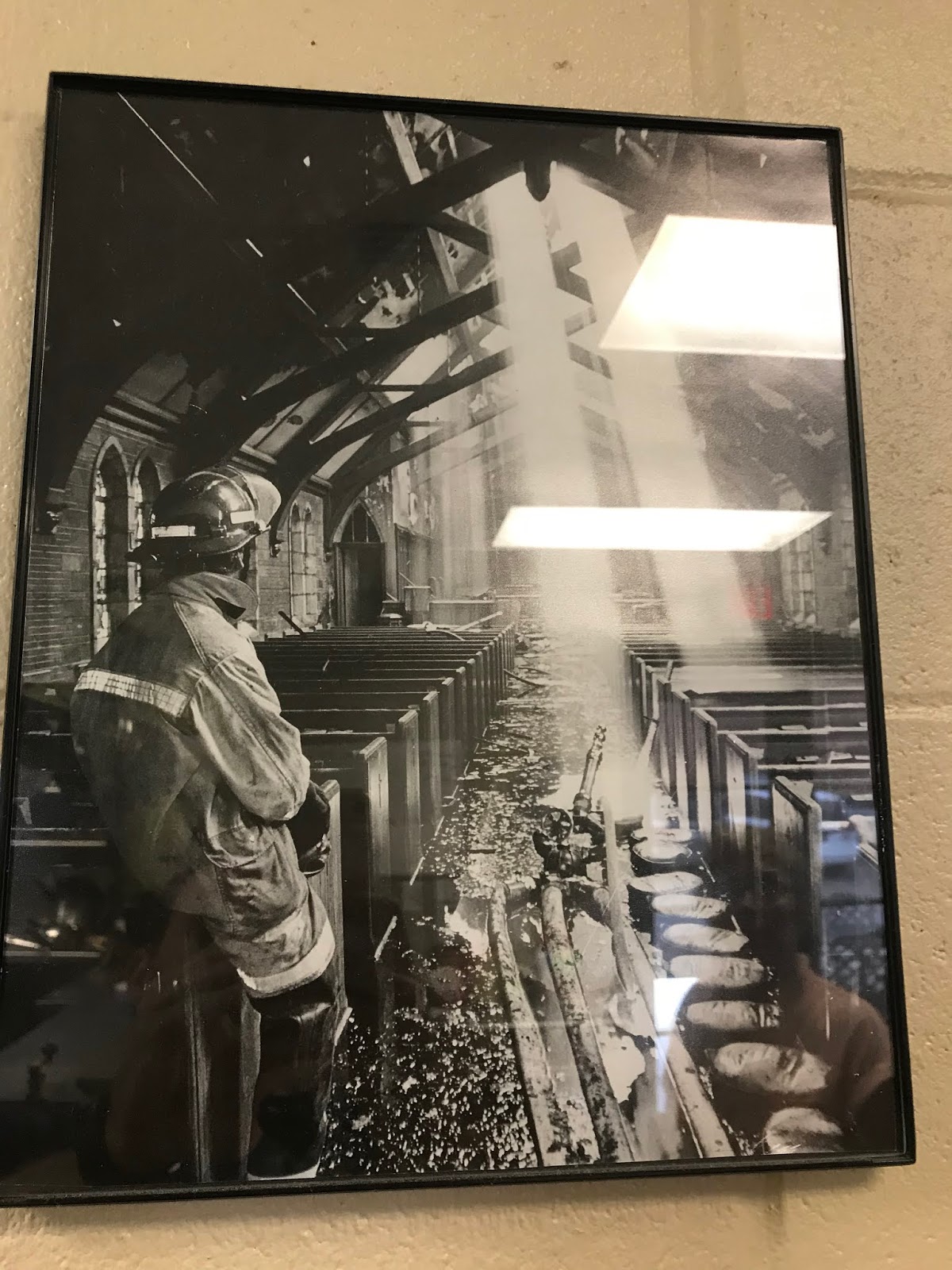
A picture of All Saints Church after the fire of the late 1980s. It hangs on the kitchen wall at Homewood Fire Station #1.

© Seth Olson 2019
August 18, 2019—The Tenth Sunday after Pentecost—Proper 15 (Gospel Reflection Track)

Before I go any further I have to make a confession to you my friends, I love fire. Maybe I’m not technically a pyromaniac, but it’s close. I come by it honestly. When I was a child my mom signed me up to be an acolyte, but I took to it because I could play with fire. There at St. Andrew’s Birmingham as a high school student, I volunteered to be thurifer any chance I could because thurifers get to swing around fire as they waft the incense. For three summers I worked at a camp where I got to carry around torches, build bonfires, and play with campfires. Even now I have far too much fun with lighter fluid and charcoal. Two weeks ago though when my son Teddy turned two I saw another side of fire.

My family took Teddy and his cousins to Homewood Fire Station #1 where the wonderfully kind firefighters showed us around the firehouse, demonstrated how they get ready, and even let us explore the fire engines. While the kindness of the firefighters and the marvelous technology they possess stand out from that day, there’s a picture that remains even more memorable.

On the wall in the kitchen of the station there’s a stark black-and-white photograph. This photo has haunted me ever since I saw it. It showed this very nave after the destructive fire of the late 1980s. As sunlight shone in from the holes in the roof, several inches of water flooded the floor making kneelers look like little rafts in the ashy liquid. When I saw that picture my gut knotted up and I felt the overwhelming fear that fire can kindle.

Herein lies the dilemma with fire, it provides light, warmth, and a means to sustenance, but it can also burn us, ruin property and even destroy lives. So when Jesus harnessed some fiery language in today’s Gospel lesson we would be wise to carefully examine his words. What was Jesus saying here? Was he illuminating us or burning us?

If we cherry pick just a few phrases from today’s lesson, we get pyro-Jesus. He catches the earth on fire, divides us, and calls us hypocrites. You might want to duck and cover when you hear this Jesus coming. I know I do. I preached on this set of readings three years ago, and I completely dodged this Gospel lesson because of its fire-filled nature. Today, I’m just foolish enough to get burned. These phrases about fire, division, and hypocrisy are not it—they aren’t all that is here. They do catch our ear though.

Many of us have a vision of a smiling, storm-calling, lamb-holding Jesus, so when we hear such strong language coming from God’s Son, we do a double-take. This rhetoric is nothing new though. For the past three chapters in Luke’s telling of the story, Jesus has grown more intense. And, can you blame him? As he put it in verse 50, “I have a baptism with which to be baptized, and what stress I am under until it is completed!” Jesus had turned toward Jerusalem and he clearly saw that his ministry led him directly to death—hence the great stress. As he anticipated this baptism of fire, something John the Baptist foretold very early in Luke, Jesus warned us of the perils of following him. Last week we heard of these dangers too.

In that passage from the same chapter, Jesus urged his followers to store treasure in heaven and to be ready for the Son of Man coming. In the story which lay between last week’s and this week’s lessons, Peter wondered whether Jesus’ warnings were for the disciples or for the larger crowd.

Instead of a direct answer, Jesus told a parable about continued watchfulness, and he backed it up by saying something that has made its way into our day-to-day language, as the phrase “To whom much is given, much is tested.” This section in total informs a different depiction of Jesus than a mellow, backwater carpenter. But, returning to today’s passage, I still wonder, why was Jesus so fiery?

Unfortunately, some of our fellow Christians have used passages like today’s to preach turn-or-burn style messages. Make no mistake, Jesus was speaking of decisions of paramount importance. And yet, today’s message is not about the eternal flames of hell. This fire is a refining one.

As Jesus drew nearer to the Cross and death, his message became clearer regarding the consequences of following him. A person back then who belonged to a traditional Jewish household who chose to follow Jesus would put herself at odds with the rest of her family. Or, a Roman soldier who decided to walk in the way of Christ would create a firewall between himself and his brothers-in-arms. Today’s fiery language was a way for Jesus to slap a warning label upon discipleship. “This will cost you,” Jesus seemed to say, “Maybe not your life, but possibly some of the most important relationships in it.” So on what are we risking our lives or at least our relationships?

To understand why someone would be willing to threaten such important things in following Jesus, we must first understand the core characteristic of Jesus and in turn His Heavenly Father. We do not explicitly find that attribute in today’s Gospel lesson. We see the consequences of it, but not the reason. We do however find the trait in today’s Psalm.

Psalm 82, according to one scholar, is the most important text in the entire Bible—because it shows us who God truly is. The most important characteristic of God is not infinite power. It’s not omnipotence. It’s not even immortality. So what is it?

In this ancient hymn, we discover that God’s most fitting trait is justice. God is always just! God fights against all the cosmic forces in the council of heaven who judge unjustly. God renders unjust all these other "gods" because they show favor to the wicked, fail to save the weak and the orphan, and abandon the humble and the needy. In the most epic cosmic aside of all time, God sighs and says, “They do not know, neither do they understand; they go about in darkness.” Talk about a burn! But, what’s the result?

All of these would-be-gods are not God because they are unjust. As a result, they are cast down from their perch in the council of heaven. They become like “any prince.” Now, we aren’t polytheistic and this clearly shows a less developed view of God than we are accustomed to in our Judeo-Christian worldview, but the point of this Psalm is nonetheless clear. God does not stand for injustice. And, if the prayer we pray most often is any indication, we want God’s reign to happen on earth as it is in this heavenly vision. Therefore, we too must oppose injustice. And that is the theme that ties together all four readings for today.

Jeremiah stood up to false prophets who made God’s people forget God’s name. In the Psalm, God cast out of heaven all forces which perpetuated unjust ways. In Hebrews, those exemplars of faithfulness, including people who were not always just in the eyes of the world, persevered in faithfulness running toward God’s justice as their prize. And this brings us back to our fire-filled Gospel lesson.

Jesus’ radical teaching of God’s justice was in and of itself divisive. When someone speaks a challenging word to us we may draw closer or we may run in the other direction. This was the case with Jesus. When he spoke the hard truth that God’s way means putting the needs of the poor, the weak, the orphan, the humble, the lowly, the foreigner, the exploited, the forgotten, and the other above our own, it created division. This truth caused some to feel burned while those left out in the cold finally felt warmth.

What about today? What about us? Is Jesus illuminating or burning us?

Well, it may be both.

A few years ago I was driving out in New Mexico through Bandelier National Monument. The Forest Service had recently conducted a controlled burn through part of the park. Some of the grounds were still smoldering. Other sections had been burned several months earlier. As I drove a van full of usually boisterous college students through the burnt forest, everyone fell silent. The same sort of internal hush that I felt when I saw the picture of All Saints in the fire station. In that burned over forest though there were sprouts of green. These ultra-green sprigs rose from the ashes.

Our lives may very well be like that forest. And Jesus’ word may very well be like that fire. Healthy sections may grow without ceasing. Other parts may need to be singed or burned to grow into God’s grace. God’s fire though is not meant to end our lives. Rather it leads us into new life. 

Following Jesus will challenge us. It should come with a warning label: "May impact your relationships." But as we shift from “my will be done” to “thy will be done.” Jesus calls us to pursue God’s justice, loving our neighbor as ourselves, and as we do, God’s fire will refine our lives leaving new patches of growth everywhere.

Wednesday, August 14, 2019

How Do We Preach Division?

Preaching on the weather (and James Spann) would be much easier than preaching on this set of readings.
There’s a whole lot in this week’s readings worth noting: Jeremiah sounding off against false prophets, God striking down false gods in the council of heaven, the writer of Hebrews challenging readers to run the race of perseverance, and Jesus revealing his pyromaniac side. Given we encounter a feisty and fiery Jesus what’s a preacher to do? I believe a helpful place to start is Jesus’ last question.

“You know how to interpret the appearance of earth and sky, but why do you not know how to interpret the present time?” Everyone can talk about the weather—it’s a universally acceptable topic of conversation. I particularly love conversing about clouds, storm systems, and barometric pressure, but I’m the guy who has four weather apps on my phone. My sweet sister gifted me a couple of the expensive ones because she wanted to make sure I’m weather aware—and boy am I! I’ve got the same radar that James Spann uses, and I can carry it around with me everywhere I go. I know which way the wind is blowing, have alerts for all types of severe weather, and even know when it’s going to start raining minutes before it happens. So, I feel pretty good about answering Jesus, “Yes I know how to interpret the appearance of earth and sky—or at least my app developers do.” But, the trouble comes in the second part of his question (I can’t seem to escape an impassioned Jesus). Why do you not know how to interpret the present time?

Why do I not know how to interpret the present time? Good question! The more I think about the present moment though, the more confused I get. It’s not to say that it wasn’t complicated 2,000 years ago. Especially since Jesus turned his face toward Jerusalem in Luke 9:51 the drama has heightened but the world around Jesus became more delineate, more black and white. And, this Sunday we hear Jesus drawing or perhaps burning a line in the sand. Those listening were challenged to make a decision, but it wasn’t turn or burn like we might be thinking (more on the type of fire in a moment).

The early followers of Jesus would have offended their parents or children or neighbors, as they sided with Jesus instead of other worldviews. Those times were certainly divisive, and with hindsight and bias we judge which side we would choose to join. What about today though? A good sermon this week might highlight the challenges we face in our current divisive age.

Right now appears even more divided than any other time
—including Jesus' own. We can see people’s opinions instantaneously on social media. When we do we can simply unfriend or unfollow those people with whom we disagree. We can watch our chosen brand of 24-hour news to further hammer home how right we are—and how wrong everyone else is. People can even quit going to a church if someone in the pulpit or the pew says something they don’t like. But, take any hot-button issue and try to interpret a peaceable solution and life will get quite complicated quite quickly. I don’t mean that people cannot figure out what they think about given issue—or what side to choose. No, I mean that all of us are struggling to coalesce and find consensus. It feels impossible to arrive at solutions where all are heard, respected, and satisfied with the result.

Experiencing the log-jammed nature of today helps me to understand Jesus’ frustration in this week’s Gospel lesson. A helpful sermon might speak of fire (told you I'd come back to it). Fire not as a way to scare people into choosing heaven over hell, but rather as a way to burn away that which does not fall in line with God’s will. Jesus used this image of fire to illuminate how God refines us. Jesus was rifting on the same image that Jeremiah used several centuries earlier. This might be another good jumping off spot for a sermon.

Jeremiah was tired of hearing the false prophets of his own day. These errant teachers were claiming that they had dreams from God, so that they could benefit themselves. This is not unlike some infamous televangelists who use hapless viewer’s charity to buy private jets or mansions. Jeremiah could not condone any of these nightmarish dreams which led God’s people astray.

A compelling dream and a flashy sales pitch can make people fall for just about anything. In this case it could even make God’s people forget God’s name. However, even more powerful than the false prophet’s dream is the Word of God. The Word of God can burn like a dividing fire and split open like a rock hammer. Still in both the Gospel lesson and here in Jeremiah we may not understand what is at stake along these dividing lines, as we experience the fiery word of God, which is where this week’s Psalm comes in handy. Again, another good sermon departure point.

Often I overlook the Psalmody in my sermon prep. They’re just old songs, right? Yes, but even though we often read them and move on these hymns cover the gamut of human experience from lamentation to ecstasy, from birth to death, from history to the end times. And, this week's psalm has a direct way of depicting who God truly is.

In Psalm 82, we are placed in the council of heaven, a common concept in the Ancient Near East—including ancient Israel and Judah. Here, YHWH or the Most High God was holding all others that were not the Most High God accountable. God took a stand against all forces not God. God took this stand because these other forces were judging unjustly. We might wonder what is the most important characteristic that makes God… well… God. Is it omnipotence? Is it infinite power? Is it immortality? What is it?

Psalm 82 responds to those questions in an unexpected way to me. All those forces in the council of heaven were cast down out of the realm of the immortal because they were... wait for it... unjust. God's most critical component here is not omnipotence, power, or immortality. It's justice! These others were showing favor to the wicked, not saving the weak and the orphan nor defending the humble and needy. They were not rescuing the weak and the poor, nor delivering them from the power of the wicked. And in a great cosmic aside, God said, “They do not know, neither do they understand; they go about in darkness; all the foundations of the earth are shaken.” In other words, these others go about in ignorance and haphazardly shake the very foundation of creation with their injustice. As a result of not living into the justice that God intended, they were cast out of this celestial realm.

Now my fellow preacher, justice is a powerful word to throw around from the pulpit. When I say justice everyone can nod their head and in other parts of the Jesus Movement people might even say “Amen!” to such a profound word. However, there’s a problem with this word. When I say justice there are as many different concepts of what that looks like as there are people in the pews. So, let me elaborate on this term using the vision that God sets forth here in Psalm 82 and also in Luke’s Gospel account.


Justice sides not with the wicked—i.e. anyone who takes advantage of the poor—but rather God’s vision of justice saves the weak and the orphan, defends the humble and needy, rescues the weak and the poor, and delivers them from those who would exploit them. And this theme, this vision of justice isn’t simply present here in Psalm 82, it’s also what Luke has been building towards throughout his entire story of Jesus.


Three canticles at the start of Luke portray this vision. Zechariah, John the Baptizer’s father, sang of this justice when he spoke of being delivered out of the hands of enemies and into freedom by God’s mercy. Simeon shared of this justice through the release for all of God’s people that he saw in the coming of the Christ child. And Mary most pointedly praised God’s justice as she sang, “He has shown the strength of his arm, he has scattered the proud in their conceit. He has cast down the mighty from their thrones, and has lifted up the lowly. He has filled the hungry with good things, and the rich he has sent away empty.” This is the vision of justice that God makes known to us, but what does this mean to us? And how can we preach when we and our congregations are often proud, mighty, and rich? I don't have a good answer for this, which is why I'm still working on my sermon.

There is a dilemma set forth in this week’s texts. Jesus touches on a nerve that Jeremiah experienced in his day, and we feel in our own. Jesus points to divisions that arise when we have to choose something paramount over something important. What happens when the stakes are raised to this level?

I believe we find the most profound truth in the psalmist's words. God is not God if God is unjust. And we in turn are not God’s people if we are perpetuating injustice. We are called to persevere just like that great cloud of witnesses persevered in the letter to the Hebrews. Our perseverance as preachers is difficult. For calling out injustice in our congregations and in our world must be done with a pastoral heart. And first Jesus’ fiery, cutting language must convict us as followers of Christ, so that all which does not fall in line with God’s will burns away. How do we preach division? First, we must allow God's refining fire to unite our true selves with Christ.

Sunday, July 28, 2019

Pray Shamelessly


Dr. Brené Brown at TED 2012
© Seth Olson 2019
July 28, 2019—The Seventh Sunday after Pentecost—Proper 12 (Gospel Reflection Track)
Genesis 18:20-32Psalm 138Colossians 2:6-15, (16-19)Luke 11:1-13

“Lord, teach us to pray.” This request (in today's Gospel) from one disciple appears simple enough. Jesus what do we say when we want to talk to God? In response, Jesus offered his followers the familiar words of the Lord’s Prayer. We often recite these comfortable words—and when we do we are literally following what Jesus said to do. We cannot do much better than that, can we?

Hammering this home, we in the Episcopal Church have taken Jesus at his word so closely—when it comes to praying the “Our Father”—that every time we gather together we say the Lord’s Prayer. Whether it’s at Holy Eucharist or Holy Baptism; during the sacramental rites of confirmation, ordination, holy matrimony, reconciliation of a penitent, or unction; whether it is part of the Daily Office or a devotion for individuals and families, every time we participate in Prayer Book liturgy—the spiritual work that binds us together—we pray in the way that Jesus taught us. So, that’s it, right? We have prayer figured out. Just stick to the script Jesus gave us. Maybe…

When the one in today’s Gospel lesson asked Jesus to teach the disciples to pray what was that inquiry really about? Was this a request about what to pray or was it about how to pray? While the importance of what Jesus offered is critical enough that we speak it every time we gather, the significance of how Jesus taught his followers to pray was even more profound.

Particularly in Luke’s telling of the Gospel, we often observe Jesus going off to pray. Right at the start of today’s story Jesus was praying. He prayed in the morning. He prayed through the night. He prayed on the eve of his death. He prayed constantly. Something we are called to do in our own lives. If his example were not enough Jesus also gave us a parable about how to pray in today’s lesson.

Fresh on the heels of teaching his disciples our most familiar prayer, Jesus invited his students into a creative exercise. I, in turn, invite you into this practice of imagining, as you seek to understand how to pray as Jesus modeled and taught.

Suppose you have a friend who is your neighbor. And, you go to your friendly neighbor to ask for some bread in the wee hours between dusk and dawn. You are doing this because you have another friend who has come to you and you have nothing to give this visiting friend to eat. Well, at first your friendly neighbor is hesitant. The neighbor has been cuddled up in bed for a while and even has children snoozing in the bed too. And just because you are this person’s friend and neighbor that’s not enough. The warmth and comfort of the bed keeps your neighbor from responding. However, as Jesus explained, “Even though [this neighbor] will not get up and give [you] anything because he is [your] friend, at least because of [your] persistence he will get up and give [you] whatever [you] need.” If this story is about how to pray, we can see that Jesus is telling us to pray persistently. It’s as clear as day, right there in the text. Jesus said prayer is about being persistent—except that’s not what he originally said.

Persistence is half-way right, but if we walk away thinking that the morale of the story is to pray persistently we will not be even half-way right. The point is not everything will turn out how you want it to turn out if you pray all the time. Jesus is not telling us that God is waiting to give us something good when we pray consistently enough. That’s just not who God is. This makes sense when we take a closer look at the word we translate as “persistent.”

The original word here is more closely related to our word shamelessness. It might be self-evident, but shamelessness means without disgrace, disrepute, or shame. How does this change the meaning of this parable? Well, let’s put the story into a contemporary setting to find out.

Suppose you knock on your neighbors door at 2 o’clock in the morning pleading for some bread because your best friends have just arrived from out of town. You don’t have anything to offer them or their family. Publix is long since closed. And, you don’t really want to go to the Green Springs Walmart Neighborhood Market, so you knock on your neighbor’s door. Your neighbor might not respond because of your friendship, but they will if you are not only persistent but also shameless in your knocking and yelling. The next day I bet your neighbor might even call you shameless. I can even hear them asking, “HAVE YOU NO SHAME?” Truthfully, that’s the point of this parable on prayer. When questioned, “Have you no shame?” in the presence of God we are to wholeheartedly respond “YES, I HAVE NO SHAME!” Maybe this sounds crazy to you, but bear with me for a moment.

What Jesus was trying to tell his disciples is that when they prayed they were to lay everything completely bare without disgrace. In doing so, they were relying upon themselves, but asking God for whatever they truly needed. This is how we are called to pray as well. Now, maybe a little clarification about shame might be helpful.

Noted author, storyteller, and researcher Dr. Brené Brown in her TED talk entitled “Listening to Shame” explained that shame prevents us from innovation, creativity, and positive change. Things that often come from prayer if you ask me. Shame is “I’m sorry. I am a mistake.” [1] As opposed to guilt, which is “I’m sorry. I made a mistake.” “Shame is the gremlin who says, ‘Uh, uh. You're not good enough. You never finished that MBA. Your wife left you… I know those things that happened to you growing up. I know you don't think that you're pretty, smart, talented or powerful enough. I know your dad never paid attention, even when you made CFO.”[2] Dr. Brown even says that shame is different for women and men.

“For women, shame is, do it all, do it perfectly and never let them see you sweat.” For men, shame is don’t be seen as weak. It’s “I’d rather die on my white horse than for others to see me fall off it.”[3] So, this is shame and it is something that prevents us from not only innovation, creativity, and positive change, it also keeps us from one another, and it can keep us from God.

So, Christ Jesus through today’s parable tells us the posture with which we are to pray is without shame. But, how do we do this? How do we overcome the gremlin?

In Holy Baptism, God calls us beloved children—we are sealed as Christ’s own forever. In Holy Eucharist, we are what we eat—we are the Body of Christ as we consume the Body of Christ. Even after experiencing these transformative services of worship regularly, I don’t always get it. I hear my own self-talk and it’s not “I’m a beloved member of the Body of Christ.” It’s more like, “I’ll be good when I…” or “I wish I hadn’t done that stupid thing, I’m such a bad (husband/father/friend/son/brother/etc.).” This sort of communication within ourselves reinforces shame—so what’s the antidote for shame?

Well, Dr. Brown says that it is empathy. Secrecy, silence, and judgment help shame to grow, but empathy destroys it. We see a glimmer of this in today’s parable.[4] The neighbor finally address his friend’s needs seeing the dilemma of the knocking neighbor. Even more clearly we see Abraham’s shameless empathy in our Old Testament lesson.

Throughout this lesson Abraham empathizes with the inhabitants of Sodom and Gomorrah. Leave alone for now the destruction of these cities. Instead focus on the prayerful actions of Father Abraham. When he sees the possibility of a righteous one struggling in a desolate city he cannot help but vulnerably lay bare his desire before God. God, don’t destroy these cities if people there are living in right relationship with you. According to Genesis this was not the case, but the what of the prayer isn’t as important as the how here. How are we to pray? Like Abraham: vulnerably, shamelessly, empathetically (if that's even a word).

Of course, this is difficult. We often think our prayers have to be pretty, that we have to have some perfect prayer routine that we stick with forever, or that God will only listen to us if we act the right way. But, this is not the case. God hears all our needs before we offer up any prayer. And, in today’s lesson Jesus provides the important instructive that we are to pray shamelessly. We are to pray without shame because God is a non-shaming entity. God wants our entire selves—even the broken, messy bits.

I’ll leave you with some inspiring words from President Theodore Roosevelt that inspired Dr. Brown. To me this is a beneficial way of envisioning our lives—prayer lives and otherwise: “It is not the critic who counts. It is not the [one] who sits and points out how the doer of deeds could have done things better and how [that one] falls and stumbles. The credit goes to the [person] in the arena whose face is marred with dust and blood and sweat. But when [that one is] in the arena, at best, [winning], and at worst, [losing], but when [that one] fails, when [that one] loses, [that one] does so daring greatly.”[5]

How are we to pray? May we dare greatly, shamelessly speaking with God who sees us completely and does not shame us, but loves us unconditionally, and calls us to reach out to others with empathy.


[1] Brené Brown, “Listening to Shame.” TED Talk. https://www.ted.com/talks/brene_brown_listening_to_shame?language=en [published March 2012; accessed July 24, 2019].
[2] Brown, “Listening to Shame.”
[3] Ibid.
[4] Ibid.
[5] Ibid.