Sunday, December 19, 2021

Bearing Christ

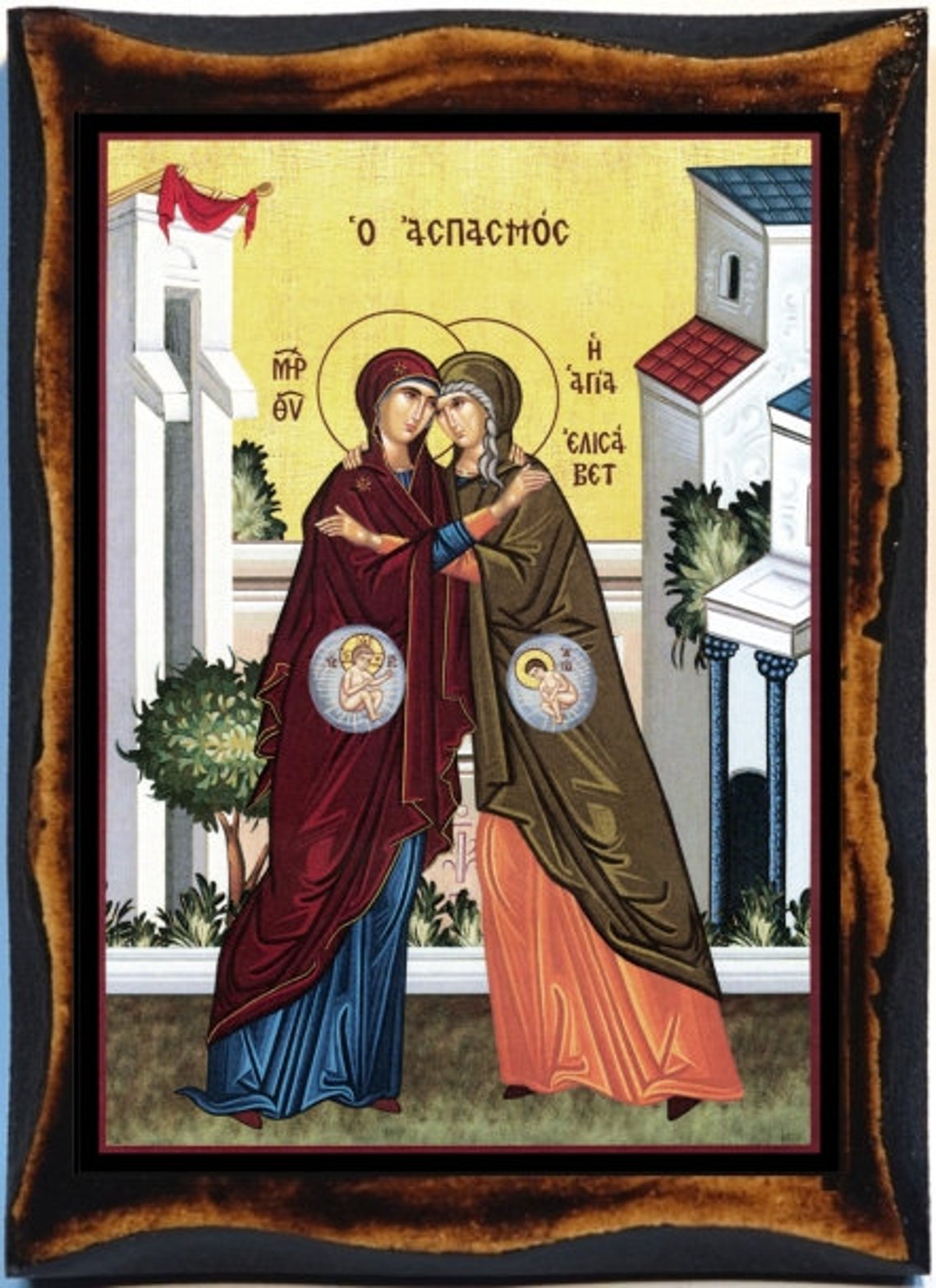
An icon of the Visitation of the Theotokos, the God-bearer


Micah 5:2-5a

Hebrews 10:5-10

Luke 1:39-45, (46-55)

Canticle 15 (or 3)

© 2021 Seth Olson

Video of this sermon may be found here.

Emmanuel, God with us, let my words be your words and when my words are not your words, let your people be wise enough to know the same. Amen.

I grew up going to a one-of-a-kind Episcopal Church—St. Andrew’s Parish in Southside Birmingham. Unique in its high church “smells and bells” style of worship—and its radical sense of hospitality—after going to church with a couple of my friends I realized my church was… different.

Instead of having a normal children’s Christmas pageant on Christmas Eve, St. Andrew’s had a very brief children’s play with only Mary and Joseph on the night before Christmas. “Why?” you might ask. Well, because at St. Andrew’s we waited until Epiphany when the wise men showed up to tell the full story of Jesus’ birth. Every year in the Epiphany pageant growing up I wanted to play the same part—not Joseph or a shepherd, nor a wise man or an angel, but rather the inn keeper. Odd, right?

If you are unfamiliar with this part in the Nativity story, Mary and Joseph had to go to Bethlehem because of a census that was being taken at the time. Joseph had to return to his family’s hometown. While the innkeeper appears nowhere in the story, this part is implied when Luke wrote “because there was no place for them to stay in the inn.” Why did I want to play this negative character? Maybe this is something to take to a therapist. As I have reflected on my penchant for this particular part, a few reasons emerge as to why I liked playing the innkeeper so much.

First, the innkeeper only had the one line, “Sorry, there’s no room in the inn.” Even after almost 30 years I nailed it! Second, I got to sit in a pew all by myself so that when Mary and Joseph walked down the aisle knocking as they looked for a place to stay, I could deny their request. Which gets to the final and most convicting reason in hindsight as to why I might have enjoyed this role. Could I have wanted to play the innkeeper because I got to deny the Christ child a place to stay?

Oomphf! This is what the innkeeper did, right? This man who owned the inn denied Jesus’ family access to a room. Except, in the Epiphany pageant at St. Andrew’s the hotel owner had a stable that he let Mary and Joseph use, so maybe there is redemption in the Inn (#dadjoke #priestjoke). Regardless, if we back up in the story as Luke tells it, before Mary and Joseph went to Bethlehem, right after Mary was visited by the Angel Gabriel, we find two figures who did not deny God a place to stay, but instead bore the Holy Spirit, God, and Christ in exemplary ways.

In today’s good news, we experience something wholly different from a denial of Christ—instead we encounter a story utterly holy—dripping with the power of God’s spirit. Two pregnant women and their visceral, feeling-soaked, prophetic conversation take center stage. Mary’s visit with Elizabeth shines a spotlight on the great hope of all who follow in the Way of Christ. What is that hope? We will get there, so keep listening, but first, let us go to the Judean hill country.

Today’s gospel story opens with “In those days.” This phrase harkens back to “the days of King Herod”[1] mentioned earlier in the story, even though we might expect God to be moving amongst the powerful, that is not what we find. Case in point, the angel Gabriel had just visited not the palace, but Mary, a lowly servant of God. Gabriel had been busy.

Earlier in Luke, God’s messenger visited Zechariah while he was offering incense in the sanctuary of the Temple. Gabriel told the priest that even in their old age Zechariah and his wife Elizabeth would have a child and they were to name him John. Being the stubborn priest that he was, Zechariah questioned God’s messenger. What happened next might have been why Elizabeth and he were finally able to conceive a child—Gabriel made Zechariah unable to speak until the child was to be born—the priest had to be quiet, and maybe he finally listened to his wife. Next thing you know, Elizabeth was pregnant with John the Baptist.

Fast forward just a bit in Luke’s account, and we find Gabriel announcing to Mary that she will bear a son as well. The angel told her, this child will be the Son of the Most High God—even with two thousand years between this news and us, it still strikes me as shocking! Gabriel told Mary this unbelievable announcement and solidified the claim by informing her that her relative, the once barren Elizabeth, was now pregnant. Mary unlike Zechariah did not question this surprising report from God’s messenger. Instead, she went with haste to meet Elizabeth, which gets us to today’s story.

When Mary entered Zechariah’s home, we can imagine the priest just silently raising his hand to wave hello, while Mary and Elizabeth embraced sweetly—the two holy children leaping within their mothers’ sacred wombs. Immediately from Elizabeth a blessing broke forth upon Mary—blessed are you among women, blessed is the fruit of your womb, blessed is she who believed that there would be a fulfillment of what was spoken to her by the Lord. The elder pronounced a three-fold beatitude upon Mary. The third of which might have been a veiled insult at her husband Zechariah who like many willful priests did not immediately believe what God’s messenger was saying.

Elizabeth pronouncing these blessings get me wondering—did Elizabeth’s late-in-life pregnancy give her new vision? Elizabeth greeted Mary with what many recognize as the beginning of the Hail Mary. “Hail Mary, full of grace, the Lord is with thee.”[2] Did Elizabeth’s own state of blessedness open the eyes of her heart to see Mary’s true nature. This makes sense. Don’t we more easily behold blessings in others when we are open to God blessing us?

Regardless, Mary inspired by Elizabeth’s words, sang some of the loveliest and most challenging words in all of Holy Scripture. She replied with what we know as The Magnificat—named such for the first line—My soul magnifies the Lord. The first few lines are all about Mary’s state of blessedness that Elizabeth was describing:


My soul magnifies the Lord, and my spirit rejoices in God my Savior, for he has looked with favor on the lowliness of his servant. Surely, from now on all generations will call me blessed; for the Mighty One has done great things for me, and holy is his name.[3]

We often might stop paying attention here. Thinking how beautiful Mary’s words are. Yes, the beginning bits of this canticle are about Mary’s blessed nature, but then the Theotokos, the God-bearer, announced a prophetic description of blessing. In it, she told us who God was, who God is, and who God will always be—and who we are called to be in response.


His mercy is for those who fear him from generation to generation. He has shown strength with his arm; he has scattered the proud in the thoughts of their hearts. He has brought down the powerful from their thrones, and lifted up the lowly; he has filled the hungry with good things, and sent the rich away empty. He has helped his servant Israel, in remembrance of his mercy, according to the promise he made to our ancestors, to Abraham and to his descendants forever.[4]

Mary, the bearer of God’s Son, pronounced a truth she intimately knew. She was blessed not just because she bore God’s Son, but also because she knew God’s way:

  • Mercy for those who lovingly hold God in awe.
  • A strong scattering of those who take pride in themselves alone.
  • Dethroning the powerful, while exalting those on the fringes of society.
  • Filling the hungry, telling the rich they’ve already had their fill—inviting them to share?
  • Holding the people of God in a merciful embrace forever.

This is God’s way, and it is to be our way too!

Elizabeth’s geriatric pregnancy opened her eyes to see her relative in a new way, such that she could pronounce a blessing upon Mary. Mary’s out-of-wedlock, divine pregnancy gave her the courage to see herself as blessed and to point out God’s countercultural way. Far from denying God a place to stay—these women prepared God mansions in which to dwell. We are called to do the same—this is the ultimate hope, which I hinted at earlier! All of us, no matter our gender, our skin color, our age, our sexual orientation, or our ability, all of us are called to not only make room for Christ, but also to bear Christ into this world—to live into the virtues set forth in Mary’s prophetic words.

The great theologian, philosopher, and mystic Meister Eckhart wrote it far more eloquently than I ever could:


We are all meant to be mothers of God. What good is it to me if this eternal birth of the divine Son takes place unceasingly, but does not take place within myself? And, what good is it to me if Mary is full of grace if I am not also full of grace? What good is it to me for the Creator to give birth to his Son if I do not also give birth to him in my time and my culture? This, then, is the fullness of time: When the Son of Man is begotten in us.[5]

In this season be it our care and delight to prepare a place for Christ to dwell—not just in a manger but in us and this world. May we be blessed like Zechariah and be quiet, so that we might hear God. May we be blessed like Elizabeth and see the blessings of others, so that we might exalt one another. May we be blessed like Mary and bear Christ in ourselves, so that God’s reign thrives in our time, place, and culture! Amen.


[1] Luke 1:5

[2] Hail Mary found on the Vatican News. https://www.vaticannews.va/en/prayers/the-hail-mary.html. [accessed December 19, 2021].

[3] Luke 1:47-49

[4] Luke 1:50-55

[5] Meister Eckhart, Be Mothers of God retrieved on the Catholic Storeroom. http://www.catholicstoreroom.com/category/quotes/quote-author/meister-eckhart-1260-1328/ [accessed December 19, 2021].

Monday, November 22, 2021

What Is Truth?


The already-and-not-yet reign of Christ is not about crowns.

2 Samuel 23:1-7
Psalm 132:1-13 (14-19)
Revelation 1:4b-8
John 18:33-37

©2021 Seth Olson

Holy God, let my words be your words, and when my words are not your words, let your people be wise enough to know the same. Amen.

Does anyone remember what happens next in this story? Do you know what Pilate said? Starting in John 18:38, Pilate responded, “What is truth?”

How did Jesus answer him? Certainly, with some wisdom-soaked teaching, right? A profound healing that stunned the governor? No, Jesus said nothing. His response was in God’s first language—silence. And, if you are bothered by this, you are not alone.

Frederick Beuchner, the spiritual giant and once-in-a-generation preacher put it this way, “The silence that has always most haunted me is the silence of Jesus before Pilate. Pilate asks his famous question, ‘What is truth?’ (John 18:38), and Jesus answers him with a silence that is overwhelming in its eloquence. In case there should be any question as to what that silence meant, on another occasion Jesus put it into words for his disciple Thomas. ‘I,’ [Jesus] said, ‘I am the truth’ (14:6).”[1]

When facing his own death, being interrogated by the highest power in his people’s occupied land, Jesus answered audaciously with self-emptying silence. Not a mighty teaching on truth, nor an earth-altering moment of restoration, Christ Jesus simply stood there.

Part of me wants to yield the rest of my time in the pulpit to God—to allow for Jesus’ silent reply to search our souls. I would love to simply dwell on what it means that Christ Jesus is the truth. However, I love working at All Saints too much to make you all sit in silence for an undetermined amount of time. And, as much as I would love to rest here in the quiet allowing God to speak in our hearts—and I know some of you would love that too—everyone might not enjoy an unannounced contemplative service. Still in wordless moments we discover the truth of Christ Jesus and on this day especially, we can aspire to know the truth of his reign in our lives and in the world.

Today is the last Sunday in our liturgical year. Advent is right around the corner and Christmas ever on its heels. Some call today Christ the King Sunday. You may wonder, where did this celebration originate? This feast sounds like an ancient occasion, so you might be surprised to discover that it emerged in Mainline Protestant Christianity after the Second World War.

Religious councils were gathering in a world and a time that felt torn apart and broken—not unlike our own day. These ecclesiastical bodies sought a shift in a brave, new, post-war world. They wondered how we as a species might avoid another contest that would bring us to the brink of total annihilation. One answer arose, which we commemorate today—Christ the King Sunday.

During this occasion we recognize that no power or principality of this world sits upon a higher throne than Christ, our true king. Of course, we here in the United States do not like kings very much. So, this feast is often referred to as the Reign of Christ Sunday, and that feels a bit more fitting—at least here stateside.

Reign of Christ Sunday sounds marvelous, but what exactly do we mean by this? What is truth in regards to Christ’s reign?

There’s a marvelous saying out at Camp McDowell, our diocesan camp and conference center, that I absolutely love, and it provides a helpful analogy. The motto goes, “This is God’s Backyard—the way the worldcould be.” Likewise we might say about Christ’s Reign that we can find it anywhere, and it’s the way God dreams it can be! There are of course, more weighty examples of what Christ’s Reign might look like or the way the world could be—including in today’s readings.

Our lesson from Second Samuel put it this way: He will “[rule] over people justly… who is like the light of morning, like the sunrising on a cloudless morning, gleaming from the rain on the grassy land.” Can’t you see Christ making things right—shining the brightness of truth over the whole earth?

The Revelation of John tells us Christ will be the Alpha and the Omega—the beginning and the end. So, the Reign of Christ has already commenced, and yet it is not yet fully realized. We are getting more pieces in the puzzle of the way God dreams the world can be!

Isaiah whom we will hear from during Advent… in 2022, so next December, describes what the Reign of Christ will look like in even more expansive and poetic language:


The wolf shall live with the lamb,
the leopard shall lie down with the kid,
the calf and the lion and the fatling together,
and a little child shall lead them.
The cow and the bear shall graze,
their young shall lie down together;
and the lion shall eat straw like the ox.
The nursing child shall play over the hole of the asp,
and the weaned child shall put its hand on the adder’s den.
They will not hurt or destroy
on all my holy mountain;
for the earth will be full of the knowledge of the Lord
as the waters cover the sea. (Isaiah 11:6-9).

This vision is stunningly beautiful. A wolf and a lamb, a leopard and a kid, a calf and a lion, a child and a snake dwelling together without violence—what a different way of being than what we are accustomed to seeing in our world of competition! It gets me wondering about this age—if Christ’s Reign started long ago at the beginning and it continues to the end, then what does the reign of Christ look like now?

Instead of a lion and lamb lying down peaceably—how about during this Iron Bowl Week the Tide and Tigers getting along? We might chuckle at this, but more seriously how about political donkeys and elephants finding ways to serve one another and the common good together! Try remembering that when you are about to argue across the Thanksgiving table. Least you think I am picking unnecessarily on politicians, how about us in the Church not deriding brothers and sisters from other denominations or other religions, but gathering around Christ’s throne?

This week I was overjoyed to walk in on Monday morning to see an empty Angel Tree. Your generosity and giving offered a glimpse at the Reign of Christ. What now we see in part through a mirror dimly God will reveal fully when God’s Kingdom comes. In the fullness of time that Angel Tree will hopefully be empty not because we took all the names of children whose parents are in jail, but because we have a reformed prison system and restored people reunited with their families.

During our Thanksserving project we gave out 40 turkeys and Thanksgiving baskets yesterday, which was wonderful and another look at God’s Kingdom. And, the full Reign of Christ may appear different. A place where there is no more hunger or children who go to sleep malnourished or starving. The Kingdom is already here, but not yet fully realized.

We have a class called Sacred Ground, which will soon begin discussing the challenges we as individuals and a church face regarding systemic racism. This course will be both challenging and life-giving! And this sort of work will open opportunities for all of us to participate in the work of truth and reconciliation. That work invites us into the Reign of Christ that has begun and beckons us to make it fully known one day.

During the Prayers of the People in a few moments we will remember Leann Hampton, a member of this parish who died tragically this week. I have been devastated and will continue to mourn the loss of this beloved child of God who had the gift of making life more fun and who rarely did not have a smile on her face when she walked in the doors of All Saints. She now dwells in the fullness of God’s presence—even if we who are on this side of the grave long for the fullness of the Reign of Christ where sorrow and pain are no more, neither sighing, but life everlasting.

Are you seeing the paradoxical nature of the Reign of Christ? It is the beginning and the end. It has already started and is also not yet. It is both here on earth and also in heaven. It is seen in who we are and what we do, still not fully. And while we spend time yearning for the whole kingdom to be revealed we would be wise not to let our own expectations get in the way of how God is already here and already working among us.

Simon Peter, one of Jesus’ chief disciples, put his own vision of Christ’s reign ahead of the truth. When Jesus talked aboutthe suffering that he would undergo—that his throne would be a cross and hisenthronement would be his crucifixion—Peter rebuked Jesus saying, “I will neverlet this happen.” To which, Jesus replied, “Get behind me Satan” and “You haveyour mind set on earthly things, not divine things.” Christ’s Reign may not look like what I expect, what I think, or even what I hope for, but that’s okay for it’s not my kingdom but Thy Kingdom.

As we dwell in the already-and-not-yet Dominion of God and anticipate Christ’s Reign which stretches from the beginning to the end, Jesus calls us to set our minds and our whole lives on how the earthly things become the divine things with God’s help. He revealed God’s “kingdom come” in eloquent teachings, powerful healings, and life-giving sacraments. We may also find the fullness of truth in God’s first language of silence. May we dwell with Christ in his reign now and forever. Amen.


[1]Frederick Buechner. Weekly Sermon Illustration: Truth, November 19, 2018. https://www.frederickbuechner.com/blog/2018/11/19/weekly-sermon-illustration-truth [accessed November 18, 2021]

Sunday, October 24, 2021

See Like Bartimaeus


Are you waiting to roller blade off a cliff to talk to God?


Job 42:1-6, 10-17
Psalm 34:1-8, (19-22)
Hebrews 7:23-28
Mark 10:46-52

© 2021 Seth Olson 

Holy God, let my words be your words, and when my words are not your words, let your people be wise enough to know the same. Amen.

There once was a man rollerblading down a mountain—which isn't an intelligent thing to do for a start—when he sailed off the edge of a cliff into the air. As he plummeted to the ground, he managed to catch hold of the root of a tree which was hanging out of the cliff face.

He was hanging there and was not really sure what he was going to do—his arms were getting tired, he could not hold on for much longer, there was no way to climb up, no ledge to stand on, and those rollerblades were getting heavier—when he heard this voice calling to him.

‘DAVE’ the voice said—for that was his name, and I was going to mention it at the beginning of the joke, but forgot—the voice said, 'DAVE!’

Dave was a bit surprised, because he was sure that there was no one else up the mountain with him. But he could hear this voice. ‘Yes?’ Dave said, ‘Is someone up there?’

‘YES’ the voice replied ‘THERE IS’

‘Help Me!’ Dave cried, ‘I can't hold on much longer’

‘I KNOW YOU CAN'T’ the voice cried ‘THAT'S WHY I'M HERE, TO SAVE YOU.’

‘Do I know you?’ Dave asked

‘OF COURSE, YOU DO’ the voice said, ‘IT'S ME, GOD!’

‘God?’

‘YES, AND I'VE COME TO SAVE YOU. YOU DO BELIEVE IN ME, DON'T YOU?’

‘Oh yes God!’ Dave replied ‘Now please throw down a rope’

‘BUT I'M GOD. I DON'T NEED A ROPE TO SAVE YOU DAVE. YOU BELIEVE IN ME, DON'T YOU?’

‘Of course, I do’ Dave replied.

‘GOOD’ said God. ‘NOW ALL I WANT YOU TO DO IS TO LET GO OF THE ROOT, AND I'LL CATCH YOU AND BRING YOU BACK TO THE TOP OF THE CLIFF’

‘Uhh..’ said Dave

‘YOU DO BELIEVE IN ME, DON'T YOU?’ God asked

‘Uhmmm, yes?’ said Dave

‘THEN JUST LET GO, AND I'LL CATCH YOU’

So, Dave thought about this for a few seconds, then yelled ‘IS THERE ANYBODY ELSE UP THERE?!?!’”[1]

Did you laugh at that joke? Yeah, so did I. Were we chuckling because it captured our relationship with God? Have we become so weary that we are missing the moments when God is staring us right in the face or is asking us to trust in God? A study conducted a few years ago sheds light on a new wave of belief in the United States. There are 5 tenants that many Christians and non-Christians alike now hold as core beliefs:

1.     A God exists who created and orders the world and watches over human life on earth.

2.     God wants people to be good, nice, and fair to each other, as taught in the Bible and by most world religions. 

3.     The central goal of life is to be happy and to feel good about oneself.

4.     God does not need to be particularly involved in one’s life except when God is needed to resolve a problem.

5.     Good people go to heaven when they die.[2]

Maybe we laughed at this type of humor because of number four: God need not be involved in our lives except when a problem arises. Society teaches us to be self-reliant. We get by on our own wherewithal until the moment comes when we are clinging to a root on the side of a cliff, then we want God to come and save the day. The last 18 months we all have been dangling precariously with more than roller blades weighing us down. And, if we are seeing things through the religious worldview of this joke, then God is like a butler uninvolved in our lives until we ring the bell for assistance,[3] or like Alexa or another smart device that is always listening, but only responds when we say her name or Okay Google. Okay God!

And if we buy into this whole model, we are to be sweet, feeling good about ourselves, knowing that nice folks go to heaven—that the Divine Watchmaker wound it all up and is around when the timepiece needs to be rewound or fixed. However, in this way of seeing life, God is not involved in our day-to-day existence, nor is God dwelling within, around, and among us. God is not rollerblading down the mountain alongside Dave. God is not passing by enfleshed as a fully human and fully divine carpenter from Nazareth. Except, that is exactly who God is.

In today’s Good News from Mark, Jesus from Nazareth made his way with his disciples towards Jerusalem. Bartimaeus, not a nameless blind man, but the son of Timaeus (a clue that he was someone known later to Mark’s community) yelled up at God as he figuratively hung off the side of a cliff. Even though he could not behold with his eyes, he could see something that the rest of the crowd was unable to perceive. For the first time in this account of the Gospel someone called Jesus the Son of David.

See, to this blind man God was not someone who was far off. No, in the person of Jesus, God had provided an heir to the throne, which David once occupied. Yes, Peter called Jesus Messiah. Sure, others recognized Jesus as a great teacher. And yet, it took a blind man to behold that Jesus was the walking and talking, living and breathing, healing and saving fulfillment of the Prophets and the hope of God’s People. Even in the face of a crowd who told Bartimaeus to hush he cried all the louder for Jesus.

Now the crowd switched in an instant, they were like bandwagon fans in this crazy college football season who pull for whoever is ranked #1 in the polls. They went from Bartimaeus’ naysayers to his cheerleaders immediately. This sort of herd mentality cannot be trusted—in much the same way as a worldview cannot be relied upon that sees God as valet or smart device.

Bartimaeus saw God differently. He outshouted the crowd, such that Jesus stopped and listened to the man. Jesus invited over the one who wanted to see again. Then, the carpenter from Nazareth uttered some familiar words, “What would you have me do for you?” Remember these words?

Jesus spoke the same words in last week’s Gospel account to James and John when they wanted to sit one at Jesus’ right hand and one at his left. Ironically enough, the sons of Zebedee could not see that they were asking not to sit upon glorious thrones, but to drink the cup of sacrifice and to undergo a baptism of suffering. Bartimaeus—having lost his sight, which he once had—already suffered much, and through this lens of loss could see who Jesus truly was. He could see that God’s Kingdom was near—that in Jesus God was incarnate.

How is your vision? In our lives, right here and now, where do you see God? Is God far off? Is God nearby? It does not take rollerblading off a cliff, losing your sight, or some other perilous moment for you to cry out to God. Our Divine Parent is closer than our very breath and our every heartbeat.

We can falsely believe that we are the center of the universe, that we are doing just fine without any help from God or one another. We can think that God waits downstairs for us to ring the bell, or sits silently listening until we say, “Okay God,” but if this is our belief, then we are not following the Incarnate One. We are not trusting in God with us. See, Jesus looked deeply into the souls of people like you and me and wondered, “What would you have me do for you?” Just like he said this to James, John, and Bartimaeus, he says it to us. Bartimaeus knew that God was not a distant problem-solver, but was the Holy One who came to make him well and to make all things well.

You and I are called to have the same vision as Bartimaeus. The crowds around us may encourage us one moment and tell us to be quiet the next. Others will insist that God watches us from far away, that our lives are all about us, and that God only loves those who are good—the Good News tells us something different! Cry out over the crowd to Jesus who reigns as the fulfillment of our greatest hopes, as the one who heals us, as the one who unites heaven and earth. Hear him ask you, “What would you have me do for you?”

Seek new vision. Have faith that heals you. Follow Jesus on the way. And you will see like Bartimaeus. Amen.


[1] Travaglia, S. (2009). The Real Other Stuff. Retrieved from The S Files: http://bofh.ntk.net/OtherStuff/RealOtherStuff/christian-joke.php

[2] Smith, C. (2005). On “Moralistic Therapeutic Deism” as U.S. Teenagers’ Actual, Tacit, De Facto Religious Faith. Retrieved from Princeton Theological Seminary: https://www.ptsem.edu/uploadedFiles/School_of_Christian_Vocation_and_Mission/Institute_for_Youth_Ministry/Princeton_Lectures/Smith-Moralistic.pdf

[3] Zscheile, D. (2015). "Agile Church: A Spirit Led Innovation in an Uncertain Age". Birmingham, AL, USA.


Monday, October 11, 2021

What Are You Keeping That Is Keeping You From God?


Money, Power, Prestige? What are you keeping that is keeping you from following Jesus?

This sermon was preached on the 20th Sunday after Pentecost (Proper 23B) at All Saints Church in Homewood, AL. A video of the sermon may be seen here. The readings for this Sunday were the following:

Job 23:1-9, 16-17
Psalm 22:1-15
Hebrews 4:12-16
Mark 10:17-31


Holy God, let my words be your words and when my words are not your words, let your people be wise enough to know the same. Amen.

A man approached Jesus. He was well dressed and well kempt. The type of man whom others admired. Surprisingly he forced his way through the crowds to get to Jesus—stopping the teacher and his disciples from leaving on a journey in the process. Once the man had Jesus’ attention, he knelt down in front of the one people were calling the Messiah. Then, came the question.

“Good Teacher, what must I do to inherit eternal life?” On the surface the question appeared innocent enough. The query had no thorns, no trap at least on the outside, but something underneath his words felt uncomfortable, hiding in plain sight, or sound, as it were. Inherit. What must I do to inherit eternal life? Not, “What must I do to enter eternal life?” nor “What must I do to have eternal life?” nor even “What must I do to earn eternal life?” This successful man wanted something else added to his portfolio. “So, what’s it going to cost me?” he might as well have said.

Jesus’ initial response pierced the surface—was this someone who just looked polished or was there depth beneath the façade? Jesus yearned to know this man’s soul. The teacher began to explore with his new student, “You know the commandments. You shall not murder; you shall not commit adultery; you shall not steal; you shall not bear false witness; you shall not defraud; honor your father and mother.” Six of the ten big ones—over half of the Ten Commandments.

If this were the initial test, the rich young man seemingly passed, as he explained “I have kept all these since my youth.” Again, on the surface all appears put together. Listen deeper though, “I have kept all these since my youth.”

Kept, like one might keep a bond certificate, guard one’s fine china, or hide away a prized possession? Jesus did not directly pounce on this word, instead he did something else odd.

Countless times Jesus showed God’s transforming love to rich and poor, old and young, Jew and Gentile, male and female, but only here with this rich man did this Gospel writer say that Jesus loved someone. Jesus agaped him. Without limit he loved this man who had almost everything, sought to inherit eternal life, and kept the rules precisely. Jesus loved him, then he challenged him.

To use poker language, Jesus had let the man call and raise his way to this point, such that he was “all in” with everything sitting at the center of the table—maybe even the watch his father had given him. Now though, Jesus was going to call the man’s bluff. “You lack one thing,” Jesus said cutting through the man’s defenses with his tough and limitless love, “Go, sell what you own, and give the money to the poor, and you will have treasure in heaven; then come, follow me.” That was it. The man folded. He walked away, like he lost more than his favorite watch. But why?

Did he not want to give up a certain standard of living? Was it that all those things made him feel important? Could he not let go of material stuff? Whatever it was, the rich man was too attached to, too enamored by, or too invested in something that kept him from selling it all and walking with Jesus. Maybe the man was shocked and heartbroken because he could not invest his way into inheriting the Kingdom. “You cannot buy your way in here. The only way in,” Jesus seemed to say, “is to sell it all.” What about us?

Life eternal awaits us now and always. Through the Sacrament of Holy Baptism we are outwardly marking this everlasting life, as Joseph Ryan Self is engrafted in the Body of Christ today at this service! As everlasting life beckons for us to enjoy, there are those things that we keep—whether they be material goods, social status, friend’s praise, family’s adoration, or whether our team won—those things that can keep us too. Don’t we get tangled up in them? We hang onto those things.

Think about what happens when we clutch onto something. As our hands grasp onto money, power, or prestige our clinched fingers do not allow us to be open to taking hold of anything else. “The things we possess, they possess us too.” Put another way it’s hard to follow the crowd and to follow Jesus too. Or, as Jesus himself put it, “No one who puts a hand to the plow and looks back is fit for the kingdom of God” (Luke 9:62). In this season when we discern our commitment to God in time, talent, and treasure, it takes courage to truly address those things that we hold onto that prevent us from receiving the gifts of God. So, I wonder for myself and for us, what happens when the things we keep are the things keeping us from following Jesus? What happens when the things you keep are the things keeping you from following Jesus?

For the rich man long ago, he wanted to keep things exactly the same (eat his cake and have it too). Even when he had eternal life right there in front of him asking him to follow, he wanted to make like Frank Sinatra, and do it “Myyyyyy WAY!!!” This sort of controlling though does not only derive from the love of power or control.

Denying Christ’s invitation to follow could result from holding onto anything that prevents us from receiving and giving the transforming love of God. Even when we keep good things or great things instead of God, we find ourselves living a limited life. With God though, all things are possible even relinquishing power and control; affection, esteem, approval, and pleasure; survival and security that we long to keep but that can keep us from following Jesus. The good news though is that we love God by loving neighbors, loving strangers, and loving ourselves—it’s a both/and not an either/or. Again I wonder, what happens when the things we keep are the things keeping us from following Jesus? What happens when the things you keep are the things keeping you from following Jesus?

There is a helpful parable by Paulo Coelho (Quail-o) about how we often seek to keep things, such that we miss Christ’s invitation to open our eyes, arms, and hearts to see, receive, and give God’s love. Here it is:

There was once a businessman who was sitting by the beach in a small Brazilian village.

As he sat, he saw a Brazilian fisherman rowing a small boat towards the shore having caught quite [a] few big fish.

The businessman was impressed and asked the fisherman, “How long does it take you to catch so many fish?”

The fisherman replied, “Oh, just a short while.”

“Then why don’t you stay longer at sea and catch even more?” The businessman was astonished.

“This is enough to feed my whole family [and then some],” the fisherman said.

The businessman then asked, “So, what do you do for the rest of the day?”

The fisherman replied, “Well, I usually wake up early in the morning, go out to sea and catch a few fish, then go back and play with my kids. In the afternoon, I take a nap with my wife, and when evening comes, I join my buddies in the village for a drink — we play guitar, sing and dance throughout the night.”

The businessman offered a suggestion to the fisherman.

“I am a PhD in business management. I could help you to become a more successful person. From now on, you should spend more time at sea and try to catch as many fish as possible. When you have saved enough money, you could buy a bigger boat and catch even more fish. Soon you will be able to afford to buy more boats, set up your own company, your own production plant for canned food and a distribution network. By then, you will have moved out of this village and to Sao Paulo, where you can set up HQ to manage your other branches.”

The fisherman continued, “And after that?”

The businessman laughed heartily, “After that, you can live like a king in your own house, and when the time is right, you can go public and float your shares in the Stock Exchange, and you will be rich.”

The fisherman asked, “And after that?”

The businessman said, “After that, you can finally retire, you can move to a house by the fishing village, wake up early in the morning, catch a few fish, then return home to play with kids, have a nice afternoon nap with your wife, and when evening comes, you can join your buddies for a drink, play the guitar, sing and dance throughout the night!”

The fisherman was puzzled, “Isn’t that what I am doing now?”[1]

Christ Jesus invites you right now to follow him in eternal life. You cannot buy your way into this inheritance. You can’t earn it. You can’t keep everything perfect so you make it in. The only way into this now and forever life is to release all that you are keeping that keeps you from God. The way in is to let go of everything you are keeping, so you may be with Christ on this eternal journey. Is it scary? Bold? Requiring courage? YES! And, it is your invitation as a beloved child of God. So, let everything go—everything you are keeping that is keeping you from God—let it go, then come and follow Christ into everlasting life. Amen.


[1] “The Fisherman and the Businessman,” Paulo Coelho. Written September 4, 2015. Accessed October 9, 2021. http://paulocoelhoblog.com/2015/09/04/the-fisherman-and-the-businessman/.