Sunday, January 26, 2020

Follow Me

Do we associate "Follow Me" with Jesus or Social Media?
© Seth Olson 2020
January 26, 2020—The Third Sunday after the Epiphany

Isaiah 9:1-4
Psalm 27:1, 5-13
“Follow me,” doesn’t mean what it once did. Our incessant connection to social media has changed what we mean by “following” someone. No longer do we most closely relate this phrase to what Jesus said in this Gospel text from long ago. Now following refers to keeping up with family, friends, and neighbors; movie stars, celebrities, and sports teams; politicians, organizations, and world leaders. Some other media platforms even use this term to refer to keeping up to date with TV series, blog posts, and podcasts. Nowadays, the way people move from being acquaintances to being friends has everything to do with who and what we follow. So, who do you follow?

No, I don’t need to know your favorite celebrity pet on Instagram or the obscure British TV series you cannot get enough of, or the crazy uncle you recently un-followed on Facebook. What I really want to know is despite social and other media’s commandeering of the term, who do you really follow? Not on Twitter, but IRL—In Real Life.

Several years back someone much wiser than me wrote something about following that bears repeating. Richard Rohr, who is a Franciscan friar, a priest, and a writer, challenged readers to realize that Jesus never said, “worship me.” Instead Jesus repeatedly invited others, saying, “Follow me.” Presiding Bishop Curry (not to be confused with Bishop-Elect Curry) called Episcopal Church leadership to realize that the real action doesn’t just happen in our liturgy. Rather our true service begins at the end of this service.[1] We are to follow Christ out into the world—to do the work God has given us to do, to go in peace to love and serve the Lord.

To be clear, I am not suggesting we do away with our Sunday service. I would be lost without our worship, without the Church’s hymns and our prayers, God’s Word and our beliefs, confession and pardon, peace and Communion. It doesn’t get any better than this! However, we would be wise to remember that the root of the word worship is connected to worth. Or to make it into a question, “to what do we give worth in this world?” In this inquiry we hear resonances of my previous one—Who do you follow? Who do you follow and to what do you give worth in this world?

We can all give the Sunday School answer, on the count of three. 1-2-3… JESUS! I would guess that like me, everyone here wants to follow Jesus. That’s presumably why you are here. We all yearn to live life in Christ. Each of us desires to be one of his disciples. But in our world full of distraction and noise and brokenness, it can be difficult to discern what Jesus’ voice sounds like. We may aim to follow Jesus. We may seek to give Him worth, but how do we walk in His ways?

Before charting our own course or reinventing the wheel, it’s useful to look at how others accomplished what we hope to do. The soon-to-be-disciples from today’s Gospel lesson clearly heard Jesus and they followed him. Seems like a good spot for us to start.

Jesus in flesh and blood, went to Capernaum, walked up to some boats, and invited two sets of brothers to abandon their lives as fishermen. Sounds like a tall order, but they dropped their nets immediately! Jesus did this by saying, “Follow me, and I will make you fish for people.” This sounds so ridiculous that we may wonder if it truly happened. Would you leave everything if a stranger invited you to follow?

Jesus though offered up a vision that these brothers could easily understand. He didn’t say to these fishermen follow me and I will make you farm for people. Jesus knew to whom he was speaking and what these brothers spent their lives doing. You might be wondering, “What about with us?”

How will God call us? We say: “I want to follow God, but how will I hear God’s voice and how will I know to follow Jesus?” God calling you and me and us is not as preposterous as it sounds. Hearing God speak doesn’t only happen in extraordinary ways, like Moses hearing a voice in a burning bush or Martin Luther meeting God in a lightning storm. God speaks in our daily lives—right where we are—like with these fishermen. God may not appear to us as a 1st century Palestinian Jewish teacher—he may—but more than likely, Our Savior will come disguised as something or someone so obvious that we find God is hiding right in front of us—hiding right within us.

The writer Parker Palmer put it this way, “Vocation [or God’s call] does not come from a voice ‘out there’ calling me to become something I am not. It comes from a voice ‘in here’ calling me to be the person I was born to be, to fulfill the original selfhood given me at birth by God.”[2] God’s voice calls us to be who we truly are—to be the person God made us to be. Family, friends, and our church help us to clarify God’s call by listening with us and testing this truth within a beloved community. But, what does this look like in action? If only there were a recent event in our community, maybe like a bishop election, where we could see God’s call in action...

Wow, as usual God provides! For one of us this call has been a slow and steadily increasing persuasion. A persuasion to pastor our diocese, administer its staff, be a messenger of God’s Good News, to lead our church, and defend our faith… sounds easy enough, right Bishop-elect? One is not merely called to be a bishop, there’s too much there. One must be persuaded to heed God’s call.

At the risk of speaking for everyone here, we all share in the joy of this call for it is indeed our collective call for Glenda to serve as our bishop in this part of the Jesus Movement. You may be here this morning seeking to Follow Jesus because you heard Glenda say, “I hope to see you at Church.” This is one way that God’s call rings out in this time and place, but vocation is not something reserved for people who wear purple shirts.

On Thursday evening we celebrated the life of Doug Barnes. A member of the Homewood community whom I did not get to know well—except by the imprint he left behind here. Charles Youngson described Doug as a non-anxious presence, as one who was completely here, like there was no other place to be. Doug heard God’s call as an invitation to be. Moses knew God as “I am” and Doug made the “Great I Am” known by being fully present with us.

There are other ways in which you might hear God beckoning you to follow. You may hear Jesus asking you to be a voice for the voiceless, to serve the least of these, or to visit those in prison. You may be called to attend Cursillo or Kairos, to help lead our children or youth, or to join the many outreach and in-reach ministries here. Your call may mean a new career, a new ministry, or maybe simply a new way of looking at what is already here. Regardless of what it sounds like, each of us is called by God.

I would like to end by sharing the story of when I heard Jesus say, “Follow me.” And, I invite you to share with each other and with me how you have been and still are being called ... because in our personal callings we hear more clearly how God is calling us collectively to follow Jesus.

As a child and adolescent, people told me I would make a good priest. I didn’t buy it! The old matriarch of my childhood church said it, my family said it, and complete strangers even said it. I had some inkling of this calling because I was the kid who followed around his priest for career day. But, I tried to fight it! I even flat out told Bishop Marc Andrus, “No!” when he tried to get me in the discernment process during college. Like Parker Palmer’s quote, I had to realize the call within me not just out there, but in here!

The summer after I graduated college at Sewanee I was hired there to be the Lay Chaplain. For three years I had the gift of trying on church ministry—I could see if the call was in me. To mark that time as holy I decided to renew my baptismal vows. I had been baptized as an infant, which I don’t remember, and confirmed in the awkward years of middle school, which I try to forget, so this was the moment when I would truly take hold of my own mature relationship with God.

After months of preparation, the big day finally arrived. At the Great Vigil of Easter we entered a completely dark chapel that eventually beamed with the brightness of the Light of Christ. The baptisms, confirmations, receptions, and reaffirmations of baptismal vows were beautiful and transformative. I was floating on a liturgical high known only to a certain few, known as church nerds. The service then turned towards communion.

That night I had the pleasure of serving chalice. Standing on the nave altar platform I received the bread and wine, the body and blood. Then, I approached the altar to pick up the Schwartz Chalice, a giant fishbowl-sized silver cup. At the same time the congregation came up to gather around the large altar platform. I took the chalice to commune the first person. Who was kneeling there? My very first priest, Fr. Francis X. Walter and his wife Faye.

In that moment I was happy to see them. But, as I lifted the giant silver chalice back I caught a glimpse of some heavenly vision. There, in the reflection of that cup, I saw the Great Cloud of Witnesses. It still sounds crazy, but in that moment I saw not only those kneeling or standing there at the altar, but also too many to number, to name, or to know.

I nearly fell down. And, for a long time I did not want to talk about that night because it just didn’t make any sense. But, what I kept coming back to was that all of us make up the Body of Christ—we are all united by Christ’s blood under his covenant of love. That night, when Jesus said, “Follow me” the path led to gathering God’s people around God’s Table.

What is your call? What is our call? Jesus says, “Follow me.”—not only to this table, but beyond. May we take this table and its gifts out into the world—following Jesus and fishing for people. Amen.


[1] Matthew Oliver, “Worship or Works? Engaging Michael Curry and Richard Rohr” The Living Church. https://livingchurch.org/covenant/2016/12/14/worship-or-works-engaging-michael-curry-and-richard-rohr/ [Written: December 14, 2016, Accessed January 23, 2020].
[2] Parker Palmer, Let Your Life Speak. (San Francisco: Jossey-Bass, 2000), 10.

Wednesday, January 15, 2020

New Year, New You?

Aslan the Lion un-dragons Eustace Scrubb

A version of this post appeared in the All Saints Parishioner the week of January 12th

Happy New Year! And, Happy New Decade! In the world around us, this means not only celebrations, but also invitations. These invites coming from gyms, financial planners, diet programs, home improvement stores, and many others essentially say: “It’s a new year and a new decade, so it’s time for a new you!” Not to burst your bubble, but I have bad news (I also have good news, so hang with me).

Every year, when marketing experts roll out ads for a new you in the new year, they are relying on a big, little lie we tell ourselves: "I can make myself new." On the surface, this statement sounds appealing. Having a new start is awesome, and we are all about new starts in the Jesus Movement. But, the trouble comes from believing we are the source of accomplishing this newness. Here's the bad news: we aren’t the ones who make life new. There is good news though...

In the crazy, mystical vision that John the Gospel Writer had on the island of Patmos, God spoke about newness. The Almighty One said, “See, I am making all things new” (Revelation 21:5). This is the good news! For God not only makes us in our individual lives new, but God also makes everything, everywhere new. So, you may be wondering, “We don’t have any part in this?” Well, we do and we don’t. Let me retell a story to help explain.

In C. S. Lewis’ fictional tale, The Voyage of the Dawn Treader, a character named Eustace became a dragon by watching another dragon die and sleeping “on a dragon’s hoard with greedy, dragonish thoughts in his heart." We might think that being a dragon would be awesome, but several days later, Eustace was miserable. He wanted nothing more than to be made a boy again.

Late one night, a lion met Eustace the dragon, and told him to follow him up a high mountain where there was a giant well. Eustace yearned to plunge into the bubbling waters; however, he couldn't as a dragon. The lion told him he must undress first. What did this mean? Eustace had to shed his skin, like a snake. So Eustace tried as best he could to un-dragon himself by peeling away his scales. After three attempts, he saw in the water’s reflection that he was very much still a dragon.

It was then that the lion told Eustace that he could not shed his skin on his own—the lion had to help. So, Eustace lay on his back, and when the lion’s claws cut through his dragon scales, Eustace thought the lion had gone right to his heart. While it was the most painful thing Eustace had ever experienced, having the scales and skin fall away was the greatest pleasure too. All of a sudden, Eustace was a boy again. Then, the lion grabbed hold of Eustace and threw him into the restoring waters. There he was made new.

This lion’s name, as you may already know, is Aslan, and in this series, he represents Christ. Sadly enough, we are represented by characters like Eustace (perhaps that’s the real, bad news). Try as we might, we can shed layers of our skin, but we cannot un-dragon ourselves. That work of being made new must be done by God. How does this happen?

While none of us will turn into an actual dragon, all of us may become quite beastly and yearn for nothing more than to be made new by becoming our truest selves. Fortunately, we have a loving lion who comes to us. A lion who will tear right to our hearts to transform us into who we truly are.

We find that lion all over the place at All Saints. We see Him in the pews on Sundays and Wednesday mornings. There, we have opportunities to be made new by meeting Christ in the Word and in the prayers, in the songs and in the silence, in the confession and in the absolution, in the peace and in the offertory, in the bread and in the wine. Throughout All Saints, you will find other ways to be made new with, between, and through one another. Whether it is during a Taize service, an Oasis program, or a Sunday School class; going to Cursillo, volunteering to serve, or joining the Church through Episcopal 101, there are many ways that our lion-hearted God is inviting us to the well. 

How will Christ un-dragon you revealing your new, true self this year?

Sunday, January 5, 2020

What We Have To Give

This corny cartoon isn't the only thing wrong with how we tell the story of the wise men, but what is the message of their coming truly about?

© Seth Olson 2020
January 5, 2020—The Second Sunday after Christmas

There once was an Episcopal priest from New England who was visiting his wife’s relatives in rural Mississippi. It was the week after Christmas. Driving through the town the priest from up north was happy to see a Nativity scene still up even though it was the eleventh day of Christmas. The care and attention put into this particular Nativity scene made it so beautiful that the priest decided to stop, get out of his car, and examine it more. (By the way, if you are wondering, this is the sort of dorky things that priests do while on vacation.)

Upon closer examination the priest was surprised—not because of the shining Angel Gabrielle, nor the placid Virgin Mary, nor the stalwart Joseph, nor even the calm baby Jesus—no, the priest was surprised to see the three wise men wearing firemen’s helmets. Baffled by the magi’s appearance, the priest walked into the church office. 

Once inside he introduced himself, and in his thick Boston area accent asked, “Why are the three wise men in your beautiful nativity scene wearing firemen’s helmets?” At this question, the church administrator became quite upset with the priest. Disappointed she exclaimed, “You Yankees! You never did read or understand the Holy Bible!”

After trying to explain that he was himself a minister, the woman at the desk started digging around her shelves. As she did the priest told her that no firemen appear in the Bible, but the administrator persisted and finally found a copy of the holy book. She frantically flipped through its pages. Turning to the appropriate chapter and verse, she pointed her index finger at the right passage, then pushed it into the priest’s face. “Look! It says it right there, ‘The three wise men came from afar…’ ”

(BOO!!! That’s a terrible joke!!! And a joke about fire at All Saints… come on!)

Even if I tried to give up dad jokes this New Year, it would be impossible. You can take the dad out of the dad joke but you cannot take the dad joke out of the dad. I apologize. While we have no confession at this service, I assure you I will certainly seek God’s forgiveness for putting you through that. Speaking of being put through things, how about these wise men?

They came from the East. They traveled across many different lands. They were guided not by a map, but by a star. They dealt with the terrible and violent King Herod. Finally, they found the Christ child. But, after giving him the gifts, they couldn’t even go home the same way because of Herod. So, what is this story truly about? 

Yes, the part of the magi is an awesome addition to the nativity pageant. Sure, the wise men coming from the East gives us an intriguing angle to the Christmas story. Of course, seeing their dutiful traveling to worship the Christ child inspires many a Christmas carol. However, the story of the magi is not simply something sentimental, rather it is a story that points us to the Epiphany when Christ was made known to the world and it is a story that challenges us to wonder, “What do we have to give to Christ?” Before exploring the Epiphany and what we might offer to Christ, let’s take a closer look at some of the often missed details of the Gospel story about the three kings. 

First, like the three firemen in the story earlier, there is no mention of three kings in the Holy Bible. What? GASP! The text never states that there are three visitors from the East. We interpret that there were that number because these foreigners brought three gifts—gold, frankincense, and myrrh. What about these gifts? 

The gifts of gold, frankincense, and myrrh weren't just random things these visitors brought. Gold represented a kingly gift, as Jesus is the true king, not only of the Jews but of Creation. Frankincense represented a spiritual gift, and it is still used as incense to symbolize our prayers and praises rising up to the throne of heaven (wherever it mystically resides). Myrrh was a stranger gift. It would have pointed to the sacrificial gift that Jesus the Christ would later give to us. Myrrh was used to anoint the dead, and so for poor Mary she might have already seen this bittersweet gift as a foreboding sign of the life her child would lead. So this is why we think there were three of them, but we do not know the actual number of visitors, we also do not know if they were kings. 

The text literally calls these visitors magicians. What? Again, GASP! Now, this is not like we are substituting a visit from Queen Elizabeth for Penn and Teller, or Prince William for David Blane. Modern-day illusionists are not the type of magician of which this text was speaking. Still, these visitors from the East were different. Some scholars believe they were not monotheistic, nor were they part of the People of God. The magi (short for magician, by the way) took their cues from the splendor of Creation rather than the rigors of the Law, the Wisdom, and the Prophets. They may have even initially been pagan… GASP, a third time! 

Sometimes we cringe or grimace when we hear the word pagan. Culturally we have been conditioned to link it to people who do not believe in God. People who are godless heathens who are out to destroy the good work being done by Christians. However, the whole point of the Epiphany is that Christ is made known not only to God’s Chosen People—the people of Israel—i.e. not us—but also to the whole world—i.e. that is us. So while they may or may not have been three in number, and they may or most likely were not kings, and they could or could not have been pagan, these visitors from the East still do point us toward the Epiphany, and what we might give to Christ.

The Epiphany is a celebration of Christ’s light, life, and love being manifested to all people in the whole world. So, it is no wonder that the Magi are the poster boys of this celebration. For, if pagan magicians from the East could observe a star at its rising, follow it for 1,000 miles, deal with a dubious politician all so that they might deliver gifts and pay homage to God incarnate, who just so happens to be an infant, then that means God is able to work on everyone, everywhere. 

So, this is the truth about the Epiphany, it is a season when we recognize God’s eternal, unconditional, and limitless love in Christ reaching to the ends of the earth. That is the epiphany that we want the whole world to have—the moment when everyone jumps up and down in their proverbial lab coats shouting, “Eureka, I’ve finally discovered it for myself. God’s grace has hit me! Now, I’ve got to share it!” And this gets us to what we have to give.

One of my favorite Christmas hymns is “In the Bleak Midwinter.” It’s last verse begins: 
What can I give him, poor as I am? 
If I were a shepherd, I would bring a lamb
If I were a wise man, I would do my part

I’ll finish the verse in a moment. What can we give Christ poor as we are? If we had been shepherds we would have brought our lambs for the young holy family to have. If we had been magicians from the East we would have brought gifts of gold, frankincense, and myrrh. If we had been Mary and Joseph we would have cared for the baby Jesus. However, we are not any of them. We might not be poor in worldly standards, but we are poor in opportunity to be with Jesus in the way the shepherds, the wise men, or Mary and Joseph were. We do not live 2,000 years ago. We cannot travel to Bethlehem to actually see the babe lying in the manger. We are us, right now, so what do we have to give?

The last line of “In the Bleak Midwinter” points us to a gift we do have to offer regardless of when or where we live. That line reads, “yet what I can I give him—give my heart.” That’s the gift we can give to Jesus, and it is the gift our entire being yearns to give. Christ Jesus is Emmanuel—God who is with us. We may not give gold, but we give worth to Christ who is our king. We may not burn frankincense here, but we offer up our prayers and praises to Christ who sits enthroned at the Father’s right hand. We might not bring myrrh, but we celebrate Jesus as the Savior who came to free us from our sins. And in these ways we give our gifts of praise and thanksgiving to Christ, we give our selves, our souls and bodies to borrow the words from our Rite I Eucharist.

So, as we celebrate this Epiphany story—a moment when God’s eternal, unconditional, and limitless love was manifested in all the whole world, may we also see the many opportunities we have to give our hearts again to Christ. Jesus laid down his life to show us what that sort of giving looks like. May we know that in Christ Jesus’ sacrifice on the cross we are loved infinitely by God. May we always and everywhere give our hearts to God as God does to us. And may we share that same self-giving love with the whole world. Amen.

Sunday, December 22, 2019

Little Moments: God Is With Us

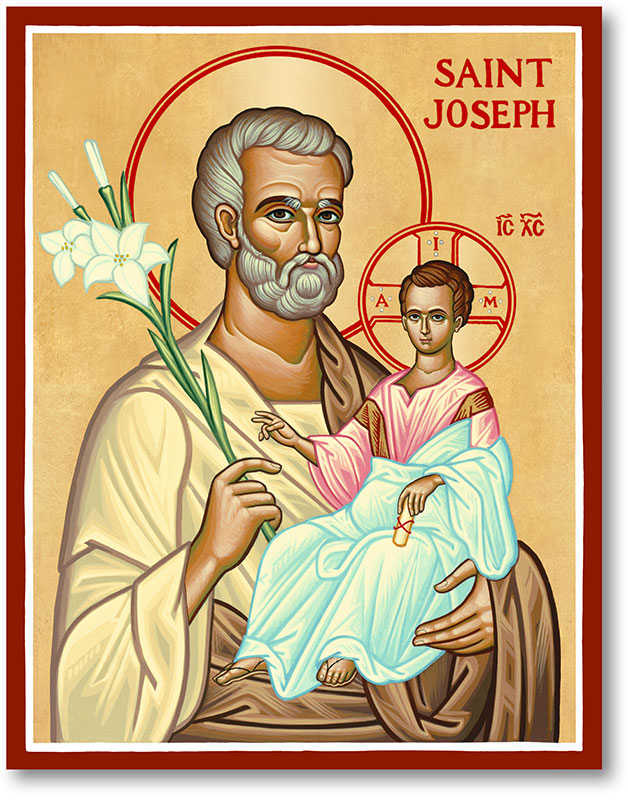
An Icon of St. Joseph holding the Christ Child


© Seth Olson 2019
December 22, 2019—The Fourth Sunday of Advent


It does not take much to change a life: A word softly spoken by a doctor. The welcome aboard email from a new company. A plummet in the market. The vibration of a phone on the night stand, and the 2 AM conversation that follows. A chance encounter. A smile. A friendly “hello.” Our lives can change in an instant. Whether we are ready for these changes—hoped for or dreaded, expected or out of the blue—whether we are ready for these changes is a completely different story. In these moments of upheaval, we are not alone though. We always have God. We have each other, of course. And, as evidenced in today’s Gospel lesson, we have the example of faithful ones who went before us, people like Joseph.

In the Church we talk a lot about Joseph’s wife Mary—and rightfully so! We sang a version of Mary’s words, “The Magnificat” during our Lessons and Carols service last Sunday. We heard part of her story then too. The angel Gabriel visited Mary announcing that she would bear the Son of God through the power of the Holy Spirit. The ability for this faithful person to say “YES!” to God even though it really complicated her life truly inspires us. Therefore, we remember Mary. We highly regard her as the God bearer or the theotokos and the Mother of God. Oftentimes though we overlook Mary’s husband.

However, today we recall the moment—or really moments—that changed Joseph’s life. In those days, betrothal was a big thing, a problematic thing too. Family elders would pull the strings of engagements—instead of the people actually involved in the relationships. There is no getting around the shameful truth that women were seen as property before they were seen as people. Being seen as such it would not have been surprising to pursue a harsh punishment, if say Joseph found out that Mary, his betrothed, was pregnant with another’s child. According to the Law, handed down from Deuteronomy, Joseph could have even had Mary stoned to death. However, that was not who Joseph was. He was a righteous man. Still his response to the news was not completely positive either.

Upon hearing that Mary was pregnant, Joseph planned to dismiss Mary quietly. Essentially he was going to null the marriage contract as privately as possible. We do not discover in Holy Scripture what the conversation was like when Mary told Joseph her news, or if she was the one to tell him at all. The news of a pregnancy is surprising enough. When Joseph discovered that Mary was pregnant with someone else’s baby, it was one of those life-changing moments. And, after regaining some composure—Joseph set about to null the marriage contract. Then, something else happened. Another—even more profound—existence-altering instants transpired.

While Joseph was sleeping, God contacted Joseph directly. To put it in a modern analogy God direct-messaged Joseph, the Lord DMed Joe which sounds like the plot to the CBS show, God Friended Me. In this vision from Matthew, God employed a messenger to change the course of Joseph’s life. The angel said, “Joseph, son of David, do not be afraid to take Mary as your wife, for the child conceived in her is from the Holy Spirit.”

Three things about this message from God. First, this messenger knew who Joseph was. Knew his story. Knew his people. Knew his lineage. God knew Joseph (and God knows us too). Second, the angel essentially said, “Joe, don’t panic. Keep calm and carry on.” This is, of course, easier said than done. However, when an angel says something those words carry more significance than a normal dream. Finally, the message to Joseph is as simple as it is clear—this is God’s child.

Let me pause here for just a moment. Imagine being in Joseph’s shoes—or sandals. You have just discovered that your betrothed is not pregnant with someone else’s child, but is pregnant with God’s child. Of course, there has to be some panic. Scratch that, there has to be some shock! “How can this be happening?” is the PG version of the question running through Joseph’s head. Still, he had to comprehend on some level, God chose this. Not only for Mary, but for Joseph as well. His part in this was massive. He had to be faithful, meaning, he had to trust God like Mary did. He had to say, “YES!” like Mary did.

Time-in! Joseph was then given a task by the angel. “You must name this child Jesus,” the messenger told him. This is the Greek translation of the Hebrew name, Joshua. What does Joshua mean? The angel said, “he will save his people from their sins.” Now, dear friend what you may not know is that right before this Gospel story for today began, Matthew opened his telling of the Good News with a list of names. Sounds pretty boring right? Sounds like these names have nothing to do with the name of Jesus? Well, these names trace backwards through generations of God’s People. Not all of them were commendable or even decent folks. Sure, some were, but none of them carried out what the angel is proposing here. Joseph’s soon-to-be-adopted son would save his people from their sins. Who are these people? Spoiler alert: the whole arc of the Good News of Christ expands this definition from God’s Chosen People of Israel to all peoples. This means Jesus saves us too.

Now Joseph awoke from his dream. Impressive, right? But then he did something more. He actually followed the instructions of the angel. Have you ever woken up from a dream and said, “Let’s live this thing out!”? I mean not the dream when you are paranoid because you forgot your clothes and now you are preaching a sermon in your pajamas… no, you haven’t all had that reoccurring dream?
Right, good me neither. Joseph’s dream though was not some random amalgamation of experiences his subconscious was still processing. No, it was, according to Matthew, a vision from God, a direct message from the Creator of the Universe. And because of this Joseph said yes. He took Mary as his wife, he supported her as she bore the child, and he named him Jesus.

So, all of this is beautiful, and perhaps it is even inspiring to us. Maybe we leave here thinking that when something tough is happening we can be faithful like Joseph. But, say we don’t have a vision from God? What if we aren’t as faithful as Joseph? Is there more that is actually going on here in this Christmas story? And yes, I know we are in Advent, but the Lectionary people let a Christmas story into our quiet season of preparation—make no mistake about it…Jesus is already born in this Gospel lesson!

Why this story of the incarnation matters to us though has everything to do with those little moments that change our lives—those instants when the proverbial toothpaste comes out of the tube and there is no way it’s going back inside. All of us more than likely will have a few of these moments in our lives—a proposal, a pregnancy test, a miscarriage, a birth, a divorce, a new job, a move, a retirement, a death, and so many others. In these moments, yes we have faithful examples. In these moments, yes we have each other. But most importantly, in these moments, we have God.

God is here. Not in some ethereal kind of way. No, God became incarnate. God became flesh and dwelt among us to peek ahead to John’s Christmas text. As Isaiah foretold and Matthew retold, “Look, the young maiden shall conceive and bear a son, and they shall name him Emmanuel,” which means “God is with us.” Now, Joseph named him what the angel told him to name him, not what scripture says; however, there’s a bigger picture being revealed here.

God is with us. Jesus was born. He breathed the air we breathe. He lived in the same world we live in. He cried as a baby—I don’t care what our Christmas hymns say—he was fully human and humans cry. He had human needs, he did human things, he ate, he drank, he danced, he laughed, he looked, he smelled, he tasted, he heard, and he felt. And in all of that in every bit of him being a human being he made every bit of our mundane, everyday life holy. Yes, all of it.

And what is more the one who was (and still is) Emmanuel—God is with us—had little moments that changed the course of his life. Whether in the synagogue the Temple, or the carpentry shop; on the road, at the market, or at home; on the shore, out at sea, or up a mountain, Jesus had life-changing moments too. So he made our existence-altering instants holy as well. Then, he took part in moments when he said or did something, or he was who he was and those moments changed other people’s lives too.

Jesus, the one who saves us from our sins, saves us still. Emmanuel, God who is with us, is with us not just in the Christmas card moments—when everything looks shiny and happy and bright. But, our God is with us in the messy moments, the life-changing ones, just like God was with Mary and Joseph, as they navigated the challenging circumstances of Jesus’ birth. God is with us in the little moments when our lives change forever because through the incarnation of Christ in the person of Jesus, God came to be with us at all times and in all places. So no matter what season of life we are in, no matter what little moment awaits us today, tomorrow, or in the future, may we trust God, like Mary and Joseph trusted God, for God is with us always. Amen.

Sunday, November 17, 2019

Do Not Be Weary

Whether you feel fine about the end of the world or not, Jesus encourages us that we are to endure even through the end. 

© Seth Olson 2019
November 17, 2019—The Twenty-Third Sunday after Pentecost—Proper 23 (Gospel Reflection Track)

Whenever I hear a Gospel lesson about the end times, like the one we heard just now, the lyrics of an “old” song come to mind:

“It’s the end of the world as we know it! 
It’s the end of the world as we know it! 
It’s the end of the world as we know it. 
And I feel fine…”

While these R.E.M. lyrics indicate how a famous rock group from Athens, Georgia feels relaxed about the dreadful portents of the mid-eighties, what about you? How do you feel about the end of the world as we know it? What do you think the disciples of Jesus thought about the end of the world? While we do not get any reaction in today’s Gospel story, I can imagine looks of terror from Peter, James, John, and others as Jesus told of false prophets, earthquakes, uprisings, persecution, and death!

Some call this passage the “Little Apocalypse,” and for good reason, right?! It sounds very much like the end times! And, when we read passages like this one with its deadly pestilences (to borrow some of the old King James’ language), we may wonder why we are reading this at all?
This week in the Men’s Bible Study on Wednesday morning someone asked just that, “Why is this passage one that the lectionary includes?” It’s a good question, and I didn’t have a good answer at the time. Today though, I want to answer that question by exploring this passage from three points of view: 1. the disciples', 2. Luke’s community's, and 3. our own. I want you to leave knowing what these words meant to these different groups and why this passage matters to us.

So first, what was Jesus saying to his disciples? To properly respond to this, we need a bit of context—especially what happened right before this story. After finally entering Jerusalem (remember Jesus had been making this journey for quite some time), Jesus with his disciples began observing what was happening at the Temple. Many rich people were giving out of their abundance, that is out of their excess. However, in the midst of all the commotion at the Temple, there came a widow who had next to nothing. And yet, she put in two of the only coins she had. She was willing to give not out of excess, nor what was left over, but out of her necessity she gave to God’s work in this world. That story blends seamlessly into today’s Gospel story when “some” (maybe disciples or perhaps others present) commented on the glory of the Temple.

It was as though what Jesus had just said about the widow’s giving went in one ear and out the other. For some said look how beautiful the stones were and what magnificent gifts had been given to the Temple. Jesus observing that a softer tactic had failed, used this moment to challenge his followers.
Now remember this group had been on a journey with Jesus as he healed people, taught the masses, and transformed lives. Through this Jesus’ path had always been meandering towards Jerusalem with betrayal, suffering, and eventually death functioning as the mile markers along the way. This journey would require Jesus’ life and he would freely give it, much like the widow freely gave all of herself over to God. When the disciples could not recognize the final destination of this journey, Jesus challenged them to see that the upcoming challenges (wars, famine, persecution) would serve as their own mile markers on the path of discipleship. What did today’s Gospel mean to Jesus’ disciples? This message was a challenge for the disciples to keep going and to keep the faith, for Christ would be enduring with them through the end.

Fast-forward about fifty-five years to the year 85 and many of these predictions from Jesus had come to pass. The Romans had destroyed the Temple in the year 70. As it fell, many teachers of the day preached wrongly that they were Jesus or falsely predicted his immediate return. In the larger context, Rome experienced upheaval as four Emperors ascended to rule the realm in quick succession right at the time Jerusalem was besieged. Some historians even described a constellation that resembled a sword and the coming of a comet right about the time that the Temple was overtaken.¹ All of these events would have influenced how Luke’s audience heard this story.

For those in the early Church living in the years soon after Jesus’ Ascension would have believed that Christ was coming back soon. He would quickly return to put all things right. However as the years went on, those hoping in God’s return must have felt a bit weary when it did not immediately happen. Like God’s People having to wander around for forty years in the wilderness, or like the ancient Isrealites hoping in the Messiah’s first coming, those in the early Church must have at some point grown tired of waiting. So, the meaning of Jesus’ message as told through the gospel writer Luke was to persevere.

Specifically Luke gave his community instructions on how to continue to share the Good News of Christ Jesus even during the most challenging and tumultuous days. When officials arrested Jesus’ followers they were to see it as an opportunity to share the story of Jesus. This was to happen not through prepared speeches, but by living in the present, trusting God to give wisdom and a word. They were to speak the truth even to those who set out to persecute them. Through Luke’s words, Jesus called these latter disciples to keep going, even if or when their family, friends, or the authorities turned against them. It was through these trials and having the patience to see them out that they would gain their souls.

To those who heard this Gospel around the year 85, this would have been the ultimate pep talk. As Christ’s message spread, those who were already undergoing suffering for their beliefs were surely yearning for inspiration to keep going. And, this may very well have been the meaning behind these words and why they were so important at the end of the First Century—inspiration! But, what about us? What do these words mean now? Why are we still reading this story almost two millennia later?

Whether you are R.E.M. singing about earthquakes, the Cold War, and the cruelty of life, or someone who observes dreadful portents in religion, in politics, in the environment, in the economy, or in everyday life, what Jesus said in this Gospel story isn’t going away. What I mean is that most of us at some point worry about “the end!” Religious extremists still shout in bullhorns that “The time is near!”. Wars, insurrections, national uprisings, and political unrest have become a part of our everyday lives. Earthquakes, hurricanes, tornadoes, fires, floods, famines, and plagues happen so regularly that news outlets cannot even cover all of them. With all of these terrifying signs as regular parts of our lives, we may wonder then what is Jesus trying to tell us?

Like with his own disciples and those who heard Luke’s words originally, Jesus challenges us who hear this Gospel now. Jesus says to us what he said to his first disciples. Keep going. Keep patience. When all of the world appears upside-down and falling apart around you keep the faith. Trust God. Don’t worry about a prepared statement or the perfect plan. Even if those closest to you turn against you because of the way you love like Jesus, keep on going. Keep on loving.

“By your endurance you will gain your souls.” These last words of this lesson do not quite get from the Greek to the English properly. Jesus did not exactly claim that endurance brings us into our souls. Rather he said that persevering in our souls—patiently and faithfully staying in relationship with Christ—gives us the endurance to make it to and through the end.

These are not empty words, nor did Jesus offer up an empty challenge. His statement is like what Barbara Brown Taylor once wrote about courage. To paraphrase her, we do not simply get courage. It’s not a transferable skill. Someone cannot simply will us to have bravery. Rather we must live through someone that makes us afraid to learn courage.² Likewise we learn faith, an enduring trust in God, not ahead of the challenges of our lives but in the challenges of our lives.

So patiently keep on trusting God! Do not grow weary of trusting God and doing what is right. Instead keep on loving God and loving your neighbor. And, as we continue on this journey with Jesus and fellow followers on the way, we will more fully awaken to the ultimate truth—God has loved our souls from the start and will love us in them through the end.

--------------------
1 Vernon K. Robbins "Luke 21:5-19" in Feasting on the Word, eds. David L. Bartlett and Barbara Brown Taylor (Louisville, KY: Westminter John Knox Press, 2010) 309-313.
2 Barbara Brown Taylor, Learning to Walk in the Dark, (San Francisco: Harper One, 2014).

Tuesday, October 29, 2019

Knit Together

Sometimes during sermon prep, I overlook the collect. If you are unfamiliar with the term, a collect is a prayer said at the beginning of a Holy Eucharist service with the purpose of drawing together or collecting the concerns of the people, the liturgical flavor of the season, and the themes of the readings. When writing a sermon on a given week, or when writing a blog about the upcoming Sunday’s liturgically assigned readings, I often skip right to the Gospel lesson—only later do I check out the First Lesson, Psalm, and Second Lesson. I almost never even consider the collect as a part of sermon prep, but this week is different.

Many churches throughout mainline Protestant Christianity will celebrate All Saints’ Sunday this week. (The actual celebration is on Friday, November 1st, but the Episcopal Church also encourages celebrating this occasion on the following Sunday.) The collect for All Saints’ Day captivates my attention and my imagination because of the descriptive language associated with God, the important role of all the saints, and the aim (or telos) of us as followers of Christ. Before going any further though, here’s the collect in its entirety:

Almighty God, you have knit together your elect in one communion and fellowship in the mystical body of your Son Christ our Lord: Give us grace so to follow your blessed saints in all virtuous and godly living, that we may come to those ineffable joys that you have prepared for those who truly love you; through Jesus Christ our Lord, who with you and the Holy Spirit lives and reigns, one God, in glory everlasting. Amen. (The Book of Common Prayer, 245).

Taking a look at the descriptive language in this prayer, we discover God’s intimate role in the lives of the saints. After the opening address, “Almighty God,” which provides a powerful portrayal of the Divine, the collect turns to a much softer active verb to depict God’s role in tying the saints together. “You have knit together your elect in one communion and fellowship…” (italics added for emphasis), the collect says. Here I imagine the Thursday knitting group, which meets here at All Saints, as they make prayer shawls that will be taken to sick babies, worried parents, and aging parishioners alike. God as Creator is not bringing us, the saints, together via thunderbolt and lightening (very, very frightening), but instead through calmly weaving us into a pattern beyond our comprehension. What’s the pattern? Our Almighty Knitter binds us together such that we actually become the Body of Christ. To borrow one of my liturgy professor’s favorite questions, “Isn’t that RAD?!”

This form that God weaves us into has the shape of the Mystical Body of Christ, but we see this pattern not only in the life of Jesus of Nazareth, but also in the lives of all the saints. Our collect does us a disservice when it says, “Give us grace so to follow your blessed saints in all virtuous and godly living.” Why is this a disservice? Well, when we describe the saints as blessed and when we say that they live godly and virtuous lives we mistakenly discount our own experiences as saints.

Recently I’ve been on a tear trying to hear as many parishioners’ stories as I can. Using Mary Parmer’s Invite Welcome Connect model as inspiration, I’ve been asking people what brought them to God or the Church, or when they have felt welcomed or like they belong (either in the Church or elsewhere). The powerful responses in the form of life-altering stories help me to see the shape of Jesus’ life and the shape of the Saints’ lives in the lives of everyday, ordinary people. I believe this is true precisely because the capital S Saints “are just folk like me” and you, to borrow a line from Lesbia Scott’s famous hymn. Virtuous and godly living then is not something that was only aspired to by people who lived a long time ago or those who currently reside in a hermitage, but rather as we become students or disciples of Jesus, we learn that we too can walk this way (talk this way) of love. We too are called to journey with Christ, Saints, and saints into abundant life, what we sometimes call the life eternal.

Finally, the collect provides us who pray these words with an aim for our lives. Virtuous living simply put is rightly aimed living. The way we find our aim is by living together in community, studying Holy Scripture and other texts, worshipping God by participating in Holy Sacraments and sacramental rites, and by allowing God’s grace to penetrate even into the most broken parts of our existence. When we take part in communities that work, pray, study, eat, and worship together, then one beautiful outgrowth we receive is values by which we can live our best life (a phrase that has seeped into the parlance of social media).

Within the All Saints (Sun)Day collect we discover that the aim of us the pray-er is to be knit into the Mystical Body of Christ (full stop). The mechanism through which this happens is God’s grace—God unconditionally loving us first. And, our response is to follow the pattern of the Saints who followed the pattern of Jesus the Christ. We follow this pattern best by becoming part of a community with virtues that align with the life of Christ and the lives of the Saints (and the saints). The by-products of this type of living, according to the collect, are ineffable joys and a full life prepared by God. (These joys by the way are unexplainable happiness, not something else, like was thought on an episode of How I Met Your Mother). So, you may be wondering though, what’s the catch?

It’s easy to read this collect and feel a bit inspired. Still, there’s the reality that, as the saying goes, the devil is in the details. So, how do we get this life with indescribable happiness? How do we become like the Saints? How do we model our lives in the form of Christ? How? Well, I do not know for sure, but I do know two things. First, the good news is that God loves us first. There’s no way to opt out of God loving us. God's love is unconditional, all-encompassing, limitless, timeless, and beyond measure. Second, our response is to do to God and neighbor exactly what God does to us—love without limit. This second part can be tough though, and this is where the saints come into the picture.

The Saints of the Church and the saints in your church are folk just like you and me. And, they didn’t always get loving God and neighbor right. What matters is that we continue to practice. When we mess up we turn back to God and reconcile (when possible) with our neighbor. But, just because we mess up it doesn’t mean we stop loving. For God who loves us completely inspires us through the lives of each other and on All Saints Sunday we are reminded that each one of us is a saint to someone else. So, don’t ever give up. Don’t ever stop receiving and giving the love of God because our Almighty Knitter is always weaving us together through the fabric of Christ’s self-giving love.

Sunday, October 13, 2019

Bad News Into Good: The Shape of the Gospel

As Frederick Buechner once wrote, "The Gospel is bad news before it is good news." This is good news to us who see bad news everywhere we look these days.


© Seth Olson 2019
October 13, 2019—The Eighteenth Sunday after Pentecost—Proper 23 (Gospel Reflection Track)

There are some times when the lector finishes reading a particularly difficult text, and in response to hearing, “The Word of the Lord,” we all look around at each other before shrugging and saying, “Thanks be to God?” And there are even some weeks when we hear a tough Gospel lesson and we have a hard time saying, “Praise to you, Lord Christ,” as the customary response. Now, you probably already know this, but gospel literally means good news. But, what you may not know is that the Gospel is bad news before it is good. Don’t believe me? Stick with me for a bit.

One of my favorite writers is Frederick Buechner. He once wrote, “The Gospel is bad news before it is good news. It is the news that [humans are sinners], to use the old word, that [we are] evil in the imagination of [our hearts], that when [we look] in the mirror all in a lather what [we see] is at least eight parts chicken, phony, slob. That is the tragedy.” Sounds pretty rough, but this is only the beginning.

The gospel is tragedy first precisely because we forget who we are and whose we are. We are God’s children and we belong to God. We come to earth knowing this deep truth within our souls. When we gaze upon newborns we remember this clearly, but somewhere along the way we lose track of the truth. This is the bad news before the good news. But, there is good news.

In today’s Epistle—when Paul was writing to his protégé Timothy—we hear the writer speak of his gospel. “My good news,” Paul wrote. What was this good news? Simply put, though Jesus died—tragedy—he was the Messiah, was raised from the dead, and brought those who believe in him with him—good news! We will return to this shape in a moment.

To Paul though, this message was worth undergoing suffering. Sometimes Paul comes off sounding outlandish or braggadocios, but here he was spot on. He was willing to be beaten and imprisoned, so that he could share good news. He underwent the bad news before ultimately experiencing the good. There’s that shape again.

Sometimes though we cannot help but get wrapped up in bad news. There is no shortage of it today in the world and in our lives. God's own creation cries out for greater care; famine, oppression, human trafficking, violence, and disease indicate a need for greater care of our neighbors; and in our own lives stress, anxiety, busyness, illness, and broken relationships point to the yearning within us to better care for ourselves. Bad news all around, right?

How do we respond? One way to respond is to get stuck in the tragedy, or worse yet to inflict tragedy upon others. Immersed in the bad news we counter what others do to us with what is called complimentary behavior—like for like. The Old Testament way of saying this is “an eye for an eye.” Or, in the positive, “I’ll scratch your back if you scratch mine.”

We even get a glimpse of this way in Paul’s letter to Timothy. Paul wrote, “If we deny him, he will also deny us.” If we are loyal, then that’s what we’ll get in return—a tooth for a tooth, denial for denial. Except that is not all there is. This is only the first act. This is merely the set up—the tragedy before the turn, for this letter more fully says: “If we have died with him, we will also live with him; if we endure, we will also reign with him; if we deny him, he will also deny us; if we are faithless, he remains faithful—for he cannot deny himself.” This opens up another way of viewing everything: death doesn’t lead to death, but to life. Endurance leads to reigning with God. Even denial gets redemption because God cannot deny God’s self. God will always be faithful. Now we see coming into focus the shape of the ultimate Good News!

Even if we falter. Even if we fail. Even when we are unfaithful, when we cannot be trusted, God will always remain faithful and trustworthy and true. This is the good news that comes in the wake of any and all bad news. And Paul truly was one who was acquainted with bad news. He knew suffering, imprisonment, betrayal, torture, and death. He willingly experienced bad news before tasting the good news. He knew the shape of the Gospel precisely because he had lived it.

Now Paul's phrase “my good news” sparked a deep wondering in my soul. Often in the Church we will talk about our favorite Gospel. Do you like Matthew, Mark, Luke, or John? I don't want burst your bubble, but there is only one Gospel—the Good News of Christ Jesus. Even knowing that there is simply THE Good News, sometimes we restrict it to the past. We mistakenly believe that God’s Good News happened 2,000 years ago half-way around the world, and four men wrote about it, and that’s it. Since then, the good news dried up, God went into hiding, and every once in a while we get a mysteriously communication as God watches from on high—like the outline of Jesus’ face in a piece of toast. But, the truth is the good news of Christ Jesus never stopped. And, it never will.

Each one of us is called to be a gospel writer. I am called to share the good news. You are called to share the good news. We are called to share the Gospel of our Lord Jesus Christ according to All Saints. This good news is diverse and unique according to each one of our voices, and yet it shares some similarities. Each one of us experiences our own Good Fridays before grace bursts in on Easter Morning. We all go to the cross on Calvary before seeing the tomb is empty. Like Buechner wrote, it is bad news before it is good news. We, like Paul, know this shape, the shape of the Gospel because it’s the shape of our lives. And, if we look around we start to see this pattern everywhere, like in today’s reading from Luke.

Seeing the arc of this leper’s life it takes the same shape as bad news looping towards good. This leper was an outcast because of his disease, and Jesus’ disciples who practiced Judaism would have looked down upon him doubly because he was a Samaritan. Samaritans had a different worldview and a different holy place, which led to conflict and even violence between the two peoples. For a Samaritan to be held up as an example for the disciples would have been challenging to say the least, but here we find this Samaritan leper’s life take the very shape of the Good News of Christ Jesus.

The leper was ostracized, ridiculed, and isolated with other lepers because of his disease—bad news. But then, he encountered Jesus. This interaction disrupted the leper’s life. He along with others asked for mercy from God. Jesus shared God’s healing with him. And, he was cured—good news! That’s it then, the leper’s life took the shape of the gospel… but that’s not it. That’s not all!

As the once-diseased man began to walk away, he observed he was cured, he turned back to God, he praised God, worshiped God by prostrating himself at Jesus’ feet, and he thanked God. We know the shape of the Gospel—tragedy gracefully swooping towards good news. But the one-time leper shows us the shape of a life impacted by good news: asking for mercy, observing God’s grace, turning back to God, praising and worshiping God, and giving thanks to God. The passage ends with some powerful words that put an exclamation point on this response to the Gospel.

Jesus said, “Your faith has made you well.” But, really he told the man, “Your faith has made you whole.” This faith, this trusting in God, allows us to walk from the bad news into the Good News of Christ with confidence that no matter what happens Jesus is walking with us. This is not just any good news it is our good news. And, it is worth sharing!

We, at All Saints, are in the midst of sharing our good news in many different ways. Last week we started a season of Shining Our Light. Today we will hear more stories of how we are revealing God’s transforming love in the world. What is this season, this time of stewardship all about? It’s about seeing the shape of the Gospel as the shape of our lives. It’s about responding to the good news in our lives and in this community with gratitude, by turning to God, and worshiping God.

God gives us everything. God shapes our lives such that through Christ all bad news bends forever towards good news. And as we walk through this life in which we see in the shape of the Gospel in multitudinous ways, may we respond like the Samaritan leper. As the light of Christ shines in our lives illuminating God’s mercy manifest within us, we are called to turn to God by praising, worshiping, and giving thanks for all the blessings we receive. What is the Good News according to All Saints? It is that Christ’s love transforms every bit of bad news into good news. And for that, thanks be to God.