Sunday, June 28, 2015

Stop fearing, trust God!

Sermon Audio May Be Found Here!

Immediately. If you have not already noticed the frequency of this word in the Second Gospel you will now. Mark loves immediately. We might translate it as “all of a sudden” or “just then”, as we are sick of hearing immediately, but that’s the word. And back then, just like today, life can change immediately.

The call from the hospital at 2 o’clock in the morning. The knock at the door from an old friend. The news alert dinging on a smart phone. The birth announcement that you never thought would come. Immediately changes everything. Today’s Gospel lesson is all about immediately. Even if you never received the phone call that shook your soul, had your life shatter to pieces right in front of you, or feel a joy that persists even to this day this passage still speaks to the truth of our frail, profound human existence. And yet, it speaks to more than that. In the face of life and death, Jesus immediately changes everything.

Today’s good news floats between two interwoven stories of Jesus’ healing, which fit together into one neat, if a little bit lengthy, package. In the first section a synagogue leader named Jairus seeks out Jesus to heal his daughter from a deadly illness. As the crowd pulses and pursues this traveling teacher Jesus says nothing to the request, but immediately goes to heal the young girl.

All of a sudden, from among the swarm comes a woman who had given up everything in her life to seek wellness. Nothing worked. She spent her last coin to find a cure, but alas sickness continues. Finally after more than a decade of desperation she turns to Jesus wondering, “What will happen if I can just touch his garment?” When she does, she feels the hemorrhaging stop and Jesus is immediately aware of his power leaving. He asks his disciples a seemingly silly question, “Who touched me?” They thought he was crazy. “How can you say, ‘who touched me?’” in the middle of a crowd. The woman though, knowing what had happened, comes up thinking she is busted.

We might not all know what it is like to suffer for twelve years, but we all need healing of some kind or another. Whether mind, body, or spirit we seek wellness somewhere beyond ourselves. For this poor woman the last twelve years of isolation, pain, and ridicule taught her to believe that she is wrong. Her bleeding would have made her impure and her religion would have quarantined her from others. A decade of believing she was immoral for having an illness meant that even when she finds healing from Jesus she responds to his question with fear and trembling and falling down. The healing is not just about her bleeding, Jesus calls her daughter and in this moment she is restored to life in community. Immediately Jesus changes everything for her.

At that same moment, messengers from Jairus’ home came to tell the synagogue leader his daughter is dead. They say, “Your daughter is dead, Why trouble the teacher any further?” This is the type of question that can immediately destroy hope. When Jesus hears it he responds saying, “Do not fear, only believe.” We do not get Jairus’ reaction to this statement. The cynics among us might hear him say, “Sure, I’ll believe when I see my daughter alive.” And yet, Jairus walks with Jesus, Peter, James, and John. So sweetly Jesus speaks to his daughter, “Little girl, get up.” Then, again he makes sure she is restored to her community, as she tells the family to eat something with her. Immediately Jesus changes everything for this family.

A lot is changing in our national landscape. In this week alone a landmark trade bill was passed, the Supreme Court upheld the Affordable Care Act and struck down the ban on Same Sex Marriage, and just yesterday the Episcopal Church elected its first ever Presiding Bishop of color. We might be overcome with joy or suffering from grief.

The truth from today’s Gospel story that speaks into our ever changing lives is that immediately Jesus changes everything for us. This story is not just about God helping us get through a tough moment though. There were other women suffering who did not touch the cloak of Jesus who kept on suffering. There were other children whose fathers did not run up to Jesus in a crowd who got weaker and weaker. This story is not about receiving healing for a moment; this story is about our eternal salvation.

Jesus said, “Do not fear, only believe.” If you are already living life afraid it is hard to hear the words “Do not fear,” and do anything but wonder, “How?” Perhaps a better way to understand these words is “From this moment moving forward, do not give into fear, instead trust in God.” of “Give your heart over to Jesus for from God is not just healing but life everlasting.”

We all need healing and immediately Jesus can change everything. For as some of us celebrate this week, others in our land feel bitterness. I clearly see the need for healing not just within ourselves as individuals, but for us as a larger community.

People keep posting “Love Wins” on FaceBook. I do not like that phrase. Not because I do not love Love, but rather because Love does not create losers. As Paul writes to the Corinthians:

"Love is patient; love is kind; love is not envious or boastful or arrogant or rude. It does not insist on its own way; it is not irritable or resentful; it does not rejoice in wrongdoing, but rejoices in the truth. It bears all things, believes all things, hopes all things, endures all things.
Love never ends" (1 Corinthians 13:4-8).

We need love. All of us together. Love never ends, nor does it create a winner or a loser, but instead it brings us into the transformation that Jesus showed in the healing of this woman and this girl. And this healing happens when we believe, when we give our hearts over not to fear, oppression, winning and losing, and bitterness, but rather when we trust God giving our hearts to the healing love of Christ.

Do not give into fear, trust in God, for Jesus changes our lives immediately!

Wednesday, June 3, 2015

Not Your Mama's Rapture

The Rapture might just look a little different than this.
(picture credit: https://www.swrc.com/media/wysiwyg/rapture.jpg)

There is an awful experience that I hope you have never endured, even though I think you probably have. Maybe this event occurs in a pivotal romantic relationship. Sometimes it happens on the playgrounds of our youth. And sadly, this scarring incident can take place in the innocence of our family of origin. Almost every single human being walking the face of the earth has at one point or another felt the suffocating heartbreak of being abandoned.

Whether you were not the right fit for someone, you were not fast enough in the schoolyard, or you were mistakenly seen as not enough by a parent or sibling that cold feeling of being left out can mark us for the rest of our lives. At times when my own insides were hollow except for the sting of rejection I would instinctively look to God, my strength and my redeemer. I can recall distinct moments when I leaned on this teaching that God’s Spirit always stuck with me no matter where I went, what I did, or what happened to me (Luke 24:49; John 3:8; John 14:26; Acts 2:4). If this belief is true, like I hope it is, then today’s Gospel Lesson from the Daily Office leaves me confused and on the verge of that empty sensation.

Luke 17 (our lesson for today) along with several other passages from Holy Scripture (Matthew 24; Daniel 12; Revelation) state that the moment of judgment separates some from God. Whether it is sheep and goats or wheat and chaff it seems that Jesus points out that some and not all receive a welcome inside, instead of where there will be weeping and gnashing of teeth. Sticking with our current lesson, Jesus tells us that “On that night there will be two in one bed; one will be taken and the other left. There will be two women grinding meal together; one will be taken and the other left” (Luke 17:36-37). So how are we to make sense of these two teachings: God’s presence remains with us no matter what AND one will be taken by God and the other one discarded?

I do not have an easy answer to this, for no one has ever experienced the moment of rapture as it is popularly described. Perhaps some have been taken away, but for those of us who remain if we observed such an occurrence would we really want to talk about it? All sarcasm aside, the way that we interpret the End of Days needs some real attention. For we can so easily slip into a practice of believing that whatever we are doing is right and will lead to being swooped up by God, while others will be left looking around as God beams us up to heaven.

While I hope in my heart that God did not, does not, and will not abandon us, there is also reason to believe in this Truth more than just the feeling of one preacher. In this same passage from Luke 17 Jesus answers the Pharisees’ (not his favorite lads) question about the Kingdom of God’s coming by saying, “The kingdom of God is not coming with things that can be observed; nor will they say, 'Look, here it is!' or 'There it is!' For, in fact, the kingdom of God is among you.” Jesus was assuredly talking about his earthly work, but that kingdom continues as we recognize the Christ within us. Additionally, if we are to believe that the Kingdom of God is already here then more of Jesus’ words are not so cryptic and like what the head of a cartel might say, but rather clues to how to live into the kingdom life.

Jesus tells his disciples, “On that day [when the Son of Man comes, which is happening NOW], anyone on the housetop who has belongings in the house must not come down to take them away; and likewise anyone in the field must not turn back… Those who try to make their life secure will lose it, but those who lose their life will keep it.” The moment of God’s Coming is not some distant time in the future, but right this very second.

We must not be distracted by the tasks of the hour, but live every moment recognizing that the Kingdom of God exists around us and within us. One might be distracted by trying to secure life instead of living in the presence of Christ that is within us all. When we focus too much on security we miss the Son of Man returning. Other instances when we focus on locking up more profits, more success, more things distracts us from seeing the richness God bestows to us in every moment. Does this mean we no longer farm, work, eat, drink, or go about our daily life? No, rather God’s constant “rapturing,” as the Son of Man comes to us in ourselves and in our neighbor means that our lives are altered not ended.

That feeling of being left out stings our entire being whether it at recess, by a lover, or in our family. We may take Jesus’ words to mean that God will leave us out if we are not careful; however, we are the ones who choose whether to take part in a relationship with the Almighty. Christ eternally comes to us in every moment. The Spirit always dwells with us. Our Creator leaves imprints on every fabric of our being. We cannot opt out of God’s love for us. We might choose to focus instead on securing this life, but in that moment we are not cast into the outer darkness, rather we miss that Christ’s presence is with us calling us ever deeper into relationship with the Divine.

Sunday, May 24, 2015

The Season of Pentecost

Like any good preacher I did not write a manuscript down for this sermon on the Day of Pentecost, but instead relied upon the Holy Spirit! Here's the audio! Sermon inspired by Acts 2:1-21.

Wednesday, May 20, 2015

Trust: The Wisdom of Infants

“I thank you Father for you have hidden these things from the wise and the intelligent and have revealed them to infants” Luke 10:21. (This sermon is based on Luke 10:17-24.)

I spent last week with two two-year-olds. They are not infants, but this message from Jesus is not lost on me after attempting to corral my twin nephews for a week at Disney World. They did not have a care in the world, and yet, everything they needed was provided for them.

My family and I were busily attempting to plan out the best way to spend each day, where we would eat, what rides we would go on, and when we would attend what shows. The twins and even their older sister were able to avoid all of the minutiae of plotting everything out, and somehow enjoy everything even more than I did (if that is possible). How did this happen? They trusted!

We are missing the beginning of the story in today’s good news. Jesus sent out 70 (or 72) of his disciples like lambs to the slaughter without purse, without bag, and without any spare underwear. Try doing that at Disney World! And yet, not only did everything go well. The disciples (all seventy of them) not only came back without blemish, but they also came back having casted out demons and not even needing an extra tunic to accomplish it.

The thought of not going even on vacation with an overnight bag and all my things makes me go a little crazy. I can make even simple trips way too complicated! As I observe my tendency to always be prepared, I notice that I like to be in control. Putting myself in control means so often that I miss opportunities to trust God and to trust my neighbors. We all have probably heard it said, “If you want to hear God laugh tell God your plans.” Somehow though I, and maybe you too, still manage to try and plan out everything according to my own will.

The story of sending out the pairs of disciples provides the perfect opening for us control freaks to wonder what it might look like not to rely so much upon what we think is best, but instead to expect that the Holy Spirit and our neighbors will provide care for us. My nephews did not worry about what they would eat or what they would drink or what they would wear. They believed in those around them to provide. What if we did like the disciples and like infants?

Sometimes we hear sensationalist stories of gunfights, riots, murders, and disasters on the news. These reports create a fear-filled perception of the world. We may think that it is best to stay in our own little bubble. Maybe this is true. On some level the newscasters base their accounts in reality. Bad things do in fact happen in our world. Jesus even acknowledged as much when he sent out his disciples in Matthew’s account of this story, “See, I am sending you out like sheep into the midst of wolves; so be wise as serpents and innocent as doves.” And yet, what happens when we no longer rely upon those around us?

Trusting God and trusting our neighbor cannot just happen. We must remember this ability to believe in others with which we were born. Sometimes though this is difficult. Perhaps what we need is the opportunity to build up this “trust muscle” within us like we any other part of ourselves. One does not hop off a couch and run a marathon, nor does one hop on stage and perform on Broadway, and no one makes a career out of something one has never studied. The same is true of our ability to trust. So what are we to do?

The Church at its best can be that place to try out trusting others. Churches are not perfect, for they are made up of imperfect people; however, my hope remains that we can practice trusting in one another here at St. John’s. When Jesus sent out the seventy they stayed in strangers’ homes, they ate what was provided, they healed others, and all of this showed their ability to let go of the details, the planning, and the control. Instead, they trusted in God and their fellow human. Let us too practice believing in one another. Be like infants who do not worry, but trust!

Sunday, April 5, 2015

Expect Resurrection

You are made of bones, sinews, flesh, skin, and... 

Homily audio can be found here. This homily is based on Genesis 1:1-2:4aGenesis 22:1-18Exodus 14:10-31; 15:20-21Ezekiel 37:1-14Romans 6:3-11 Matthew 28:1-10

We have made our way through Holy Week. We have walked the streets of Jerusalem waving palms. We have had our feet washed by Jesus and washed one another’s feet. We have witnessed the betrayal, denial, and sentencing of Jesus. We have journeyed to the Cross to behold the pain of Jesus and the glory of God’s self-sacrificing love. Now after a day of rest we are at the tomb.

“Suddenly there was a noise, a rattling, and the bones came together, bone to its bone. I looked, and there were sinews on them, and flesh had come upon them, and skin had covered them; but there was no breath in them” (Ezekiel 37:7-8).

You are made of bones and sinews and flesh and skin. You are also made of atoms, a lot of atoms! Rob Bell, who is a Christian thinker and author, said on a recent podcast that we are made up of 7 billion, billion, billion atoms. Some of the atoms in our bodies date back over a billion years. That is right, you are made of atoms that previously constituted something else. The heavier atoms actually come from star dust. So you are made of bones, sinews, flesh, skin, atoms, and stars!

What is more parts of you are constantly dying away. Every week you regenerate new skin cells. More amazingly every seven years or so your entire body will be reconstituted by new cells. Hundreds of millions of cells die within you and hundreds of millions more come to life. You are ever dying and you are ever coming to life. You are not just made of bones and sinews and flesh and skin and atoms and stardust. You are made of death and rebirth! The you that you are today is not the you that you once were, nor is it the you that you will become. You are made of death and rebirth. You are death and resurrection.

If this is who you are, which I believe is the case for all of us, spotting death and resurrection would seem an easy task, but somehow we miss it or part of it. We easily observe death, just turn on CNN, open your paper, or check out a news website. Death drives sales! Yet, all this death tends to dry us out. We end up like the bones from Ezekiel’s valley. We are breathless. So what do we do? How can we mere mortals catch God’s breath? We can’t. Not because we are unworthy or bad or wrong, but because God’s Spirit already resides within us. Yet, if this breath is in us how can we get so lifeless? We need Resurrection.

A long time ago there were two women. Although they did not appear in the foreground of Matthew’s account of the Good News about Jesus of Nazareth until the very end, they had been with him since the beginning at Galilee. They have provided for him Matthew tells us. This is an interesting word for it is not used all that often except to describe angels, Peter’s mother-in-law, and Jesus himself. They provided Jesus with comfort, food, and fellowship. They gave life, but how?

Now on the first day of the week after the day when Jesus was crucified and after the Sabbath when Mary and Mary had been starring at the place where Jesus rest, they decided to go see the tomb. These women act strangely at first glance, why would you sit and stare or go to look at a sealed grave? Recall that Jesus foretold of his Resurrection, well these two actually heard it and remembered it. They were not going to look at an enclosed cavern they were coming to see the Resurrection. They were on the hunt for Resurrection. They understood that they were not going out to look at death for they brought no spices to adorn the dead. They went out actually looking for Jesus to be raised from the dead.

To be here at the Easter Vigil I imagine that you are pretty serious or pretty curious. You are either pretty serious about following Jesus or you are pretty curious about what following Jesus actually means. Following Jesus means recognizing the substance of your being comes from death and resurrection. Following Jesus means being like these women who provided for Jesus, except that when we provide for Jesus now that means we provide for everyone who makes up his body now (i.e. the least among us). Following Jesus means that we do not remain dry and breathless in the face of death, but in the face of death we expect God’s resurrecting power.

On this most Holy night remember that you are made of bones, sinews, flesh, skin, atoms, stardust, death, God’s breath, and Resurrection. Know that your call in this new glow of Easter is to be like Mary and Mary. Go out and provide for Jesus wherever you meet Him. And, most importantly expect Resurrection! Expect to find Resurrection wherever you may see death! Be Resurrection, provide for the Resurrected Lord, and expect Resurrection!

In the name of the Resurrected Lord who is Father, Son, and Spirit! Amen.


Friday, April 3, 2015

Human Failure and God's Love

This Good Friday Sermon is based upon John's Passion Gospel. Sermon audio can be found here.

On Good Friday we hear John’s Passion Gospel every year. Somehow though something different sticks out each time that I hear this painful story. Today, I cannot help, but hear the failure of human beings just like you and me. Mistake after mistake after mistake:

Judas betraying Jesus into the hands of a detachment of soldiers and police from the chief priests and Pharisees.

Peter not just wielding the three-fold blade of denial, but also striking Malchus on the ear, as he attempted to save Jesus.

The religious crowd, which recently cheered “Hosanna!” fearfully transforming into a mob shouting, “Crucify Him!”

Pilate tired and apathetic giving up on a man whom he knew was innocent.

Soldiers tearing the garments off of Jesus for their own gain.

Roman occupiers meaning not only to kill Jesus but through crucifixion to embarrass and torture him and his people.

What stands out at first is human failure after failure after failure resulting in the death of Jesus of Nazareth. I think I see this because I want to reach back in time and stop this moment from happening. I want to say, I would never fail you Lord, but as soon as I say those words, I hear Peter telling Jesus he will never deny his teacher. I want to skip over this day.

We in the Church often say that we are Easter people and are in the business of new life, reconciliation, and resurrection. While I fully believe we mean this, we do not wear miniature empty tombs around our necks, nor do we put that symbol on a pole to follow as we make our way through life together. On this day when we have hidden the sign of the Cross I find it difficult not to see the Cross everywhere I look.
Yesterday 147 students were massacred at a Kenyan college primarily because they followed Jesus. Throughout the Middle East ISIS continues to persecute and kill Christians without hesitation. Closer to home over 14,000 people are murdered every year within the United States (FBI Crime Stats). 32 states, including Alabama, still implement the death penalty. Prophets of our age warn us of the harm we inflict on the earth through poor care of Creation practices, yet we apathetically continue our lives of convenience. AK-47s, electric chairs, and smoke stakes are the Crosses of our day. We who are Easter people may just want to skip ahead like fast-forwarding through painful scenes in a movie.

In the movie Shawshank Redemption (a film particularly fitting for this weekend) the protagonist, a man named Andy Dufresne, finds himself imprisoned at Shawshank Penitentiary. In a moment of desperate clarity he says to his friend, “Get busy living or get busy dying.” I think when we simply call ourselves Easter people we tend to twist this phrase around, as we say to Jesus, “Get busy dying, so that we can get busy living.” We are not strictly Easter people, nor is the Cross simply about human failure, nor is today merely a day to make it through.

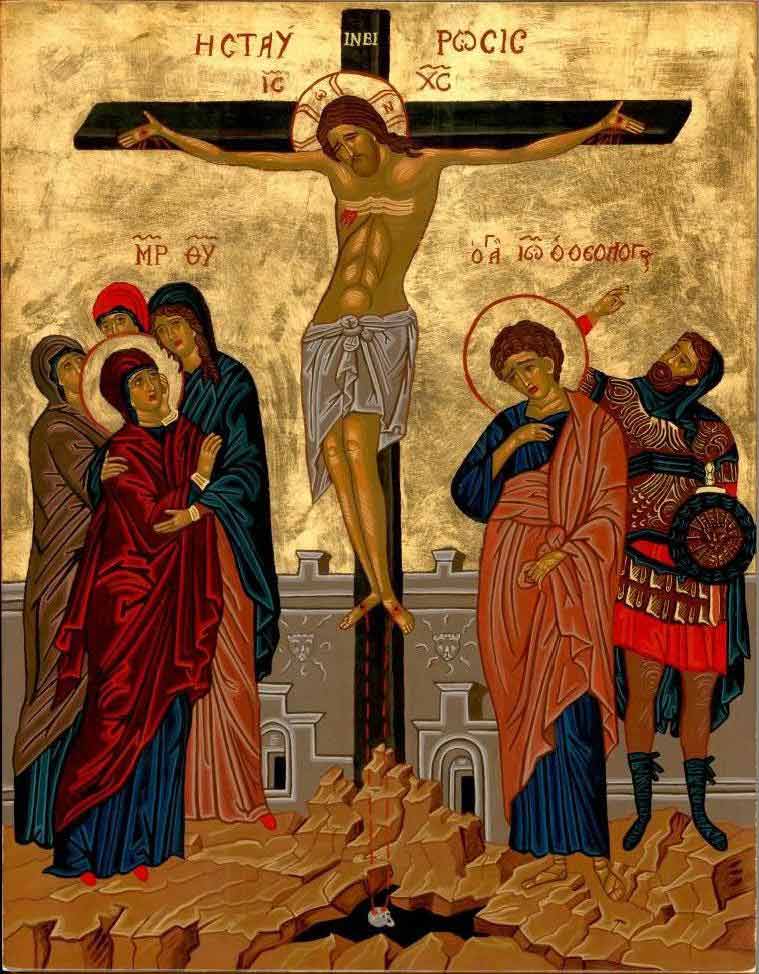
Last night Peter did not want Jesus to wash his feet. The disciple could not understand what was happening. He protested his teacher’s lesson of service saying, “You will never wash my feet!” Jesus replied, “Unless I wash you, you have no share with me.” Yet, this message did not just pertain to the moment when Jesus knelt down at his disciples’ feet. We are now at the feet of Jesus who hangs upon the Cross and we must receive another washing, but this one is not so peaceful or placid.

Jesus did not endure the shame of the Cross because of human failure. This moment when we see the worst in humanity simultaneously serves as the instant when we see just how profoundly God loves us. If we are not willing to gaze upon the Cross, if we cannot see the pain that the Body of Christ still endures today, if we do not see past our own failures to the self-emptying love of this moment, then we are not actually Easter people at all. Unless Jesus washes us with his blood we have no share with him.

This day Jesus shows us the extent of God’s love. When asked by Pilate, “What is truth?” His response as the Word of God is not with mere words, but with the fullest act of self-sacrificing love ever witnessed. What is truth? The Truth is Jesus. And the Truth is if we want to be Easter people, then we have to receive the love of Jesus now at the foot of the Cross.

Jesus willingly drank the cup given to him, he willingly took the load of our failings on his back, and he willingly laid down his life on the Cross. If we receive this love of Jesus, then we too are able to love Jesus as he loved us, not just when things are good, not just on shiny, happy mornings, but when everywhere we look we see the Cross. We are Easter people, but first must be Good Friday people. Unless we are washed by Jesus by his blood we have no share with him in his Resurrection.


Wednesday, April 1, 2015

The Only Time I Want To Finish Second

Who are you following? (Picture courtesy of Bondiband)

During this Holy Week we have been wandering together as we follow Jesus and pondering together what does it mean to follow Jesus to the Cross?

I feel the need to confess something that may not seem all that sinful to you: I do not like to lose. I never have liked losing. My family knows this. My friends know this. Maybe even some of you know this. Certainly no one likes to lose, but I actively avoid it almost to the point that I have a diagnosable phobia of losing.

Lately though I have been actively trying to push myself to the point of losing. Not just to get over my fear of it, but also because by actually avoiding challenges in which I might fail my gifts and skills atrophy away. Plus, I will never learn how good I might be at something I am afraid to try because I might lose at it. This reminds me of one experience in which failing brought new insight and new growth in my life.

When I was in college I switched from being a life-long soccer player to a first-time track and cross-country runner. I was terrible. Not just bad, but awful. I was the last placed runner for most of the first track season I ran. In the slowest heat of the 800 meter or 1500 meter race I was often a distant last placed finisher too. For some reason though instead of quitting I kept with it.

Eventually I learned to push through what I perceived were my barriers and with the encouragement, advice, and pacing of others I actually turned out to be an okay student-athlete. Yet, what I learned in this endeavor of failing over and over again was not so much my strengths or my weaknesses, but rather the truth from the letter to the Hebrews we heard today.

“Since we are surrounded by so great a cloud of witnesses, let us also lay aside every weight and the sin that clings so closely, and let us run with perseverance the race that is set before us, looking to Jesus the pioneer and perfecter of our faith, who for the sake of the joy that was set before him endured the cross, disregarding its shame, and has taken his seat at the right hand of the throne of God.”

Running a race with perseverance requires some skills, good training, and sound advice. And yet, some more pertinent pieces, albeit less catchy ones, from the author of the letter to the Hebrews get overlooked. First, we are surrounded by a cloud of witnesses. We have help in this race that we call life. People who have gone before us and those alive now can give us aid in this journey.

Next, to run a race with a weight tied to your ankle or strapped to your chest sounds torturous. On this journey of following Jesus lay aside the burden of sin that we so often carry around our necks. In this vein, do not think about the past times of failure either. They have brought you to this very moment.

Finally, and most importantly, you are not running this race without someone who is pacing you, someone who is blocking the wind for you, someone who has run the race before you. Jesus is the pioneer and perfecter of this journey that is our race. Somehow I often overlook the leader who goes before me, instead focusing on how I might fail.

In today’s Gospel story from John, Jesus goes before us in a very direct way. In the synoptic gospels we find Judas to be a traitor who seeks only more money. Yet, here we find that Jesus tells Judas what to do. Even in how he was handed over to torture and death the Son of God remained aware and in control of the race he was running.

We cannot control all things. However, we do have the power to control our interior spiritual life, the thoughts to which we give energy, and the feelings which ebb and flow our mood. Jesus did not let the shame of the Cross destroy him. He knew guilt lay with others and that he was God’s Son worthy of praise and devotion not riotous murder. We too are called to cast aside the shame of whatever it is that haunts us, whether it is the irrational fear of losing, the pain of a bad decision, or something else that clings to us. Within us we have inherit worth for we too are children of God adopted through the all-encompassing love of Christ.

This section of the race brings us every closer to our yearly remembrance of Jesus’ death. Run it with perseverance, or better yet slow down to walk the way of the Cross. For we have been given a perfect pace-setter to follow. And for me, trailing after Jesus might be the only time when I want to follow finishing second instead of leading.