Sunday, March 8, 2020

The Sun Was Rising

Nicodemus came to Jesus by night, but when did he leave?
© Seth Olson 2014, 2020
March 8, 2020—The Second Sunday of Lent

Nicodemus couldn’t sleep again. The all too familiar feeling of anxiety ravaged through his stomach, like monstrous, marauding butterflies. His wife, Rachel, lay beside him in their king-size bed. She could sense his worry; it made her uneasy too. As she drifted off into a troubled sleep, Nicodemus simply starred at the ceiling. The mortgage, the bills, the children’s education, it all added up. These problems alone though did not keep this religious leader from resting peacefully. No, something else was the matter. By morning he would have all the covers wrapped around himself, like some sort of cocoon of fear, yet for Nicodemus that night there was no metamorphosis, no change, no growth. The only butterflies were in his gut.

He left the covers behind before the sun left the cover of the night. Standing in the pre-dawn half-light, he could see the dark circles around his eyes. They grew ever more visible each day in the mirror. Seeing Rachel resting peacefully in the reflection, Nicodemus remembered the pledges he made to her on their wedding night. Promises of trips to the Mediterranean, family vacations, and putting his time in early, so that he could retire at reasonable age, and they could enjoy their golden years together. These hopes vanished, as his focus returned to his rapidly aging face. Looking into his own eyes, he recognized an emptiness.

Following every word of the Law, working harder than every other Pharisee, arriving earlier and leaving later, these were the rules Nicodemus lived by, but still he felt hollow. Like a wineskin with no wine or an inn with no visitors, Nicodemus’ soul felt empty and vacant. Kissing Rachel and his children goodbye, Nicodemus started hurriedly to the Temple to lead morning prayers, as the sun hurried to the horizon. If he felt any peace embracing his family, it vanished, as he stepped out into the street. His thoughts turned to the upcoming Passover festivities, and that morning’s meeting of the Sanhedrin, the religious council.

In a stuffy room with many leather-bound books of the Law and the Prophets, the Sanhedrin members gathered. This council dispatched with old business quickly, then an elder member brought up a touchy, new subject. His calculating words cut through the stale air of conference room B, like a snake darting through withered grass. “What are we to do about this upstart teacher from Galilee?” the man asked. Then continuing without pause enough for a reply, he hissed, “He is gaining followers, you know, disciples even! My sources tell me that he has performed some mighty signs, even turning water into wine at a wedding.”

Another voice emerged, “Where is he now?” The elder Pharisee replied, “Capernaum with his family.” Nicodemus, intrigued by the miraculous deeds and exhausted from his insomnia, forgot himself and excitedly piped up, “Do you think he’ll come to Passover?” Before he could even finish his sentence, Nicodemus knew that the emotions worn on his decorated sleeve had given away his giddiness. In his desperation, Nicodemus secretly hoped he’d meet this itinerant miracle worker.

The elder Pharisee looked down at Nicodemus and snarled. Another leader with long fringes and broad phylacteries questioned, “Why does it matter if this man shows up?” he interrogated, “Nicodemus, why do you care?” A pragmatic voice cut off the questioning to get back to business, “This week, we need extra security at the Temple to prepare for this man… What is his name again?” The elder Pharisee replied disgustedly, “Jesus.”

Although Passover begins at sundown, Nicodemus left long before sunrise on the first day of the festivity. As he made his way to the Temple, he thought, “Maybe, just maybe, God will show me a sign today,” and in this moment of hope, the tension within him released.

Suddenly, right as he entered the Temple gates he heard shouting, then the crack of a whip, sprinting to see what was happening Nicodemus saw a rough looking man. He was driving out the merchants who were selling cattle, sheep, and doves, and the money changers seated at their tables. As the vendors scattered in all directions, the unkempt man flipped over their tables and proclaimed, “Take these things out of here! Stop making my Father’s house a marketplace!” Nicodemus wondered who this man was, was this Jesus, and a verse from Scripture arose, “Zeal for your house will consume me.” Other Pharisees just arriving began to question this man’s motives, but Nicodemus just wanted to know, “When can I meet him?”

Several Pharisees, seething at Jesus’ irreligious behavior and his disrespect for their Tradition, watched him carefully for a mistake. Nicodemus, on the other hand, looked on with eager anticipation, hoping for another sign. Secretly following Jesus around, he watched from a distance as Jesus healed a man blind since birth. It was then, that Nicodemus made up his mind, he would risk his status within the Sanhedrin, so that he could meet with Jesus.

The night Passover was finishing, Nicodemus told his wife he was going to seek out a mighty healer, in hopes of a sign that might fill the emptiness within him. Rachel urged her husband to find healing. Then, Nicodemus pulled his cloak over his head and hurried through the streets to the outskirts of Jerusalem.

He had used the Sanhedrin’s intelligence network to discover where Jesus was staying. After mistakenly waking a few neighbors in search of Jesus’ exact location, Nicodemus eventually found the right house. When he knocked on the door quietly, two of Jesus’ disciples, Simon-Peter and Andrew, came to the door. Nicodemus asked if he could speak to their teacher. Welcoming the guest inside, Simon-Peter went back to sleep. Andrew went to wake their teacher. Soon, Jesus emerged silently from his sleeping quarters, lit a candle, poured some wine for his guest, and offered Nicodemus some of the remaining Passover feast.

Speechless, Nicodemus could not initially reply to the hospitality. Only long ago when, as a child he had traveled to Temple for high holy days with his family had Nicodemus felt such a rush of spiritual energy. Jesus’ eyes beamed in the candlelight and Nicodemus could tell that when Jesus looked at him he was looking deep within his soul.

Anxiously, Nicodemus tried to cue up the questions that he had prepared, but he blabbered out instead, “Teacher, uh… we know that you are a… uh teacher who has come from God; for no one can do these… eh, signs that you do apart from the presence of… um God.” Before he could continue, Jesus swiftly replied, “Very truly, I tell you, no one can see the kingdom of God without being born from above.”

Confused and wearied by his many sleepless nights, Nicodemus’ legal and literal mind churned out a logical question, “How can anyone be born after having grown old? Can one enter a second time into the mother’s womb and be born?”

Wiping some sleep from his eyes, Jesus attempted to broaden Nicodemus’ horizons, “Very truly, I tell you, no one can enter the kingdom of God without being born of water and Spirit. What is born of the flesh is flesh, and what is born of the Spirit is spirit. Do not be astonished that I said to you, ‘You must be born from above.’ The wind blows where it chooses, and you hear the sound of it, but you do not know where it comes from or where it goes. So it is with everyone who is born of the Spirit.”

Perplexed even more now, Nicodemus’ head was swimming in a vast ocean of questions, helplessly grasping for something to keep him afloat, he wondered, “How can these things be?”

With a smirk, Jesus replied, “Are you a teacher of Israel, and yet you do not understand these things? Very truly, I tell you, we speak of what we know, we testify to what we’ve seen; yet you Pharisees do not receive our testimony. If I have told you about earthly things and you do not believe, how can you believe if I tell you about heavenly things? No one has ascended into heaven except the one who descended from heaven, the Son of Man. And just as Moses lifted up the serpent in the wilderness, so must the Son of Man be lifted up, that whoever believes in him may have eternal life.”

Nicodemus still reeling from how one can be born of the Spirit, could barely keep up with Jesus now. His mind was sprinting just to keep up with Jesus’ strolling pace. Nicodemus thought, “I am just here to understand the signs.” But amid this swirling sea of wonder, confusion, and mystery, Nicodemus realized that his heart felt alive and his spirit felt awake for the first time in years. Cutting through the questions, the literalism, and the legalism, Jesus spoke words that would be forever ringing in Nicodemus’ soul:

“For God so loved the world that he gave his only Son, so that everyone who believes in him may not perish but may have eternal life. Indeed, God did not send the Son into the world to condemn the world, but in order that the world might be saved through him.”

Jesus continued talking shifting his focus now more pointedly toward those whose hearts and minds and souls remained closed—closed to this radical truth that God’s Son had indeed come into the world. “This is the judgment, that the light has come into the world, and people loved darkness rather than light because their deeds were evil. For all who do evil hate the light and do not come to the light, so that their deeds may not be exposed.” Nicodemus wondered if Jesus was talking about his sneaking around to find Jesus that night. As Jesus caught his attention, starring Nicodemus right in the eye, the upstart teacher said, “But those who do what is true come to the light, so that it may be clearly seen that their deeds have been done in God.”

Upon hearing this challenge, Nicodemus finished the cup before him, his soul felt full for the first time in years. Thanking his hosts, he silently departed. As he left Jesus, the sun was rising.

Sunday, February 16, 2020

Who’s Steering?

Some life lessons are more painful to learn, like not doing too many things at once on a bicycle.

© Seth Olson 2020
February 16, 2020—The Sixth Sunday after the Epiphany

When I was a junior in college my dad offered to buy me a new car. It was generous of him, but I responded with a counter-proposal. Buy me a new bicycle instead. Sounds crazy, right? Who passes up a car for a bike? My reasoning was that my college’s campus was much easier to navigate on two wheels rather than on four. What I did not realize when getting this bicycle though was all the valuable life lessons I would soon learn riding it.

The first lesson? On a bicycle one can only do a certain amount of activities at one time. How did I learn this? One afternoon, as I was excitedly riding to track practice, I tried to take off my sweatshirt, take a sip from my water bottle, and hop a curb all at the same time. This proved to be a bit too much. When it came time to pop up on the curb instead I went flying over my handlebars. That moment is clearly etched in my memory—and the scars from that accident are clearly etched under my right eye. A friend was standing on the sidewalk nearby. I still recall his horrified face, snarling as I crashed onto the pavement face first. He ran inside to tell my track coach that I was probably unconscious or maybe dead. An Emergency Room visit and 25 stitches later I learned a valuable lesson: don’t do too much at one time, or as Jesus might say, “There is need of only one thing.”

Another piece of wisdom I learned on that bicycle happened just a few weeks later. I was hurrying to breakfast before class, when I tried to take a turn too aggressively. As usual it was foggy and misting in Sewanee where I went to school, and my tires slid sideways on some slick sandstone. Again, I found myself headed to the ER. This time it was my lower leg that required stitches with 4 deep incisions made from the teeth of the chainwheel cutting into me. By this point, my father began questioning whether he should have purchased this bicycle for me. 2 ER trips in one month, maybe a car would have been a cheaper gift? The second valuable lesson: One cannot steal time. Or as it says in Proverbs, “Ignorant zeal is worthless, haste makes waste.”

The third lesson I learned on that bicycle came years later. After graduating from Sewanee, I had the privilege of living and working there for three more years. During that time I rode my bike even more. My roommate worked in the local bike shop and some weeks we traveled more than 100 miles together. One day we were descending down Highway 41 from Sewanee towards a little town called Cowan. In the early morning we rode through a slight fog just as the sun was rising. There was just enough light to see a piece of debris in the road. As I zoomed closer and closer to the object I found that my path was completely locked onto the thing in the road. At the last second, I clumsily swerved out of the way, barely keeping my balance.

My friend noticed my awkward darting, dodging maneuver. When we finished the descent and were calmly pedaling down a valley road, he asked, “What happened?” I told him that I was so locked onto the object in the road that I barely missed it and almost crashed getting out of the way. He told me, “You can’t focus on where you don’t want to go. Your hands and your bike will follow your eyes. If you look at a pothole you will steer towards the pothole. If you steer towards the clear path, then that’s where you’ll go.” This was the third, and perhaps most enlightening lesson I learned on that bicycle. And, Jesus has a lot to say about this lesson too, especially in today’s Gospel text.

In this passage from the Gospel according to Matthew, we observe Jesus talking about several places where we are not to steer. What are the objects for us to dodge along the way? Not only murder, adultery, and swearing falsely, but also anger, name-calling, lusting, lying, and swearing by anything at all. Some of the language Jesus utilized makes it sound like he was trying to scare his audience into doing what is “right.” But, Jesus wasn’t saying we must miss all these obstacles or else we will be steering our lives into hell. Instead in this passage, Jesus revealed that our actions follow our intentions.

In other words, steer towards where you want to go—not where you don’t want to go. Jesus urged us to understand that our intentions inextricably link with our actions. Perhaps, in the bicycling analogy, it’s more apt to call murder, adultery, and lying the ravines off the side of the road rather than the tiny pebbles along the way, regardless our intentions are the eyes that direct us toward our destination—whether it be healthy, unhealthy, or somewhere in between.

This is why Christ Jesus said it’s not good enough not to murder, we are not to become angry with our neighbor. Because our anger towards another has the potential to dehumanize and destroy relationships. It’s not good enough not to commit adultery, we are not to lust after our neighbor. For our lust towards others objectifies them and distorts relationships. It’s not good enough to avoid swearing falsely, we are to let our yes be yes and our no be no. Because any exaggeration of the truth destroys trust and makes honest relationship impossible. And, I believe these intentions exist as the highest goals for us as individuals and as a community. We are to aim our lives toward them, as we follow Our Lord. But… 

What happens when we do become angry with our neighbor? Are we to ignore it bottling up the rage? What happens when we lust after someone, or someone’s car, house, job, or life? Are we to just ignore it hoping it magically goes away? What happens when we lie, swearing by something or someone? Is it good enough for us to just pretend like it never happened?

No! Of course not. But herein lies the challenge of this passage, Jesus provided for us targets impossibly difficult to hit—establishing that it is no longer good enough for us to keep ourselves from killing or committing adultery or swearing falsely by God’s name. Instead, the path has become much narrower. So what do we do?

I love the image of our aim affecting our steering. I love the comparison to the bicyclist’s hands guiding where she goes. I love the analogy of aiming toward the place where we want to go, not the place where we do not want to go. But, still there are moments when we will go the wrong way—intentionally or unintentionally, through thoughts, words, and deeds, things done and left undone. And, the question is what do we do then? It’s pretty easy actually. We turn around.

Jesus lets us know that we are called to immediately turn around to reconcile with our neighbors. To seek repentance even before bringing in someone else. We can wonder, what about when that doesn’t work? What if the crime is too grave? Or what if we are too scared?

Oftentimes we psych ourselves out. We start to believe sin is some particular action that is on a list somewhere that Jesus wrote down for us. “Don’t do these things” it says at the top of the page. However, sin is not a particular act, but whatever causes separation between God and ourselves, between our neighbors and us. We all sin. We all steer to the wrong spot. We all aim at the wrong thing. We all make mistakes. But more than some list of things that we aren’t to do, sins are the ways in which we distort our relationships with God, with Creation, and with one another. Whatever sins we commit cause separation. If that sin consumes us, it can distort who we are, and we can believe that we are separated from God. This sounds scary. It feels scary. Because it is scary. Yet, it is not the truth.

The truth is that even though our sins and wrong intentions create a sense of separation between us and God, there is nothing—absolutely nothing—that can cause God not to love us. When we recognize this reality—that God loves us unconditionally, eternally, limitlessly—then we can see with new eyes who’s steering us on our lifelong journey.

When we invite God to guide our lives, then we can begin to see where the distortion and separation exist within us, which sounds like a good Lenten practice if you are looking for one. God will remove those parts from us, like Jesus invited his audience to proverbially cut those parts off in today’s Gospel. There is no way to completely avoid potholes, debris, and even the ditch on this side of the road. They all come with the journey. And, yes we probably crash or go the wrong way. But, as we bring our wills in line with Christ’s own, we realize the journey is not about keeping from crashing, going the “right” way, or even getting to the destination. No, our journeys are about inviting Christ to be with us every mile we travel. Keep pedaling and let Jesus steer. Amen.

Sunday, January 26, 2020

Follow Me

Do we associate "Follow Me" with Jesus or Social Media?
© Seth Olson 2020
January 26, 2020—The Third Sunday after the Epiphany

Isaiah 9:1-4
Psalm 27:1, 5-13
“Follow me,” doesn’t mean what it once did. Our incessant connection to social media has changed what we mean by “following” someone. No longer do we most closely relate this phrase to what Jesus said in this Gospel text from long ago. Now following refers to keeping up with family, friends, and neighbors; movie stars, celebrities, and sports teams; politicians, organizations, and world leaders. Some other media platforms even use this term to refer to keeping up to date with TV series, blog posts, and podcasts. Nowadays, the way people move from being acquaintances to being friends has everything to do with who and what we follow. So, who do you follow?

No, I don’t need to know your favorite celebrity pet on Instagram or the obscure British TV series you cannot get enough of, or the crazy uncle you recently un-followed on Facebook. What I really want to know is despite social and other media’s commandeering of the term, who do you really follow? Not on Twitter, but IRL—In Real Life.

Several years back someone much wiser than me wrote something about following that bears repeating. Richard Rohr, who is a Franciscan friar, a priest, and a writer, challenged readers to realize that Jesus never said, “worship me.” Instead Jesus repeatedly invited others, saying, “Follow me.” Presiding Bishop Curry (not to be confused with Bishop-Elect Curry) called Episcopal Church leadership to realize that the real action doesn’t just happen in our liturgy. Rather our true service begins at the end of this service.[1] We are to follow Christ out into the world—to do the work God has given us to do, to go in peace to love and serve the Lord.

To be clear, I am not suggesting we do away with our Sunday service. I would be lost without our worship, without the Church’s hymns and our prayers, God’s Word and our beliefs, confession and pardon, peace and Communion. It doesn’t get any better than this! However, we would be wise to remember that the root of the word worship is connected to worth. Or to make it into a question, “to what do we give worth in this world?” In this inquiry we hear resonances of my previous one—Who do you follow? Who do you follow and to what do you give worth in this world?

We can all give the Sunday School answer, on the count of three. 1-2-3… JESUS! I would guess that like me, everyone here wants to follow Jesus. That’s presumably why you are here. We all yearn to live life in Christ. Each of us desires to be one of his disciples. But in our world full of distraction and noise and brokenness, it can be difficult to discern what Jesus’ voice sounds like. We may aim to follow Jesus. We may seek to give Him worth, but how do we walk in His ways?

Before charting our own course or reinventing the wheel, it’s useful to look at how others accomplished what we hope to do. The soon-to-be-disciples from today’s Gospel lesson clearly heard Jesus and they followed him. Seems like a good spot for us to start.

Jesus in flesh and blood, went to Capernaum, walked up to some boats, and invited two sets of brothers to abandon their lives as fishermen. Sounds like a tall order, but they dropped their nets immediately! Jesus did this by saying, “Follow me, and I will make you fish for people.” This sounds so ridiculous that we may wonder if it truly happened. Would you leave everything if a stranger invited you to follow?

Jesus though offered up a vision that these brothers could easily understand. He didn’t say to these fishermen follow me and I will make you farm for people. Jesus knew to whom he was speaking and what these brothers spent their lives doing. You might be wondering, “What about with us?”

How will God call us? We say: “I want to follow God, but how will I hear God’s voice and how will I know to follow Jesus?” God calling you and me and us is not as preposterous as it sounds. Hearing God speak doesn’t only happen in extraordinary ways, like Moses hearing a voice in a burning bush or Martin Luther meeting God in a lightning storm. God speaks in our daily lives—right where we are—like with these fishermen. God may not appear to us as a 1st century Palestinian Jewish teacher—he may—but more than likely, Our Savior will come disguised as something or someone so obvious that we find God is hiding right in front of us—hiding right within us.

The writer Parker Palmer put it this way, “Vocation [or God’s call] does not come from a voice ‘out there’ calling me to become something I am not. It comes from a voice ‘in here’ calling me to be the person I was born to be, to fulfill the original selfhood given me at birth by God.”[2] God’s voice calls us to be who we truly are—to be the person God made us to be. Family, friends, and our church help us to clarify God’s call by listening with us and testing this truth within a beloved community. But, what does this look like in action? If only there were a recent event in our community, maybe like a bishop election, where we could see God’s call in action...

Wow, as usual God provides! For one of us this call has been a slow and steadily increasing persuasion. A persuasion to pastor our diocese, administer its staff, be a messenger of God’s Good News, to lead our church, and defend our faith… sounds easy enough, right Bishop-elect? One is not merely called to be a bishop, there’s too much there. One must be persuaded to heed God’s call.

At the risk of speaking for everyone here, we all share in the joy of this call for it is indeed our collective call for Glenda to serve as our bishop in this part of the Jesus Movement. You may be here this morning seeking to Follow Jesus because you heard Glenda say, “I hope to see you at Church.” This is one way that God’s call rings out in this time and place, but vocation is not something reserved for people who wear purple shirts.

On Thursday evening we celebrated the life of Doug Barnes. A member of the Homewood community whom I did not get to know well—except by the imprint he left behind here. Charles Youngson described Doug as a non-anxious presence, as one who was completely here, like there was no other place to be. Doug heard God’s call as an invitation to be. Moses knew God as “I am” and Doug made the “Great I Am” known by being fully present with us.

There are other ways in which you might hear God beckoning you to follow. You may hear Jesus asking you to be a voice for the voiceless, to serve the least of these, or to visit those in prison. You may be called to attend Cursillo or Kairos, to help lead our children or youth, or to join the many outreach and in-reach ministries here. Your call may mean a new career, a new ministry, or maybe simply a new way of looking at what is already here. Regardless of what it sounds like, each of us is called by God.

I would like to end by sharing the story of when I heard Jesus say, “Follow me.” And, I invite you to share with each other and with me how you have been and still are being called ... because in our personal callings we hear more clearly how God is calling us collectively to follow Jesus.

As a child and adolescent, people told me I would make a good priest. I didn’t buy it! The old matriarch of my childhood church said it, my family said it, and complete strangers even said it. I had some inkling of this calling because I was the kid who followed around his priest for career day. But, I tried to fight it! I even flat out told Bishop Marc Andrus, “No!” when he tried to get me in the discernment process during college. Like Parker Palmer’s quote, I had to realize the call within me not just out there, but in here!

The summer after I graduated college at Sewanee I was hired there to be the Lay Chaplain. For three years I had the gift of trying on church ministry—I could see if the call was in me. To mark that time as holy I decided to renew my baptismal vows. I had been baptized as an infant, which I don’t remember, and confirmed in the awkward years of middle school, which I try to forget, so this was the moment when I would truly take hold of my own mature relationship with God.

After months of preparation, the big day finally arrived. At the Great Vigil of Easter we entered a completely dark chapel that eventually beamed with the brightness of the Light of Christ. The baptisms, confirmations, receptions, and reaffirmations of baptismal vows were beautiful and transformative. I was floating on a liturgical high known only to a certain few, known as church nerds. The service then turned towards communion.

That night I had the pleasure of serving chalice. Standing on the nave altar platform I received the bread and wine, the body and blood. Then, I approached the altar to pick up the Schwartz Chalice, a giant fishbowl-sized silver cup. At the same time the congregation came up to gather around the large altar platform. I took the chalice to commune the first person. Who was kneeling there? My very first priest, Fr. Francis X. Walter and his wife Faye.

In that moment I was happy to see them. But, as I lifted the giant silver chalice back I caught a glimpse of some heavenly vision. There, in the reflection of that cup, I saw the Great Cloud of Witnesses. It still sounds crazy, but in that moment I saw not only those kneeling or standing there at the altar, but also too many to number, to name, or to know.

I nearly fell down. And, for a long time I did not want to talk about that night because it just didn’t make any sense. But, what I kept coming back to was that all of us make up the Body of Christ—we are all united by Christ’s blood under his covenant of love. That night, when Jesus said, “Follow me” the path led to gathering God’s people around God’s Table.

What is your call? What is our call? Jesus says, “Follow me.”—not only to this table, but beyond. May we take this table and its gifts out into the world—following Jesus and fishing for people. Amen.


[1] Matthew Oliver, “Worship or Works? Engaging Michael Curry and Richard Rohr” The Living Church. https://livingchurch.org/covenant/2016/12/14/worship-or-works-engaging-michael-curry-and-richard-rohr/ [Written: December 14, 2016, Accessed January 23, 2020].
[2] Parker Palmer, Let Your Life Speak. (San Francisco: Jossey-Bass, 2000), 10.

Wednesday, January 15, 2020

New Year, New You?

Aslan the Lion un-dragons Eustace Scrubb

A version of this post appeared in the All Saints Parishioner the week of January 12th

Happy New Year! And, Happy New Decade! In the world around us, this means not only celebrations, but also invitations. These invites coming from gyms, financial planners, diet programs, home improvement stores, and many others essentially say: “It’s a new year and a new decade, so it’s time for a new you!” Not to burst your bubble, but I have bad news (I also have good news, so hang with me).

Every year, when marketing experts roll out ads for a new you in the new year, they are relying on a big, little lie we tell ourselves: "I can make myself new." On the surface, this statement sounds appealing. Having a new start is awesome, and we are all about new starts in the Jesus Movement. But, the trouble comes from believing we are the source of accomplishing this newness. Here's the bad news: we aren’t the ones who make life new. There is good news though...

In the crazy, mystical vision that John the Gospel Writer had on the island of Patmos, God spoke about newness. The Almighty One said, “See, I am making all things new” (Revelation 21:5). This is the good news! For God not only makes us in our individual lives new, but God also makes everything, everywhere new. So, you may be wondering, “We don’t have any part in this?” Well, we do and we don’t. Let me retell a story to help explain.

In C. S. Lewis’ fictional tale, The Voyage of the Dawn Treader, a character named Eustace became a dragon by watching another dragon die and sleeping “on a dragon’s hoard with greedy, dragonish thoughts in his heart." We might think that being a dragon would be awesome, but several days later, Eustace was miserable. He wanted nothing more than to be made a boy again.

Late one night, a lion met Eustace the dragon, and told him to follow him up a high mountain where there was a giant well. Eustace yearned to plunge into the bubbling waters; however, he couldn't as a dragon. The lion told him he must undress first. What did this mean? Eustace had to shed his skin, like a snake. So Eustace tried as best he could to un-dragon himself by peeling away his scales. After three attempts, he saw in the water’s reflection that he was very much still a dragon.

It was then that the lion told Eustace that he could not shed his skin on his own—the lion had to help. So, Eustace lay on his back, and when the lion’s claws cut through his dragon scales, Eustace thought the lion had gone right to his heart. While it was the most painful thing Eustace had ever experienced, having the scales and skin fall away was the greatest pleasure too. All of a sudden, Eustace was a boy again. Then, the lion grabbed hold of Eustace and threw him into the restoring waters. There he was made new.

This lion’s name, as you may already know, is Aslan, and in this series, he represents Christ. Sadly enough, we are represented by characters like Eustace (perhaps that’s the real, bad news). Try as we might, we can shed layers of our skin, but we cannot un-dragon ourselves. That work of being made new must be done by God. How does this happen?

While none of us will turn into an actual dragon, all of us may become quite beastly and yearn for nothing more than to be made new by becoming our truest selves. Fortunately, we have a loving lion who comes to us. A lion who will tear right to our hearts to transform us into who we truly are.

We find that lion all over the place at All Saints. We see Him in the pews on Sundays and Wednesday mornings. There, we have opportunities to be made new by meeting Christ in the Word and in the prayers, in the songs and in the silence, in the confession and in the absolution, in the peace and in the offertory, in the bread and in the wine. Throughout All Saints, you will find other ways to be made new with, between, and through one another. Whether it is during a Taize service, an Oasis program, or a Sunday School class; going to Cursillo, volunteering to serve, or joining the Church through Episcopal 101, there are many ways that our lion-hearted God is inviting us to the well. 

How will Christ un-dragon you revealing your new, true self this year?

Sunday, January 5, 2020

What We Have To Give

This corny cartoon isn't the only thing wrong with how we tell the story of the wise men, but what is the message of their coming truly about?

© Seth Olson 2020
January 5, 2020—The Second Sunday after Christmas

There once was an Episcopal priest from New England who was visiting his wife’s relatives in rural Mississippi. It was the week after Christmas. Driving through the town the priest from up north was happy to see a Nativity scene still up even though it was the eleventh day of Christmas. The care and attention put into this particular Nativity scene made it so beautiful that the priest decided to stop, get out of his car, and examine it more. (By the way, if you are wondering, this is the sort of dorky things that priests do while on vacation.)

Upon closer examination the priest was surprised—not because of the shining Angel Gabrielle, nor the placid Virgin Mary, nor the stalwart Joseph, nor even the calm baby Jesus—no, the priest was surprised to see the three wise men wearing firemen’s helmets. Baffled by the magi’s appearance, the priest walked into the church office. 

Once inside he introduced himself, and in his thick Boston area accent asked, “Why are the three wise men in your beautiful nativity scene wearing firemen’s helmets?” At this question, the church administrator became quite upset with the priest. Disappointed she exclaimed, “You Yankees! You never did read or understand the Holy Bible!”

After trying to explain that he was himself a minister, the woman at the desk started digging around her shelves. As she did the priest told her that no firemen appear in the Bible, but the administrator persisted and finally found a copy of the holy book. She frantically flipped through its pages. Turning to the appropriate chapter and verse, she pointed her index finger at the right passage, then pushed it into the priest’s face. “Look! It says it right there, ‘The three wise men came from afar…’ ”

(BOO!!! That’s a terrible joke!!! And a joke about fire at All Saints… come on!)

Even if I tried to give up dad jokes this New Year, it would be impossible. You can take the dad out of the dad joke but you cannot take the dad joke out of the dad. I apologize. While we have no confession at this service, I assure you I will certainly seek God’s forgiveness for putting you through that. Speaking of being put through things, how about these wise men?

They came from the East. They traveled across many different lands. They were guided not by a map, but by a star. They dealt with the terrible and violent King Herod. Finally, they found the Christ child. But, after giving him the gifts, they couldn’t even go home the same way because of Herod. So, what is this story truly about? 

Yes, the part of the magi is an awesome addition to the nativity pageant. Sure, the wise men coming from the East gives us an intriguing angle to the Christmas story. Of course, seeing their dutiful traveling to worship the Christ child inspires many a Christmas carol. However, the story of the magi is not simply something sentimental, rather it is a story that points us to the Epiphany when Christ was made known to the world and it is a story that challenges us to wonder, “What do we have to give to Christ?” Before exploring the Epiphany and what we might offer to Christ, let’s take a closer look at some of the often missed details of the Gospel story about the three kings. 

First, like the three firemen in the story earlier, there is no mention of three kings in the Holy Bible. What? GASP! The text never states that there are three visitors from the East. We interpret that there were that number because these foreigners brought three gifts—gold, frankincense, and myrrh. What about these gifts? 

The gifts of gold, frankincense, and myrrh weren't just random things these visitors brought. Gold represented a kingly gift, as Jesus is the true king, not only of the Jews but of Creation. Frankincense represented a spiritual gift, and it is still used as incense to symbolize our prayers and praises rising up to the throne of heaven (wherever it mystically resides). Myrrh was a stranger gift. It would have pointed to the sacrificial gift that Jesus the Christ would later give to us. Myrrh was used to anoint the dead, and so for poor Mary she might have already seen this bittersweet gift as a foreboding sign of the life her child would lead. So this is why we think there were three of them, but we do not know the actual number of visitors, we also do not know if they were kings. 

The text literally calls these visitors magicians. What? Again, GASP! Now, this is not like we are substituting a visit from Queen Elizabeth for Penn and Teller, or Prince William for David Blane. Modern-day illusionists are not the type of magician of which this text was speaking. Still, these visitors from the East were different. Some scholars believe they were not monotheistic, nor were they part of the People of God. The magi (short for magician, by the way) took their cues from the splendor of Creation rather than the rigors of the Law, the Wisdom, and the Prophets. They may have even initially been pagan… GASP, a third time! 

Sometimes we cringe or grimace when we hear the word pagan. Culturally we have been conditioned to link it to people who do not believe in God. People who are godless heathens who are out to destroy the good work being done by Christians. However, the whole point of the Epiphany is that Christ is made known not only to God’s Chosen People—the people of Israel—i.e. not us—but also to the whole world—i.e. that is us. So while they may or may not have been three in number, and they may or most likely were not kings, and they could or could not have been pagan, these visitors from the East still do point us toward the Epiphany, and what we might give to Christ.

The Epiphany is a celebration of Christ’s light, life, and love being manifested to all people in the whole world. So, it is no wonder that the Magi are the poster boys of this celebration. For, if pagan magicians from the East could observe a star at its rising, follow it for 1,000 miles, deal with a dubious politician all so that they might deliver gifts and pay homage to God incarnate, who just so happens to be an infant, then that means God is able to work on everyone, everywhere. 

So, this is the truth about the Epiphany, it is a season when we recognize God’s eternal, unconditional, and limitless love in Christ reaching to the ends of the earth. That is the epiphany that we want the whole world to have—the moment when everyone jumps up and down in their proverbial lab coats shouting, “Eureka, I’ve finally discovered it for myself. God’s grace has hit me! Now, I’ve got to share it!” And this gets us to what we have to give.

One of my favorite Christmas hymns is “In the Bleak Midwinter.” It’s last verse begins: 
What can I give him, poor as I am? 
If I were a shepherd, I would bring a lamb
If I were a wise man, I would do my part

I’ll finish the verse in a moment. What can we give Christ poor as we are? If we had been shepherds we would have brought our lambs for the young holy family to have. If we had been magicians from the East we would have brought gifts of gold, frankincense, and myrrh. If we had been Mary and Joseph we would have cared for the baby Jesus. However, we are not any of them. We might not be poor in worldly standards, but we are poor in opportunity to be with Jesus in the way the shepherds, the wise men, or Mary and Joseph were. We do not live 2,000 years ago. We cannot travel to Bethlehem to actually see the babe lying in the manger. We are us, right now, so what do we have to give?

The last line of “In the Bleak Midwinter” points us to a gift we do have to offer regardless of when or where we live. That line reads, “yet what I can I give him—give my heart.” That’s the gift we can give to Jesus, and it is the gift our entire being yearns to give. Christ Jesus is Emmanuel—God who is with us. We may not give gold, but we give worth to Christ who is our king. We may not burn frankincense here, but we offer up our prayers and praises to Christ who sits enthroned at the Father’s right hand. We might not bring myrrh, but we celebrate Jesus as the Savior who came to free us from our sins. And in these ways we give our gifts of praise and thanksgiving to Christ, we give our selves, our souls and bodies to borrow the words from our Rite I Eucharist.

So, as we celebrate this Epiphany story—a moment when God’s eternal, unconditional, and limitless love was manifested in all the whole world, may we also see the many opportunities we have to give our hearts again to Christ. Jesus laid down his life to show us what that sort of giving looks like. May we know that in Christ Jesus’ sacrifice on the cross we are loved infinitely by God. May we always and everywhere give our hearts to God as God does to us. And may we share that same self-giving love with the whole world. Amen.

Sunday, December 22, 2019

Little Moments: God Is With Us

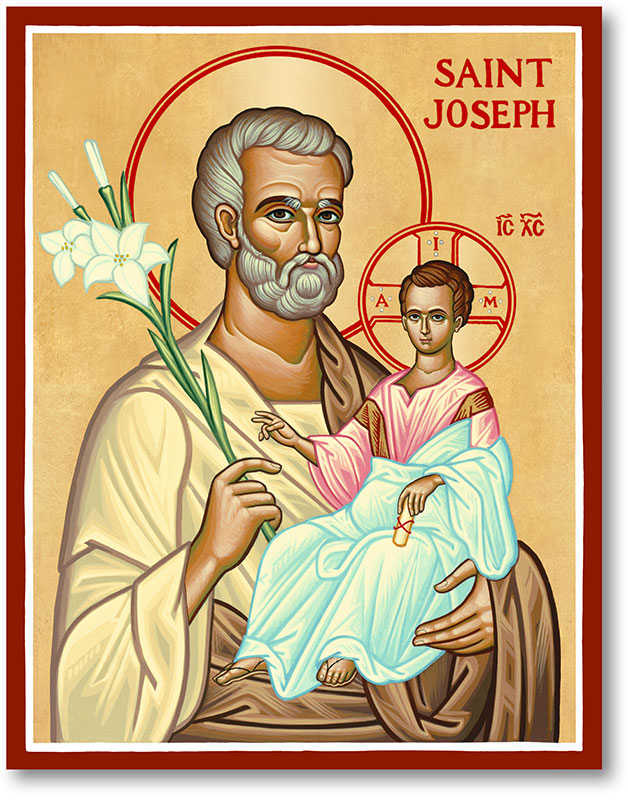
An Icon of St. Joseph holding the Christ Child


© Seth Olson 2019
December 22, 2019—The Fourth Sunday of Advent


It does not take much to change a life: A word softly spoken by a doctor. The welcome aboard email from a new company. A plummet in the market. The vibration of a phone on the night stand, and the 2 AM conversation that follows. A chance encounter. A smile. A friendly “hello.” Our lives can change in an instant. Whether we are ready for these changes—hoped for or dreaded, expected or out of the blue—whether we are ready for these changes is a completely different story. In these moments of upheaval, we are not alone though. We always have God. We have each other, of course. And, as evidenced in today’s Gospel lesson, we have the example of faithful ones who went before us, people like Joseph.

In the Church we talk a lot about Joseph’s wife Mary—and rightfully so! We sang a version of Mary’s words, “The Magnificat” during our Lessons and Carols service last Sunday. We heard part of her story then too. The angel Gabriel visited Mary announcing that she would bear the Son of God through the power of the Holy Spirit. The ability for this faithful person to say “YES!” to God even though it really complicated her life truly inspires us. Therefore, we remember Mary. We highly regard her as the God bearer or the theotokos and the Mother of God. Oftentimes though we overlook Mary’s husband.

However, today we recall the moment—or really moments—that changed Joseph’s life. In those days, betrothal was a big thing, a problematic thing too. Family elders would pull the strings of engagements—instead of the people actually involved in the relationships. There is no getting around the shameful truth that women were seen as property before they were seen as people. Being seen as such it would not have been surprising to pursue a harsh punishment, if say Joseph found out that Mary, his betrothed, was pregnant with another’s child. According to the Law, handed down from Deuteronomy, Joseph could have even had Mary stoned to death. However, that was not who Joseph was. He was a righteous man. Still his response to the news was not completely positive either.

Upon hearing that Mary was pregnant, Joseph planned to dismiss Mary quietly. Essentially he was going to null the marriage contract as privately as possible. We do not discover in Holy Scripture what the conversation was like when Mary told Joseph her news, or if she was the one to tell him at all. The news of a pregnancy is surprising enough. When Joseph discovered that Mary was pregnant with someone else’s baby, it was one of those life-changing moments. And, after regaining some composure—Joseph set about to null the marriage contract. Then, something else happened. Another—even more profound—existence-altering instants transpired.

While Joseph was sleeping, God contacted Joseph directly. To put it in a modern analogy God direct-messaged Joseph, the Lord DMed Joe which sounds like the plot to the CBS show, God Friended Me. In this vision from Matthew, God employed a messenger to change the course of Joseph’s life. The angel said, “Joseph, son of David, do not be afraid to take Mary as your wife, for the child conceived in her is from the Holy Spirit.”

Three things about this message from God. First, this messenger knew who Joseph was. Knew his story. Knew his people. Knew his lineage. God knew Joseph (and God knows us too). Second, the angel essentially said, “Joe, don’t panic. Keep calm and carry on.” This is, of course, easier said than done. However, when an angel says something those words carry more significance than a normal dream. Finally, the message to Joseph is as simple as it is clear—this is God’s child.

Let me pause here for just a moment. Imagine being in Joseph’s shoes—or sandals. You have just discovered that your betrothed is not pregnant with someone else’s child, but is pregnant with God’s child. Of course, there has to be some panic. Scratch that, there has to be some shock! “How can this be happening?” is the PG version of the question running through Joseph’s head. Still, he had to comprehend on some level, God chose this. Not only for Mary, but for Joseph as well. His part in this was massive. He had to be faithful, meaning, he had to trust God like Mary did. He had to say, “YES!” like Mary did.

Time-in! Joseph was then given a task by the angel. “You must name this child Jesus,” the messenger told him. This is the Greek translation of the Hebrew name, Joshua. What does Joshua mean? The angel said, “he will save his people from their sins.” Now, dear friend what you may not know is that right before this Gospel story for today began, Matthew opened his telling of the Good News with a list of names. Sounds pretty boring right? Sounds like these names have nothing to do with the name of Jesus? Well, these names trace backwards through generations of God’s People. Not all of them were commendable or even decent folks. Sure, some were, but none of them carried out what the angel is proposing here. Joseph’s soon-to-be-adopted son would save his people from their sins. Who are these people? Spoiler alert: the whole arc of the Good News of Christ expands this definition from God’s Chosen People of Israel to all peoples. This means Jesus saves us too.

Now Joseph awoke from his dream. Impressive, right? But then he did something more. He actually followed the instructions of the angel. Have you ever woken up from a dream and said, “Let’s live this thing out!”? I mean not the dream when you are paranoid because you forgot your clothes and now you are preaching a sermon in your pajamas… no, you haven’t all had that reoccurring dream?
Right, good me neither. Joseph’s dream though was not some random amalgamation of experiences his subconscious was still processing. No, it was, according to Matthew, a vision from God, a direct message from the Creator of the Universe. And because of this Joseph said yes. He took Mary as his wife, he supported her as she bore the child, and he named him Jesus.

So, all of this is beautiful, and perhaps it is even inspiring to us. Maybe we leave here thinking that when something tough is happening we can be faithful like Joseph. But, say we don’t have a vision from God? What if we aren’t as faithful as Joseph? Is there more that is actually going on here in this Christmas story? And yes, I know we are in Advent, but the Lectionary people let a Christmas story into our quiet season of preparation—make no mistake about it…Jesus is already born in this Gospel lesson!

Why this story of the incarnation matters to us though has everything to do with those little moments that change our lives—those instants when the proverbial toothpaste comes out of the tube and there is no way it’s going back inside. All of us more than likely will have a few of these moments in our lives—a proposal, a pregnancy test, a miscarriage, a birth, a divorce, a new job, a move, a retirement, a death, and so many others. In these moments, yes we have faithful examples. In these moments, yes we have each other. But most importantly, in these moments, we have God.

God is here. Not in some ethereal kind of way. No, God became incarnate. God became flesh and dwelt among us to peek ahead to John’s Christmas text. As Isaiah foretold and Matthew retold, “Look, the young maiden shall conceive and bear a son, and they shall name him Emmanuel,” which means “God is with us.” Now, Joseph named him what the angel told him to name him, not what scripture says; however, there’s a bigger picture being revealed here.

God is with us. Jesus was born. He breathed the air we breathe. He lived in the same world we live in. He cried as a baby—I don’t care what our Christmas hymns say—he was fully human and humans cry. He had human needs, he did human things, he ate, he drank, he danced, he laughed, he looked, he smelled, he tasted, he heard, and he felt. And in all of that in every bit of him being a human being he made every bit of our mundane, everyday life holy. Yes, all of it.

And what is more the one who was (and still is) Emmanuel—God is with us—had little moments that changed the course of his life. Whether in the synagogue the Temple, or the carpentry shop; on the road, at the market, or at home; on the shore, out at sea, or up a mountain, Jesus had life-changing moments too. So he made our existence-altering instants holy as well. Then, he took part in moments when he said or did something, or he was who he was and those moments changed other people’s lives too.

Jesus, the one who saves us from our sins, saves us still. Emmanuel, God who is with us, is with us not just in the Christmas card moments—when everything looks shiny and happy and bright. But, our God is with us in the messy moments, the life-changing ones, just like God was with Mary and Joseph, as they navigated the challenging circumstances of Jesus’ birth. God is with us in the little moments when our lives change forever because through the incarnation of Christ in the person of Jesus, God came to be with us at all times and in all places. So no matter what season of life we are in, no matter what little moment awaits us today, tomorrow, or in the future, may we trust God, like Mary and Joseph trusted God, for God is with us always. Amen.

Sunday, November 17, 2019

Do Not Be Weary

Whether you feel fine about the end of the world or not, Jesus encourages us that we are to endure even through the end. 

© Seth Olson 2019
November 17, 2019—The Twenty-Third Sunday after Pentecost—Proper 23 (Gospel Reflection Track)

Whenever I hear a Gospel lesson about the end times, like the one we heard just now, the lyrics of an “old” song come to mind:

“It’s the end of the world as we know it! 
It’s the end of the world as we know it! 
It’s the end of the world as we know it. 
And I feel fine…”

While these R.E.M. lyrics indicate how a famous rock group from Athens, Georgia feels relaxed about the dreadful portents of the mid-eighties, what about you? How do you feel about the end of the world as we know it? What do you think the disciples of Jesus thought about the end of the world? While we do not get any reaction in today’s Gospel story, I can imagine looks of terror from Peter, James, John, and others as Jesus told of false prophets, earthquakes, uprisings, persecution, and death!

Some call this passage the “Little Apocalypse,” and for good reason, right?! It sounds very much like the end times! And, when we read passages like this one with its deadly pestilences (to borrow some of the old King James’ language), we may wonder why we are reading this at all?
This week in the Men’s Bible Study on Wednesday morning someone asked just that, “Why is this passage one that the lectionary includes?” It’s a good question, and I didn’t have a good answer at the time. Today though, I want to answer that question by exploring this passage from three points of view: 1. the disciples', 2. Luke’s community's, and 3. our own. I want you to leave knowing what these words meant to these different groups and why this passage matters to us.

So first, what was Jesus saying to his disciples? To properly respond to this, we need a bit of context—especially what happened right before this story. After finally entering Jerusalem (remember Jesus had been making this journey for quite some time), Jesus with his disciples began observing what was happening at the Temple. Many rich people were giving out of their abundance, that is out of their excess. However, in the midst of all the commotion at the Temple, there came a widow who had next to nothing. And yet, she put in two of the only coins she had. She was willing to give not out of excess, nor what was left over, but out of her necessity she gave to God’s work in this world. That story blends seamlessly into today’s Gospel story when “some” (maybe disciples or perhaps others present) commented on the glory of the Temple.

It was as though what Jesus had just said about the widow’s giving went in one ear and out the other. For some said look how beautiful the stones were and what magnificent gifts had been given to the Temple. Jesus observing that a softer tactic had failed, used this moment to challenge his followers.
Now remember this group had been on a journey with Jesus as he healed people, taught the masses, and transformed lives. Through this Jesus’ path had always been meandering towards Jerusalem with betrayal, suffering, and eventually death functioning as the mile markers along the way. This journey would require Jesus’ life and he would freely give it, much like the widow freely gave all of herself over to God. When the disciples could not recognize the final destination of this journey, Jesus challenged them to see that the upcoming challenges (wars, famine, persecution) would serve as their own mile markers on the path of discipleship. What did today’s Gospel mean to Jesus’ disciples? This message was a challenge for the disciples to keep going and to keep the faith, for Christ would be enduring with them through the end.

Fast-forward about fifty-five years to the year 85 and many of these predictions from Jesus had come to pass. The Romans had destroyed the Temple in the year 70. As it fell, many teachers of the day preached wrongly that they were Jesus or falsely predicted his immediate return. In the larger context, Rome experienced upheaval as four Emperors ascended to rule the realm in quick succession right at the time Jerusalem was besieged. Some historians even described a constellation that resembled a sword and the coming of a comet right about the time that the Temple was overtaken.¹ All of these events would have influenced how Luke’s audience heard this story.

For those in the early Church living in the years soon after Jesus’ Ascension would have believed that Christ was coming back soon. He would quickly return to put all things right. However as the years went on, those hoping in God’s return must have felt a bit weary when it did not immediately happen. Like God’s People having to wander around for forty years in the wilderness, or like the ancient Isrealites hoping in the Messiah’s first coming, those in the early Church must have at some point grown tired of waiting. So, the meaning of Jesus’ message as told through the gospel writer Luke was to persevere.

Specifically Luke gave his community instructions on how to continue to share the Good News of Christ Jesus even during the most challenging and tumultuous days. When officials arrested Jesus’ followers they were to see it as an opportunity to share the story of Jesus. This was to happen not through prepared speeches, but by living in the present, trusting God to give wisdom and a word. They were to speak the truth even to those who set out to persecute them. Through Luke’s words, Jesus called these latter disciples to keep going, even if or when their family, friends, or the authorities turned against them. It was through these trials and having the patience to see them out that they would gain their souls.

To those who heard this Gospel around the year 85, this would have been the ultimate pep talk. As Christ’s message spread, those who were already undergoing suffering for their beliefs were surely yearning for inspiration to keep going. And, this may very well have been the meaning behind these words and why they were so important at the end of the First Century—inspiration! But, what about us? What do these words mean now? Why are we still reading this story almost two millennia later?

Whether you are R.E.M. singing about earthquakes, the Cold War, and the cruelty of life, or someone who observes dreadful portents in religion, in politics, in the environment, in the economy, or in everyday life, what Jesus said in this Gospel story isn’t going away. What I mean is that most of us at some point worry about “the end!” Religious extremists still shout in bullhorns that “The time is near!”. Wars, insurrections, national uprisings, and political unrest have become a part of our everyday lives. Earthquakes, hurricanes, tornadoes, fires, floods, famines, and plagues happen so regularly that news outlets cannot even cover all of them. With all of these terrifying signs as regular parts of our lives, we may wonder then what is Jesus trying to tell us?

Like with his own disciples and those who heard Luke’s words originally, Jesus challenges us who hear this Gospel now. Jesus says to us what he said to his first disciples. Keep going. Keep patience. When all of the world appears upside-down and falling apart around you keep the faith. Trust God. Don’t worry about a prepared statement or the perfect plan. Even if those closest to you turn against you because of the way you love like Jesus, keep on going. Keep on loving.

“By your endurance you will gain your souls.” These last words of this lesson do not quite get from the Greek to the English properly. Jesus did not exactly claim that endurance brings us into our souls. Rather he said that persevering in our souls—patiently and faithfully staying in relationship with Christ—gives us the endurance to make it to and through the end.

These are not empty words, nor did Jesus offer up an empty challenge. His statement is like what Barbara Brown Taylor once wrote about courage. To paraphrase her, we do not simply get courage. It’s not a transferable skill. Someone cannot simply will us to have bravery. Rather we must live through someone that makes us afraid to learn courage.² Likewise we learn faith, an enduring trust in God, not ahead of the challenges of our lives but in the challenges of our lives.

So patiently keep on trusting God! Do not grow weary of trusting God and doing what is right. Instead keep on loving God and loving your neighbor. And, as we continue on this journey with Jesus and fellow followers on the way, we will more fully awaken to the ultimate truth—God has loved our souls from the start and will love us in them through the end.

--------------------
1 Vernon K. Robbins "Luke 21:5-19" in Feasting on the Word, eds. David L. Bartlett and Barbara Brown Taylor (Louisville, KY: Westminter John Knox Press, 2010) 309-313.
2 Barbara Brown Taylor, Learning to Walk in the Dark, (San Francisco: Harper One, 2014).