Tuesday, June 7, 2016

Fortune Favors the Bold

This Sunday’s Collect reads:
Keep, O Lord, your household the Church in your steadfast faith and love that through your grace we may proclaim your truth with boldness, and minister your justice with compassion; for the sake of our Savior Jesus Christ, who lives and reigns with you and the Holy Spirit, one God, now and for ever. Amen (Book of Common Prayer, 230).

Several characteristics strike me when reading through this collect. First, this prayer begins slightly unusually with a plea to God to allow us in the state of faith and love. Could this be our natural state if we are asking God to keep us in this place? Second, the reason we would like to be steadfast in faith and love is that we would like, through God’s grace, to proclaim God’s truth with boldness and to minister God’s justice with compassion. This is almost always the case with Prayer Book collects, we ask God for one of God’s qualities that we might be more Godly! Finally, what truly hits home about this collect is that it fits so well with our Gospel lesson for Sunday (Luke 7:36-8:3).

Most notably linking with the Gospel the line “minister your justice with compassion” reminds me of how Jesus explains God’s merciful, grace-filled forgiveness. When the Pharisee and the sinful woman lay their sins out next to one another to the human eye it seems as though the woman beats the religious man by a mile in a competition of iniquities. And yet, as a couple of my friends were want to say in college (and beyond), “Fortune favors the bold.” Or, to borrow a line from Martin Luther, “Sin boldly.”

It seems a bit strange to advocate sinning, but I am not as much advocating living in a distorted relationship with God or neighbor as much as I am pointing to the great (and difficult) truth of God’s love: our sins do not matter. As tough as it is for us to understand or comprehend this, God loves the jaywalker as much as God loves the murderer. God loves the overdue library member as much as God loves the two-timing cheater. God does not see us through a lens of sin, but instead God views us through the love of Christ.

When we sin we obscure how we see God, but it does nothing to how God sees us. Should we then attempt to get in as much sin as possible? I find that twisting my relationship with self, others, and God takes more than it gives, but when we sin and even when we sin boldly we know that greater sin only means greater love (as we see from the woman’s story in the Gospel lesson). Martin Luther, of course, wrote more than just “Sin boldly.” He finished that thought by writing, “but believe and rejoice in Christ even more boldly.” We start in a state of faith and love, when we mess up God love us enough to see us as he sees Christ, so when we sin boldly believe and rejoice in Christ just as boldly, for fortune favors the bold.

Monday, June 6, 2016

Wait, Did Jesus Say That To Peter?

This coming Sunday’s gospel text (Luke 7:36-8:3) is one of my favorite not-so-well-known texts from the Good News of Christ Jesus. I love it because it has this strange encounter between “a woman in the city, who was a sinner,” a dinner party hosting Pharisee, Jesus, and poor ol’ Peter. Jesus called him Simon, but I cannot help but think of what my colleague Jeff Evans likes to say after speaking Peter’s name, “Bless his heart.” Peter was plopped into the middle of some conflict that had nothing to do with him, but why?

Let’s take a look at what happened in the story. A generous, or at least showy, Pharisee decided to throw a dinner. He invited Jesus. Somehow in the midst of the evening’s events a woman from the city, a known sinner, more than likely a prostitute, snuck into the party and started washing Jesus’ feet with tears, hair, and ointment. The Pharisee, not so pleased with the uninvited guest, thought some snarky comment in his head. All he did was think something. Then, strangely Jesus turned not to him, but to Peter to tell a story.

Jesus told Peter a tale about two debtors, one with a greater debt than the other. He asked his disciple if both were forgiven by their creditor which one would love the forgiving person more. Peter responded the one who had the greater debt. We can easily draw the comparison of the bigger debtor being the woman of the city. Also, we can think that the Pharisee was forgiven less; however what seems strange in this story is that Jesus did not tell the story to either the Pharisee or the woman. “Wait, did Jesus say that to Peter?” we might question. Then, Jesus takes it a step further.

Jesus turned toward the woman but again spoke to Peter. He told Peter that since he had entered his house Peter had not given him any accommodations, no water for Jesus’ feet, no kiss of peace, and no oil for his head. This woman; however, had not stopped welcoming Jesus. She washed his feet, she kept kissing him, and she spread oil upon him. While most of this is true, there is one huge mistake. This is not Peter’s home! So why did Jesus say this to him?

Sometimes in life we are not ready to hear the truth. Peter was serving a divine purpose. He could listen and respond to Jesus’ inquiry and (hopefully) not be offended by the teaching moment. Peter could hear the truth in the place of those who were not ready to hear. The Pharisee was not ready to hear this difficult (for him) message that God’s love cancels out all debts, so Jesus spoke to Peter instead. Additionally, Jesus did not speak to the woman, perhaps because he did not want to take her from this moment of service. Even though the Pharisee was an expert on the Law and what God had spoken to God’s people, he was not an experienced practitioner of forgiving and being forgiven. The woman on the other hand was intimate with not only sinfulness, but God’s grace, forgiveness, and unconditional love.

What lesson are we being taught indirectly by God? Who is God speaking about us, but right next to us? How might Jesus be teaching us of the healing power of forgiveness through our neighbors?

Wednesday, June 1, 2016

Justin: A Martyr Seeking the Truth

Today, June 1, the Church celebrates the Christian martyr and apologist Justin.
Every once in a while a moment will emerge allowing us to take stock in life. These can be transitional events like a graduation, a marriage, a birth, a move, a new job, a retirement, a change in health, or a death. In thirty days, precisely one month from now, I will get married. And even now I feel myself taking a step back to gain some perspective.

In these reflective moments, I find that we mostly discover that life moved as we anticipated with each step happening in a predictable manner. OKAY, JUST KIDDING! This hardly ever happens. Life does not move in easily foreseeable ways. As the old saying goes, “If you want to hear God laugh, tell God your plans.” We may lull ourselves into a false understanding that we know what today will look like because it is a Wednesday, and all Wednesdays are the same because they all have this thing that happens and that part of my routine and whatever it is that we think makes Wednesday different from Tuesday and Thursday. Sure on the surface this seems apparent, but truthfully it is not the case for Wednesdays, or for Junes, or for entire years. For we are not re-living other parts of life, in fact, there has never been this moment, this day, this week, this month, or this year, so how can it be like anything else?

Life actually moves in unpredictable ways to us humans. We may believe that we chose something, but so often events happen to us, and so we these occurred by happenstance. Later on these seemingly random events though may become the very things that drive us into who we are today, what we are doing today, or the people with whom we share life. I do not subscribe to a belief in coincidence. Strangely in the midst of chaos, God weaves this sort of tapestry that is our collective life together. We cannot always tell what the pattern is until much later in life. This was the case with the second century Christian martyr Justin.

Justin began his life as a Greek-speaking pagan who grew up in the middle of Israel near Shechem. Within him lay this intellectual thirst that drove Justin to seek greater understanding, so he was educated in various Greek philosophies. First, he learned in the school of the Cynics. Then, he moved on to studies in Pythagorean thought. Finally, Justin found wisdom in Platonism. This movement through Greek philosophies only gave him a deeper desire for the Truth.

One day when Justin was walking on a beach in Ephesus, he happened upon a stranger. This old man told him of Jesus fulfilling all the prophets of the Old Testament. This coupled with the impression that Christian Martyrs made on Justin lit a flame within this seeker’s heart. All the bouncing around from one philosophy to another had not been random, but had put Justin into a precise moment when God spoke to him through this man on the beach of Ephesus.

Justin went on to start a school of Christian philosophy beginning in Ephesus, then moving to Rome. In this school Justin did not discount the traditions that had brought him to his acceptance of Christ Jesus as the Ultimate Truth. Instead he wrote that Platonism especially can serve as a teacher that will lead us to know Christ. Justin’s three surviving works give to us today a knowledge of Christian practices of his time, as well as an understanding of the development of Christian philosophy during the second century.

During a public debate in Rome Justin accused a Cynic philosopher named Crescens of being both oblivious and unethical. Instead of fighting back in the debate Crescens took up a legal case against Justin, which led to the arrest of not only Justin, but also six of his students. The Roman prefect gave the Christians an opportunity to deny their Faith in Jesus, but they did not and were subsequently put to death around June 1, 167.

The witness of Justin serves us well today. We may look at the events of our lives as random. We can even allow ourselves to believe that we are somehow in control of the things that happen around us and to us. However, in hindsight we clearly see through the lens of Faith that God weaves together the diverse strands of our lives into the larger pattern that is Ultimate Truth. Justin sought the Truth and articulated that it is present not exclusively within the Judeo-Christian Tradition. Christ’s life, death, and Resurrection extend to all parts of Creation such that Truth is not solely possessed in one place, one people, or one period. Instead, the healing, uniting, and loving works of God in Christ Jesus sent shock waves of Truth throughout all time and space.

Take a moment to take stock, to reflect, and to look back. How has the Truth been woven into your story? What has propelled your life to this very moment? In what ways have diverse threads been tied together to reveal the pattern that is life in Christ?

Wednesday, May 18, 2016

Rules

Some rules build up the Kingdom of God and some rules do not.
My niece who is now six-years-old is fond of coming up with rules. They are often hilarious, as her insight provides a funny glimpse into how a child views the world, but on another level these rules are remarkable and sometimes even a little breath-taking, as I get to see how a child envisions justice and even God’s presence in the world. The following are some of my favorites:

As a six-year-old:
-Don’t flush anything but the toilet. (Practical advice)
-Never yell at your daughter—if you are a mama.
-Be careful where you step. (Helpful around my apartment complex it seems)

As a three-year-old (these fall into “thou shalt not” category):
-Don’t touch a turkey while it’s cooking.
-Don’t mess up the settings once they are on the table. (Proper Southern Etiquette)
-Don’t interrupt a blessing. (As a priest, this one is a reminder to keep blessings short and sweet!)

I love these rules. I love them because they are funny. I love them because they don’t just reveal who this child is, but how the innocent see the world. It’s almost as though through these rules we get a glimpse of how God might rule the world.

Rules are peculiar though. As the rules we make do not always provide justice and protection for all, or give us an image of God’s way of ruling, but instead they write in stone a certain prejudice or a practice of discrimination. We can clearly see now that racially segregated restrooms, drinking fountains, and schools were not just a problematic practice, but they choked the very breath from the Body of Christ and prevented the Kingdom of God from existing let alone thriving. While this example is easy to spot after the fact, we still make the same mistakes today. Whether it is passing legislation to deny service to gay and lesbian couples, to keep black or Latino/a voters from easily making it to the polls, or humiliating transgendered persons when they are simply trying to use the restroom, state and federal politicians around the country are sponsoring laws that are once again maiming the Body of Christ and halting the spread of God’s Kingdom.

Of course, Jesus witnessed this type of discriminatory rule making. When he engaged with the people in Chorazin and Bethsaida, they attempted to shut down his cousin John's and his own ministry. The people in these places misused their understanding of the Torah to ridicule both John the Baptizer and Jesus himself. When John came with his radical message of repentance and fasting they said he had a demon and told him to lighten up. Then, when Jesus came fulfilling all Scripture and bringing with him the Good News to outcasts they called him a glutton, a drunkard, and a friend to the sinners. They changed the rules to discriminate as they saw fit. They did everything in their power to feel comfortable where they were, but Jesus said "Woe unto thee." They were missing God at work because they had such a narrow view of how God worked into the world.

The one “woe unto thee” rule my niece uttered that I did not mention earlier is pretty profound. She said, “Don’t ever make the children of God be bad!” However, I feel that is exactly what happened to tax collectors and sinners in Jesus' day and it happens today when we turn our spiritual relationship with God Almighty into a list of rules that exclude people. As one Episcopal CafĂ© writer put it, “Whenever you draw a line in the sand, Jesus is on the other side of that line.” (Bowie Snodgrass, “The relativity of modern morality,” Washington Window, Vol. 73, No. 11, November 2005). When we use our religion as brick and mortar to build a wall between ourselves and others Jesus is on the other side of that wall from us. When we use our religion as demolition crew to knock down bridges Jesus stands on the other side of that gulf from us. When we use our religion as a stick to draw a line in the sand Jesus will be on the other side of the line from us. When will we Christians learn to be more like Jesus who embraced the outcasts?

Jesus summed up all the commandments very simply, “Love the Lord your God with all your heart, and with all your soul, and with all your mind, and with all your strength...Love your neighbor as yourself” (Mark 12:30-31, Matthew 22:37, Luke 10:27). While quite often we try to narrow down who are neighbor is, Jesus in the parable of the Good Samaritan made clear for us that neighbor is an infinitely applicable term that extends even to those we believe we are to mistrust, to fear, or even to hate. We are to love all our neighbors regardless of race, sexual orientation, gender identity, ethnicity, country of origin, or any other category we may make up. And, we are to love not with some halfhearted gesture, but with the best of our abilities.

Love does not discriminate. Love does not shut off. Love does not do violence. Love equals respect. Love equals openness. Love equals laying down our own agenda for the building up of Christ’s Body and God’s Kingdom.

We have an opportunity in the world today. Using legislation, policy, and our votes we may create a society that keeps us comfortably divided, racially separated, and fearful of LGBTQ neighbors. Or, we can see what Jesus continually did, that is side with those on the other side of hateful rule-changing, wall-building, bridge-destroying, and line-drawing.

"Don’t ever make the children of God be bad!” A three-year-old has a better grasp on following Jesus than many politicians who claim a Christian identity. As we continue in this polarizing, divisive, and hurtful trend of new rules perhaps we would be better served to figure out how our neighbor might want to be respected, understood, and loved. Of course, it's not a rule or law to love God and neighbor it's simply the Greatest Commandment.

Wednesday, May 11, 2016

The Spiritual Realm

Don’t you just love a good demon story? In our world where popular culture craves post-apocalyptic/Sci-Fi/fantasy TV shows and movies with zombies, vampires, and witches, a story about Jesus releasing two demoniacs appears a bit mundane though. Were there no werewolves or ogres to conquer? While I am being a bit playful, I have a hard time with stories about demonic forces in the Bible.

I do not think I am alone in the Episcopal Church in having some questions about demons. We keep a tight lip about things like exorcism in this tradition. In fact, the only reference made to it in our liturgical resources is one page within The Book of Occasional Services. It merely urges one who suspects some sort of demon-possession in oneself or another to call the bishop. And yet, Matthew’s telling of the Good News of Jesus of Nazareth overflows with references to demons.

People bring the demon possessed to Jesus for a cure, Pharisees claim that Jesus casts out demons because he is the ruler of the demons (Beelzebul), and Jesus gives voice to a mute man by casting out his demon. Other stories in Matthew and the other Gospel accounts seem to have much more credence in how we live out our Faith in God. “Love God with all your heart, mind, spirit, and strength, and love your neighbor as yourself,” (Matthew 22:37-38) makes sense to us. Heck, even the feeding of the 5,000 has some interpretations that allow ultra-rational folk to understand it in a way that applies to my life. When some saw the generosity of a few who offered the bread and fish that led to all sharing the provisions they had brought with them. However, curing people with demons lies outside of my tightly-held worldview. One could choose the route of believing that demons were what we call mental illness, but an experience from my life showed me that there is more to this world than what meets the eye.

On an outreach experience in Quito, Ecuador my group went to a small church one Sunday morning. This community met in a bright yellow school room that sat on the edge of a cliff face that overlooked the valley where Ecuador’s capital city rests. I was completely out of my element at this service. Electric guitar praise music blared through a broken set of speakers, a thirty minute sermon turned into a forty-five minute sermon due to translating it into English, and then came the altar call. When one of the students on the trip wanted to go up I felt the need as group leader to support her decision, even if it made no sense to me. After hearing the prayer both in Spanish and then translated into English I thought, “This is not so bad. It is kind of like the Public Service of Healing.” The student got up from kneeling and she returned to her seat.

At that moment I turned to walk back as well, but the leader of this congregation stopped me. What was translated to me was something like, “You are the leader of the group and you need a blessing.” I waved my hands and shook my head saying, “No, I’m good.” Then he insisted, and not wanting to deny his hospitality and thinking, he’ll just say some prayer, I agreed to the blessing. This is when things got weird.

As soon as this man put his hands on my shoulders my heart began to race, as though it were trying to burst forth from my chest. He spoke words that were being translated, but somehow I already knew what he was praying. His hand touched my forehead and it felt white hot! Then, he said the Spirit is strong with you and this blessing will knock you down. I thought, “No, it won’t!” I had no power over what was happening, though and I fell backwards into the arms of some fellow leaders. There’s a picture of me after this experience and I have this calm look on my face, as though a peace, which I cannot understand was dwelling within me.

As much as I try not to believe in a spiritual realm where demons, angels, and other forces exist, I am almost certain that I am wrong. Just because I do not understand quantum physics does not mean that it does not exist. Jesus was more than aware of the spiritual realm; he encountered it; he tamed its unruly members; he held control even over those parts of reality that we cannot see or have a hard time believing exist.

When the Messiah came among us in the person of Jesus God touched every part of our existence setting it apart as holy! This story of Jesus casting out demons from two Gadarenes (Gad-a-renes) informs us of the thickness of our reality. There is more to life than what meets the eye. While on some level this may appear frightening, Jesus controls even those parts in this universe that we cannot perceive with our human senses. When we trust in God through Jesus strange things may happen, even the casting out of forces that repel God. Following Jesus is not about having understanding, but about having Faith. Have Faith that Jesus is the Lord of all things: seen and unseen!

Wednesday, April 13, 2016

Love

The way we love sometimes makes us forget that we are already beloved.

Have you ever written a list of reasons why you love someone? “I love the way her hair smells.” “I cannot help but smile when he smiles.” “I adore how she listens to me as an equal.” It is invigorating to have someone who loves us. And, it can be wonderful to actually name all the ways in which that love is expressed; however, if we turn that list around it can become dangerous.

What I mean is that conditional love can creep in if we turn these statements around on themselves. I will love her when she smells good. I will love him when he smiles. I will love her when she listens to me. This type of love is dangerous, and the crazy thing is that it’s even more worrisome if we do this to ourselves… I say if, but really I mean WHEN WE DO THIS TO OURSELVES.

I will be okay when I am good… when I am serving… when I am achieving… when I am significant… when I am capable… when I am reliable… when I am happy… when I am strong… when I am at peace. Each one of us is susceptible to this type of thinking on some level. It will be alright when (fill in the blank) and I will be okay once I (fill in the blank). And, because we are each vulnerable to this way of living our lives, we end up believing that love is not something that is innately present, but something that is to be sought or achieved both within and outside our selves.

We all fall prey to the same belief that one day I will figure it out… I will love myself. This is so dangerous because we believe that there is something missing inside and so, we spend our lives trying to fill some interior hole with all sorts of things that don’t belong (alcohol, sex, drugs, shopping, overeating, or escapism). Some people even fill that hole with seemingly good things like exercise or religion or service. It’s not always a vain pursuit, but this pursuit of and belief in conditional love harms our lives in some pretty significant ways. The good news is that even in this misguided journey we will often find a new place of understanding, but the price of that path is often years of our lives and deep anguish to our souls and the lives of those closest to us.

John the Baptizer did not know he was loved in today’s reading. He did not believe he ought to be baptizing Jesus. He believed it was something outside of himself that would make him alright. Then, God from the depths of those baptismal waters and the height of those billowing clouds cried out something. The words of belovedness echoed down from on high and fell upon Jesus, but they fell upon John the Baptizer and they fell on us too! You are my beloved. YOU! Not when John made the paths straight and cried out in the wilderness, but always he was beloved. Not when you are good, serving, achieving, significant, capable, reliable, happy, strong, or at peace, but right now you are God’s beloved, with you God is well pleased.

When Jesus heard those words shock waves rippled throughout all time and space to amplify what is built into our very nature. In the beginning what God created was not just good, but very good. What God continues to create is still good. And it is not just some simplistic varnish that gets overlain atop our lives when we remember that Jesus loves us. No, God Incarnate, God with us, came and dwelt among us and we receive through Jesus the ultimate statement of how God feels about us. In the beginning we were seen as very good in God’s eyes, but through Jesus the Almighty says, “You are my beloved.” I LOVE YOU. Right here, right now, and just as you are.

In the name of our ever-loving God, the Father, the Son, and the Holy Spirit. Amen.

Monday, April 11, 2016

Tell Us Plainly

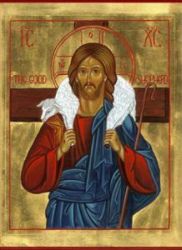
This Sunday we celebrate the Good Shepherd, but won't he tell us plainly?
This coming Sunday's Gospel reading comes from John 10, as we celebrate Good Shepherd Sunday. While at some point my thinking and preparation for Sunday night's sermon will inevitably turn towards the many examples of Jesus being our Good Shepherd, I am struck today by the words of some faithful Jews: "How long will you keep us in suspense? If you are the Messiah, tell us plainly." My focus zeroes in on these words because so often my anxious prayer to God sounds eerily similar to that of these religious leaders who are my spiritual ancestors.

About this time three years ago when I was discerning where my first call to ordained ministry would be I prayed, "GOD, just tell my plainly where I am to go." As my fiancee and I discerned a call to marriage I wanted God to just give me a simple sign. Way back when I wanted to know if I ought to go to seminary out in Austin, Texas I pleaded with God to let me know in a clear way. I imagine that whenever I face a stressful stretch of life my instinct will be to pray, "Do not keep me in suspense. Let me know what I am to do." But, doesn't this way of praying deny the act of faith?

When I was going through my rage against the Church and God phase in college I thought of the word faith as this phrase that simple-minded, religious folk used to keep themselves from thinking too hard or too much. Now I feel remorse that I thought that way, but I am happy that I struggled with how I define faith. To be faithful means that I will be in suspense. To be faithful means that I will not get the precise sign that I want or need. To be faithful requires that sometimes I walk in the dark, not knowing entirely that God is walking right beside me.

The life of a faithful follower of God will inevitably lead to moments when she does not know what the hell she is doing, and yet, somehow she still knows that God is leading her a step at a time. My hope is that I might be so wise as to have faith to not let my anxiety be my guide, but instead allow the Good Shepherd to call me onward. As sheep we will not know the reasoning of the Shepherd, we will certainly want to say "tell us plainly," and we will not like the suspense of walking by faith, but that is the great work of our lives (spiritual and otherwise) to trust that God walks with us, leading us wherever we go.