The Rev. J. Seth Olson © 2019
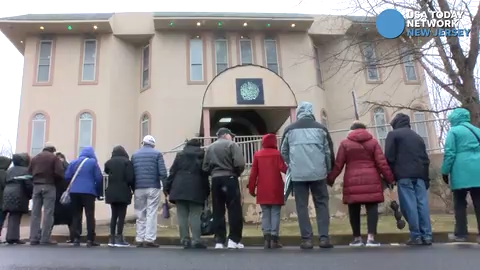 |
| An Interfaith circle protects the Al Noor Mosque during Friday Prayers |
March 24, 2019—The Third Sunday in Lent
Audio for this sermon may be found here.
In the midst of a conversation about the immediate need for humans to turn to God, an age old debate broke out. The question at hand? Are tragedies enacted by God? Jesus phrased it this way: “Do you think that because these Galileans suffered in this way they were worse sinners than all other Galileans?” We might ask, “Why do bad things happen to good people?” or maybe “Why do bad things happen at all if God is good?” This argument surrounding theodicy—or why a good God would allow evil to persist—began to break out at the beginning of today’s Gospel lesson. While we may not ever be ready to engage in such a heavy conversation, Jesus drags us into one today whether we like it or not.
In those days two separate tragedies
had recently affected the larger Hebrew community: one a state-sanctioned
multiple homicide at the hands of Pilate and the other a tragic tower collapse
that left eighteen dead. The surrounding crowd pushed for an answer from Jesus.
They wanted to know, “Were these things punishments for sinful behavior? Why
did God make this happen?”
We too might be wondering something
similar. Questions like these though form a trap that often capture us, even if
we logically know better. Yes, we can easily discount the loud voices of rogue
preachers who claim that tragedies befall those with hidden sins. We can quiet
those who wrongfully argue that natural disasters only impact sinful cities.
Still, even if we don’t believe these hate-filled voices, we sometimes connect
the imaginary dots between a tragedy and a victim’s behavior.
Deep within ourselves we want to know
what the crowd pushing in on Jesus wanted to know. Specifically, “Did this bad
thing happen because these people were bad?” We ask these questions in the wake
of natural disasters, untimely deaths, and even suicides. We cannot help but
get bogged down wondering “Why?” or “How
did this happen?” or “What could I have done differently?” And, while today it
may be difficult to answer these questions in the abstract, what we are never
ready to do is answer these questions in the midst of our own personal
tragedies—when a loss, a death, or a disaster happens to us.
In our lives—both individual and
corporate—we have suffered so many losses, deaths, and disasters recently.
There have also been so many acts of hatred that we may not know what to do
anymore. We may have just become numb to all the destruction. Or, we might try
to explain all of it away by saying that God wanted the victims to suffer. As
human beings, we may come by meaning-making honestly, but to shame victims is a
route that leads only to more devastation. So, what do we do? How then shall we
respond to tragedies? What’s the answer to all of these questions? If we look
to Jesus in today’s Gospel lesson we may very well see a path leading us beyond
the endless questioning.
Jesus was not interested in theodicy—he
did not talk about why bad things happen to God’s beloved children. He did not
even pause long enough to speak about the morality of the Galileans or the
Jerusalemites who had died except to say that, like all of us, they were
sinners and in need of God’s redemption. And, in that moment long ago, Jesus
bypassed the conversation others were having about God and evil and suffering
so that he could talk about something he found even more pressing.
The question of “Why do bad things
happen to good people?” often distracts us from the real matter at hand. We can
wonder all day long about God and evil and suffering, but when given the chance
to speak on the subject, Jesus himself chose to cut through the distractions of
why, so that He could talk about turning back to God. Jesus spoke on our
inherent need as human beings to turn to God instead of blaming victims or
wondering why God would let something happen. So what about us?
In the midst of the most recent tragedy
that our world suffered, the terrorist attack on the Al Noor Mosque in
Christchurch, New Zealand we may be tempted once again to begin with the litany
of questions wondering why. But, this massacre, which killed 50 faithful
people, 50 children of God, this massacre is not an opportunity to put the
blame on someone else--worst of all those who died. No, this is a time when
each and every one of us are called to repentance. We are called as individuals
and as an entire species to turn back to God. What might this returning to God
look like?
God calls us to turn away from
remaining silent about the hatred that lives within our society and our
systems, which we perpetuate often unknowingly.
God calls us to turn away from simply
hoping that someone else will change the inherent bigotries that persist in our
world. To turn to God is to turn from racism, sexism, homophobia, xenophobia,
or fear of those who practice another religion. We are called to turn from
these and to turn toward loving our neighbors as ourselves.
God calls us to turn away from being
like ostriches with our heads in the sand, ignoring the ugly truth that, while
God sees all of us as equal children, this world does not inherently value
everyone equally.
While these unredeemed parts of
ourselves may be difficult for us to confront, the saving grace is that God
already knows all our faults, and God still loves us. This we see in the
parable from today’s Gospel lesson. Even when we are spiritually or otherwise fruitless,
even when we are like the fig tree who has done nothing for years, we are not
left alone to wither. God is always willing to give us another opportunity to
turn back to the Son, to be quenched by the living water, and to grow.
Jesus tends to us like that gardener
tended to the fig tree. The good gardener knows what each plant needs to grow.
God knows what we all need to grow. So in those moments when we put ourselves
before others, or “protect power over people,” or “turn the spotlight on others
before taking a good, hard look at ourselves.”[1]
God already knows this. And, God knows the best way to help us grow. Painfully
this might be by pruning those unintegrated, unhealthy, and unloving parts of
us away, or it might mean putting a bunch of manure on us. (Yes, that was meant
to make you chuckle.) The repentance is needed before the growth can occur!
This is why Jesus wasn’t interested in a theological debate.
Jesus was interested in changing
people’s lives. Jesus is interested in changing your life. Jesus came to end
the suffering of the marginalized. He came to end oppression, degradation,
famine, violence, and corruption. He came to end the separation that we feel
from one another and from God. How did he do all this? He came to do all this
by calling us to repent, to turn away from these things that lead to nothing,
so that we can turn to the One who made us, the One who still molds us, the One
who makes us whole. “Will
you persevere in resisting evil, and, whenever you fall into sin, repent and
return to the Lord?”[2]
We will with God’s help. Amen.

