Showing posts with label Fire. Show all posts

Sunday, June 8, 2025

The Wild Breath of God

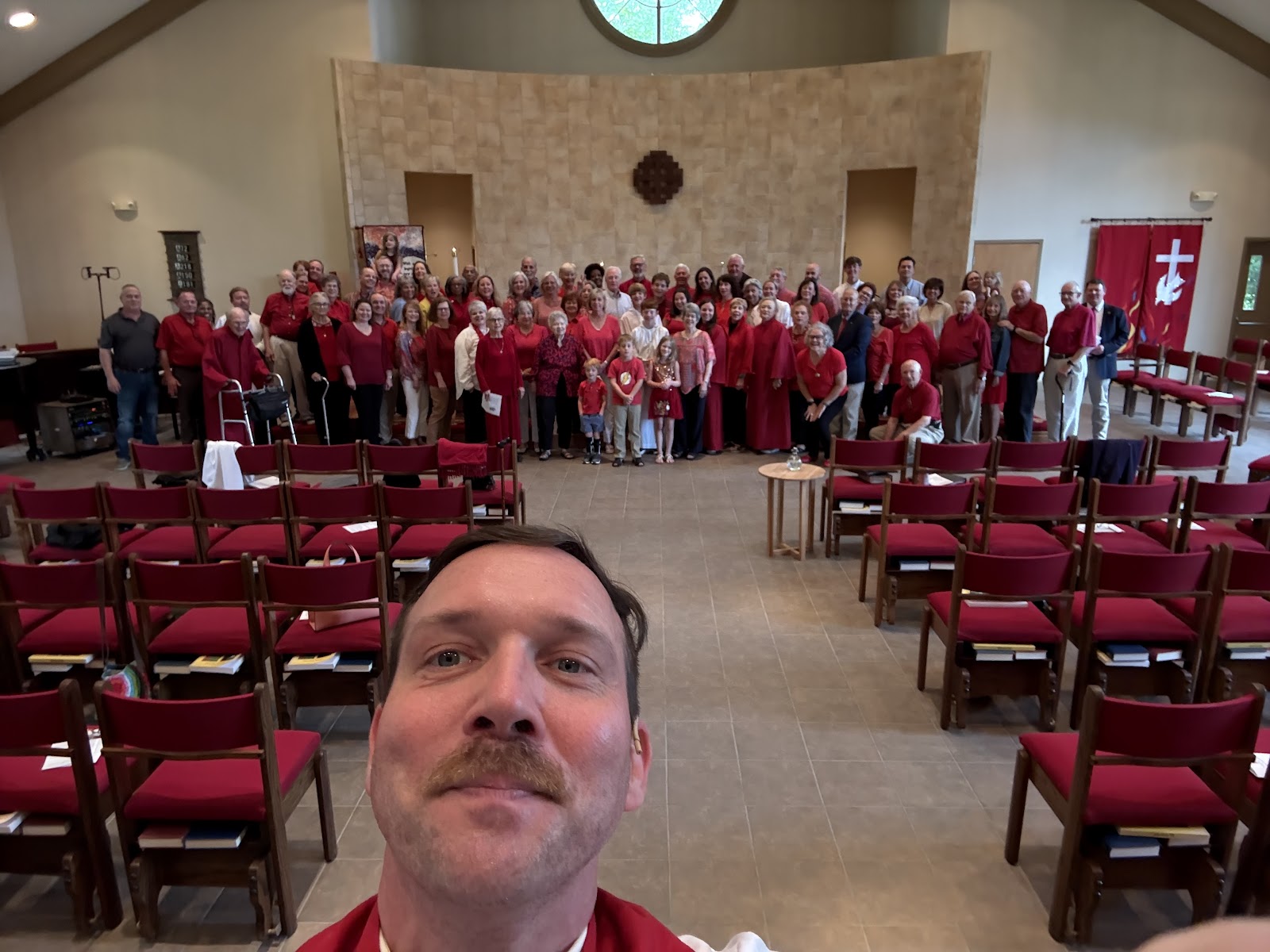
A Pentecost Selfie at Holy Apostles


Acts 2:1-21

Psalm 104:25-35, 37

Romans 8:14-17 

John 14:8-17, (25-27)


©2025 The Rev. Seth Olson


This sermon was preached on Pentecost Sunday at the Episcopal Church of the Holy Apostles in Hoover, AL. Video of the sermon may be found here


Holy God, let my words be your words—and when my words are not your words, may your people be wise enough to know the same. Amen.


Happy birthday to you. Cha cha cha!

Happy birthday to you. 

Happy birthday Mother Church,

Happy birthday to you!


I tried to bring candles, and no not the ones already on the altar, but the Holy Spirit keeps blowing the little ones out. Okay, I kid, but…


Today, Pentecost is a day full of wind, fire, confusion, and—as Peter helpfully points out—supposed pre-noon intoxication. And that’s just the opening verses of Acts. 


Today is the moment when we celebrate the Spirit bursting onto the scene not as a polite suggestion, but as a rush of violent wind and divided tongues of flame. It’s holy. It’s chaos. It’s Holy chaos. And somehow, in that chaos, people hear clearly in their own native tongue.


In Bible Study earlier this week, we recalled that this story is the undoing of what happened at Babel. When all the people of the earth all spoke the same language, which sounds lovely; however, it was highly problematic. For, as Genesis 11:1-9 informs us, the people attempted building a mighty tower to make a name for themselves, avoid being scattered—which God had commanded them “fill the earth”—and reach (beyond) heaven. Why? It's not quite clear, but some think it was to exert control over who gets into heaven. What happened?


The tower collapsed. The efforts failed. But, here on Pentecost we observe a throughline. Like Jesus undoing the denials of Peter on the beach, which we read earlier in Easter, here the Spirit brings back together these people from across the world. And yet, they keep their individual identity, still they can hear through the mighty power of not Google Translate, but the Holy Spirit!


It's as though the Spirit doesn’t just stir the pot—it lights it on fire and tosses it out the window. And, truth be told the Spirit is wild like that. God is wild like that.


I had a moment a few years ago that I think of every Pentecost. It wasn’t a wind or a fire. It wasn’t even very dramatic. It was just a breath.


It happened during an ordinary Tuesday. I was feeling worn down. Emails piling up. Laundry left unfolded. Parishioners in pain. Children growing faster than I could process. I sat down in a chair in the corner of our living room, not to pray—just to be still. I didn’t say a word. I just sighed.

And in that sigh, something happened.


Not a dove descending. Not a voice from heaven. But in that moment, a sense of peace washed over me—not like a solution, but like companionship. I felt held. It was as if the very air in my lungs was whispering: “You are not alone. I am with you.”


Jesus calls the Spirit the Advocate. The Greek word here is Paraclete, which literally means “the one called alongside.” The one who shows up. Who sighs with us. Who intercedes with sighs too deep for words, as Paul says elsewhere.


The Spirit is not just fire and frenzy; the Spirit is breath. In Hebrew, the word is רוח (ruach or roo’aak). It even sounds like a breath. And like breath, the Spirit is steady. Unrelenting. She’s ever pulsating within our mortal being. 


And the Spirit is ever present within our Holy Scripture, too. Like in Psalm 104, which reads, “You send forth your Spirit, and they are created; and so you renew the face of the earth.” That may sound familiar to anyone who has gone through Cursillo—precisely because that piece of the Psalter is quoted within the prayer invoking the Holy Spirit. “Send forth your Spirit and we shall be created and you shall renew the face of the earth,” is almost a direct quotation and just think about what that is saying: the Spirit’s mission is not just creation, but also re-creation. Renewal. She didn’t simply move over the face of the Deep at the beginning of Genesis, she renewed those weary ones on the first Pentecost, and she’s here now (and I heard she’s bringing tacos and ice cream).


Yes, the Spirit is not done. God is not finished. And if you’re here today wondering whether God still shows up—wondering if there's anything left to breathe into the dust of your soul—then I have good news: Pentecost isn’t a one-time event. It’s a daily reality.


Sometimes I think we imagine the Spirit like a wind turbine out in the desert—powerful, yes, but distant, industrial, mechanical. What Scripture offers is more like this: the Spirit is the wild breath of God, as close as our next inhalation, as unpredictable as a summer storm in Alabama, as fierce as wildfire and as intimate as a whispered name.


Now I know that sounds poetic, but it’s also terrifying. Because if the Spirit is wild, then we can’t control it, like those ones wanted to do at the Tower of Babel. The uncontrollable nature of God’s Spirit unsettles us. We like to know the plan. We like to keep things orderly—thank you very much, The Book of Common Prayer. But the Spirit doesn’t follow our rubrics—those little italicized instructions.


As one preacher said: “The Holy Spirit will not be boxed, bottled, or booked in advance.” The Holy Spirit is more jazz than classical—improvisational, collaborative, and full of unexpected grace notes. 


That’s the kind of God we have. A God who breathes into locked rooms where disciples cower in fear. A God who sets shy fishermen on fire with courage. A God who whispers peace—not in the absence of trouble, but right in the middle of it.

Jesus told the disciples, “Peace I leave with you; my peace I give to you. I do not give to you as the world gives.” This isn’t Hallmark peace. It’s not spa-day peace. This is hard-earned, crucified, and risen peace. It’s the kind of peace that keeps showing up when everything else falls apart.


Friends, I don’t know what kind of Pentecost you’re hoping for. But I know what kind we need.

We need a Pentecost that breaks open our tightly sealed agendas.
We need a Pentecost that speaks to our divided tongues and reminds us we are still one body.
We need a Pentecost that breathes new life into the weary, the grieving, the burned out, and the fed up.

So breathe, Church.


Take a deep breath—like right now.
That breath is a gift.
That breath is a promise.
That breath is the Spirit.

And God’s Spirit is wild enough to help us wherever we journey next.

So, Come Holy Spirit fill the hearts of your faithful, kindle in us the fire of your love, and through your work help us to renew the face of the earth. It may be the Church’s birthday, but we are nothing without the gifts of the Spirit. Amen. 

Sunday, August 18, 2019

Into the Fire

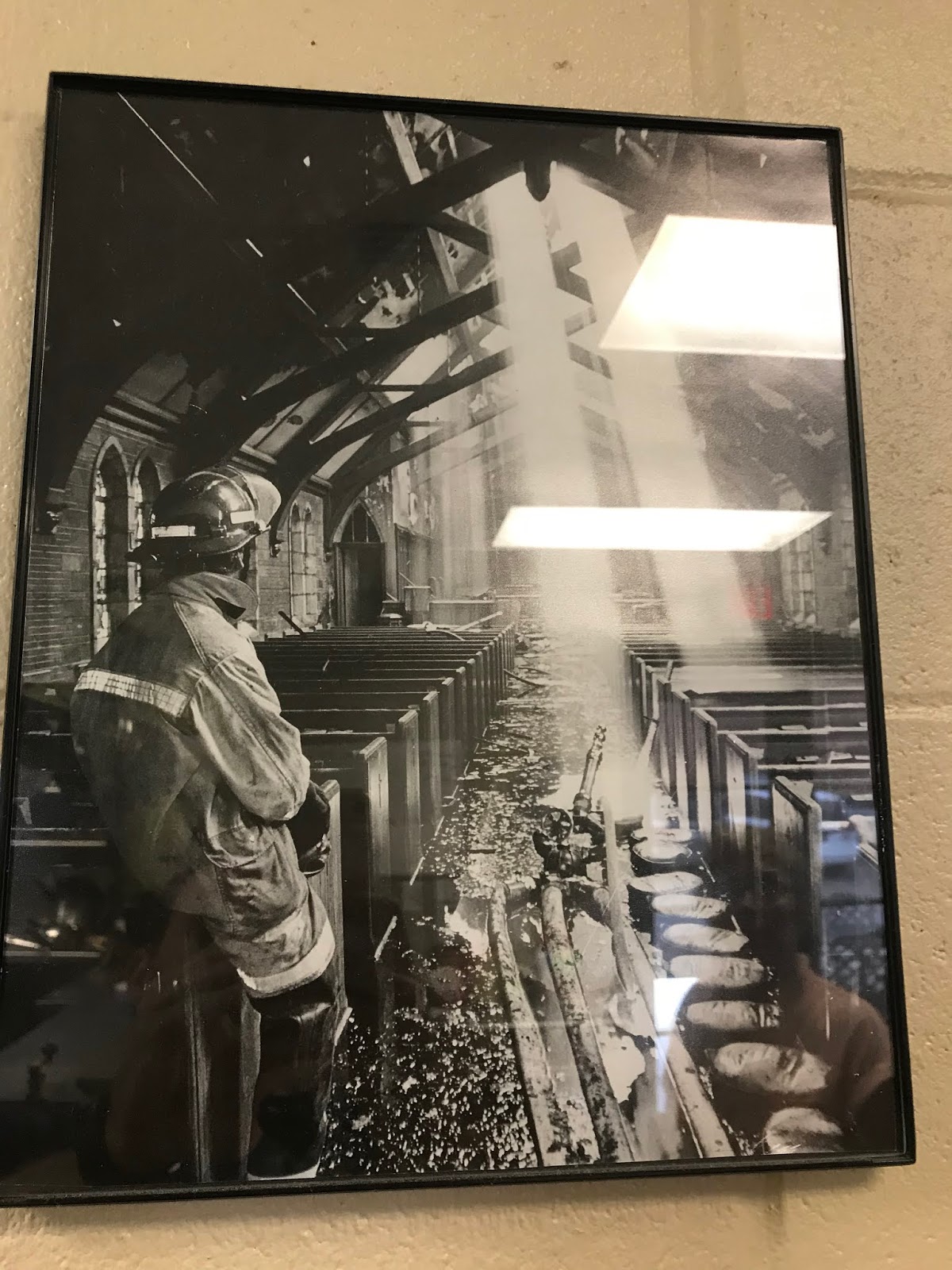
A picture of All Saints Church after the fire of the late 1980s. It hangs on the kitchen wall at Homewood Fire Station #1.

© Seth Olson 2019
August 18, 2019—The Tenth Sunday after Pentecost—Proper 15 (Gospel Reflection Track)

Before I go any further I have to make a confession to you my friends, I love fire. Maybe I’m not technically a pyromaniac, but it’s close. I come by it honestly. When I was a child my mom signed me up to be an acolyte, but I took to it because I could play with fire. There at St. Andrew’s Birmingham as a high school student, I volunteered to be thurifer any chance I could because thurifers get to swing around fire as they waft the incense. For three summers I worked at a camp where I got to carry around torches, build bonfires, and play with campfires. Even now I have far too much fun with lighter fluid and charcoal. Two weeks ago though when my son Teddy turned two I saw another side of fire.

My family took Teddy and his cousins to Homewood Fire Station #1 where the wonderfully kind firefighters showed us around the firehouse, demonstrated how they get ready, and even let us explore the fire engines. While the kindness of the firefighters and the marvelous technology they possess stand out from that day, there’s a picture that remains even more memorable.

On the wall in the kitchen of the station there’s a stark black-and-white photograph. This photo has haunted me ever since I saw it. It showed this very nave after the destructive fire of the late 1980s. As sunlight shone in from the holes in the roof, several inches of water flooded the floor making kneelers look like little rafts in the ashy liquid. When I saw that picture my gut knotted up and I felt the overwhelming fear that fire can kindle.

Herein lies the dilemma with fire, it provides light, warmth, and a means to sustenance, but it can also burn us, ruin property and even destroy lives. So when Jesus harnessed some fiery language in today’s Gospel lesson we would be wise to carefully examine his words. What was Jesus saying here? Was he illuminating us or burning us?

If we cherry pick just a few phrases from today’s lesson, we get pyro-Jesus. He catches the earth on fire, divides us, and calls us hypocrites. You might want to duck and cover when you hear this Jesus coming. I know I do. I preached on this set of readings three years ago, and I completely dodged this Gospel lesson because of its fire-filled nature. Today, I’m just foolish enough to get burned. These phrases about fire, division, and hypocrisy are not it—they aren’t all that is here. They do catch our ear though.

Many of us have a vision of a smiling, storm-calling, lamb-holding Jesus, so when we hear such strong language coming from God’s Son, we do a double-take. This rhetoric is nothing new though. For the past three chapters in Luke’s telling of the story, Jesus has grown more intense. And, can you blame him? As he put it in verse 50, “I have a baptism with which to be baptized, and what stress I am under until it is completed!” Jesus had turned toward Jerusalem and he clearly saw that his ministry led him directly to death—hence the great stress. As he anticipated this baptism of fire, something John the Baptist foretold very early in Luke, Jesus warned us of the perils of following him. Last week we heard of these dangers too.

In that passage from the same chapter, Jesus urged his followers to store treasure in heaven and to be ready for the Son of Man coming. In the story which lay between last week’s and this week’s lessons, Peter wondered whether Jesus’ warnings were for the disciples or for the larger crowd.

Instead of a direct answer, Jesus told a parable about continued watchfulness, and he backed it up by saying something that has made its way into our day-to-day language, as the phrase “To whom much is given, much is tested.” This section in total informs a different depiction of Jesus than a mellow, backwater carpenter. But, returning to today’s passage, I still wonder, why was Jesus so fiery?

Unfortunately, some of our fellow Christians have used passages like today’s to preach turn-or-burn style messages. Make no mistake, Jesus was speaking of decisions of paramount importance. And yet, today’s message is not about the eternal flames of hell. This fire is a refining one.

As Jesus drew nearer to the Cross and death, his message became clearer regarding the consequences of following him. A person back then who belonged to a traditional Jewish household who chose to follow Jesus would put herself at odds with the rest of her family. Or, a Roman soldier who decided to walk in the way of Christ would create a firewall between himself and his brothers-in-arms. Today’s fiery language was a way for Jesus to slap a warning label upon discipleship. “This will cost you,” Jesus seemed to say, “Maybe not your life, but possibly some of the most important relationships in it.” So on what are we risking our lives or at least our relationships?

To understand why someone would be willing to threaten such important things in following Jesus, we must first understand the core characteristic of Jesus and in turn His Heavenly Father. We do not explicitly find that attribute in today’s Gospel lesson. We see the consequences of it, but not the reason. We do however find the trait in today’s Psalm.

Psalm 82, according to one scholar, is the most important text in the entire Bible—because it shows us who God truly is. The most important characteristic of God is not infinite power. It’s not omnipotence. It’s not even immortality. So what is it?

In this ancient hymn, we discover that God’s most fitting trait is justice. God is always just! God fights against all the cosmic forces in the council of heaven who judge unjustly. God renders unjust all these other "gods" because they show favor to the wicked, fail to save the weak and the orphan, and abandon the humble and the needy. In the most epic cosmic aside of all time, God sighs and says, “They do not know, neither do they understand; they go about in darkness.” Talk about a burn! But, what’s the result?

All of these would-be-gods are not God because they are unjust. As a result, they are cast down from their perch in the council of heaven. They become like “any prince.” Now, we aren’t polytheistic and this clearly shows a less developed view of God than we are accustomed to in our Judeo-Christian worldview, but the point of this Psalm is nonetheless clear. God does not stand for injustice. And, if the prayer we pray most often is any indication, we want God’s reign to happen on earth as it is in this heavenly vision. Therefore, we too must oppose injustice. And that is the theme that ties together all four readings for today.

Jeremiah stood up to false prophets who made God’s people forget God’s name. In the Psalm, God cast out of heaven all forces which perpetuated unjust ways. In Hebrews, those exemplars of faithfulness, including people who were not always just in the eyes of the world, persevered in faithfulness running toward God’s justice as their prize. And this brings us back to our fire-filled Gospel lesson.

Jesus’ radical teaching of God’s justice was in and of itself divisive. When someone speaks a challenging word to us we may draw closer or we may run in the other direction. This was the case with Jesus. When he spoke the hard truth that God’s way means putting the needs of the poor, the weak, the orphan, the humble, the lowly, the foreigner, the exploited, the forgotten, and the other above our own, it created division. This truth caused some to feel burned while those left out in the cold finally felt warmth.

What about today? What about us? Is Jesus illuminating or burning us?

Well, it may be both.

A few years ago I was driving out in New Mexico through Bandelier National Monument. The Forest Service had recently conducted a controlled burn through part of the park. Some of the grounds were still smoldering. Other sections had been burned several months earlier. As I drove a van full of usually boisterous college students through the burnt forest, everyone fell silent. The same sort of internal hush that I felt when I saw the picture of All Saints in the fire station. In that burned over forest though there were sprouts of green. These ultra-green sprigs rose from the ashes.

Our lives may very well be like that forest. And Jesus’ word may very well be like that fire. Healthy sections may grow without ceasing. Other parts may need to be singed or burned to grow into God’s grace. God’s fire though is not meant to end our lives. Rather it leads us into new life. 

Following Jesus will challenge us. It should come with a warning label: "May impact your relationships." But as we shift from “my will be done” to “thy will be done.” Jesus calls us to pursue God’s justice, loving our neighbor as ourselves, and as we do, God’s fire will refine our lives leaving new patches of growth everywhere.

Wednesday, August 14, 2019

How Do We Preach Division?

Preaching on the weather (and James Spann) would be much easier than preaching on this set of readings.
There’s a whole lot in this week’s readings worth noting: Jeremiah sounding off against false prophets, God striking down false gods in the council of heaven, the writer of Hebrews challenging readers to run the race of perseverance, and Jesus revealing his pyromaniac side. Given we encounter a feisty and fiery Jesus what’s a preacher to do? I believe a helpful place to start is Jesus’ last question.

“You know how to interpret the appearance of earth and sky, but why do you not know how to interpret the present time?” Everyone can talk about the weather—it’s a universally acceptable topic of conversation. I particularly love conversing about clouds, storm systems, and barometric pressure, but I’m the guy who has four weather apps on my phone. My sweet sister gifted me a couple of the expensive ones because she wanted to make sure I’m weather aware—and boy am I! I’ve got the same radar that James Spann uses, and I can carry it around with me everywhere I go. I know which way the wind is blowing, have alerts for all types of severe weather, and even know when it’s going to start raining minutes before it happens. So, I feel pretty good about answering Jesus, “Yes I know how to interpret the appearance of earth and sky—or at least my app developers do.” But, the trouble comes in the second part of his question (I can’t seem to escape an impassioned Jesus). Why do you not know how to interpret the present time?

Why do I not know how to interpret the present time? Good question! The more I think about the present moment though, the more confused I get. It’s not to say that it wasn’t complicated 2,000 years ago. Especially since Jesus turned his face toward Jerusalem in Luke 9:51 the drama has heightened but the world around Jesus became more delineate, more black and white. And, this Sunday we hear Jesus drawing or perhaps burning a line in the sand. Those listening were challenged to make a decision, but it wasn’t turn or burn like we might be thinking (more on the type of fire in a moment).

The early followers of Jesus would have offended their parents or children or neighbors, as they sided with Jesus instead of other worldviews. Those times were certainly divisive, and with hindsight and bias we judge which side we would choose to join. What about today though? A good sermon this week might highlight the challenges we face in our current divisive age.

Right now appears even more divided than any other time
—including Jesus' own. We can see people’s opinions instantaneously on social media. When we do we can simply unfriend or unfollow those people with whom we disagree. We can watch our chosen brand of 24-hour news to further hammer home how right we are—and how wrong everyone else is. People can even quit going to a church if someone in the pulpit or the pew says something they don’t like. But, take any hot-button issue and try to interpret a peaceable solution and life will get quite complicated quite quickly. I don’t mean that people cannot figure out what they think about given issue—or what side to choose. No, I mean that all of us are struggling to coalesce and find consensus. It feels impossible to arrive at solutions where all are heard, respected, and satisfied with the result.

Experiencing the log-jammed nature of today helps me to understand Jesus’ frustration in this week’s Gospel lesson. A helpful sermon might speak of fire (told you I'd come back to it). Fire not as a way to scare people into choosing heaven over hell, but rather as a way to burn away that which does not fall in line with God’s will. Jesus used this image of fire to illuminate how God refines us. Jesus was rifting on the same image that Jeremiah used several centuries earlier. This might be another good jumping off spot for a sermon.

Jeremiah was tired of hearing the false prophets of his own day. These errant teachers were claiming that they had dreams from God, so that they could benefit themselves. This is not unlike some infamous televangelists who use hapless viewer’s charity to buy private jets or mansions. Jeremiah could not condone any of these nightmarish dreams which led God’s people astray.

A compelling dream and a flashy sales pitch can make people fall for just about anything. In this case it could even make God’s people forget God’s name. However, even more powerful than the false prophet’s dream is the Word of God. The Word of God can burn like a dividing fire and split open like a rock hammer. Still in both the Gospel lesson and here in Jeremiah we may not understand what is at stake along these dividing lines, as we experience the fiery word of God, which is where this week’s Psalm comes in handy. Again, another good sermon departure point.

Often I overlook the Psalmody in my sermon prep. They’re just old songs, right? Yes, but even though we often read them and move on these hymns cover the gamut of human experience from lamentation to ecstasy, from birth to death, from history to the end times. And, this week's psalm has a direct way of depicting who God truly is.

In Psalm 82, we are placed in the council of heaven, a common concept in the Ancient Near East—including ancient Israel and Judah. Here, YHWH or the Most High God was holding all others that were not the Most High God accountable. God took a stand against all forces not God. God took this stand because these other forces were judging unjustly. We might wonder what is the most important characteristic that makes God… well… God. Is it omnipotence? Is it infinite power? Is it immortality? What is it?

Psalm 82 responds to those questions in an unexpected way to me. All those forces in the council of heaven were cast down out of the realm of the immortal because they were... wait for it... unjust. God's most critical component here is not omnipotence, power, or immortality. It's justice! These others were showing favor to the wicked, not saving the weak and the orphan nor defending the humble and needy. They were not rescuing the weak and the poor, nor delivering them from the power of the wicked. And in a great cosmic aside, God said, “They do not know, neither do they understand; they go about in darkness; all the foundations of the earth are shaken.” In other words, these others go about in ignorance and haphazardly shake the very foundation of creation with their injustice. As a result of not living into the justice that God intended, they were cast out of this celestial realm.

Now my fellow preacher, justice is a powerful word to throw around from the pulpit. When I say justice everyone can nod their head and in other parts of the Jesus Movement people might even say “Amen!” to such a profound word. However, there’s a problem with this word. When I say justice there are as many different concepts of what that looks like as there are people in the pews. So, let me elaborate on this term using the vision that God sets forth here in Psalm 82 and also in Luke’s Gospel account.


Justice sides not with the wicked—i.e. anyone who takes advantage of the poor—but rather God’s vision of justice saves the weak and the orphan, defends the humble and needy, rescues the weak and the poor, and delivers them from those who would exploit them. And this theme, this vision of justice isn’t simply present here in Psalm 82, it’s also what Luke has been building towards throughout his entire story of Jesus.


Three canticles at the start of Luke portray this vision. Zechariah, John the Baptizer’s father, sang of this justice when he spoke of being delivered out of the hands of enemies and into freedom by God’s mercy. Simeon shared of this justice through the release for all of God’s people that he saw in the coming of the Christ child. And Mary most pointedly praised God’s justice as she sang, “He has shown the strength of his arm, he has scattered the proud in their conceit. He has cast down the mighty from their thrones, and has lifted up the lowly. He has filled the hungry with good things, and the rich he has sent away empty.” This is the vision of justice that God makes known to us, but what does this mean to us? And how can we preach when we and our congregations are often proud, mighty, and rich? I don't have a good answer for this, which is why I'm still working on my sermon.

There is a dilemma set forth in this week’s texts. Jesus touches on a nerve that Jeremiah experienced in his day, and we feel in our own. Jesus points to divisions that arise when we have to choose something paramount over something important. What happens when the stakes are raised to this level?

I believe we find the most profound truth in the psalmist's words. God is not God if God is unjust. And we in turn are not God’s people if we are perpetuating injustice. We are called to persevere just like that great cloud of witnesses persevered in the letter to the Hebrews. Our perseverance as preachers is difficult. For calling out injustice in our congregations and in our world must be done with a pastoral heart. And first Jesus’ fiery, cutting language must convict us as followers of Christ, so that all which does not fall in line with God’s will burns away. How do we preach division? First, we must allow God's refining fire to unite our true selves with Christ.

Wednesday, March 20, 2019

Life, Death, and Repentance

Is this Sunday's Gospel merely a "Turn or Burn!" message?


This Sunday’s Gospel lesson has me (and probably a few other preachers) a little flustered. Throughout Luke 12, the chapter preceding this week's lesson, Jesus urgently taught his followers to turn to God’s Reign even if it costs them greatly (i.e. their familial relationships). Then right at the beginning of Luke 13, where this Sunday's Gospel picks up, some people tell of a state-sanctioned multiple homicide seemingly to test Jesus. The passage does not lay out a specific question asked of Jesus; however, the crowd might as well have wondered, “Is this sort of awful death a punishment for not turning to God?” We onlookers 2,000 years later still question, “Well, is it?”

In response to people wondering if certain painful deaths are directed by God, Jesus responded with a charge for all of humanity to return to God. Instead of saying, “Sure, God purposed these gruesome deaths,” Jesus pointed out that the people who died were no worse offenders than others. In addition, Jesus said that even those who died in a freak accident at the Tower of Siloam were not any worse (or better) than others in Jerusalem. So, what? Is everything terrible and we’re all going to die? Sometimes and certainly yes. But, that seems horribly beside what Jesus wanted to talk about way back then, and that means it’s a tempting aside for the frustrated modern preacher to ignore also. Jesus wanted to talk not about why someone died, but about the need for the living to repent.

Some say the only universal experiences that we hold in common with is life, death, and taxes, but Jesus speaks of something else that we all share. In this coming Sunday’s bit from the Good News according to Luke, Jesus informed us that all of us will die (and maybe quickly and in some horrible way), so what matters to each of us immediately is our need to return to God. What do we all have in common—the Galilean, the Jerusalemite, the American, the Kiwi, etc.? Life, death, and repentance. We are all called to turn back to God. So, that’s it? Turn or burn? 

You, me, and everyone else gets called in manifold different directions throughout our lives. Yesterday in our staff meeting at All Saints' Church we read Rite I Morning Prayer from the Episcopal Book of Common Prayer. The service began with a Confession of Sin and one line in particular stood out to me: “We have followed too much the devices and desires of our own hearts” (BCP, 41). It’s not that we aren’t called to listen to our hearts, as that is often where we meet the Living Christ. Rather, there are moments when the distractions and desires and even duties of life wear us down and lead us astray such that we wake up one day and don’t recognize the image of God that stares back at us in the mirror, across the dinner table, or from someone else's profile/avatar. We might believe these confusing, heart-breaking moments to be the most terrible ones in our lives—and they aren’t pretty, fun, or easily endured. Still, it’s in these times when we can become aware enough to notice that we aren’t where we thought we were, we aren’t where we want to be, nor are we where we will eventually end up. And, it’s in these moments that we are hit most overwhelmingly with a surprising wave of grace. This grace comes in the form of a deep knowing.  

When at the core of our souls we know that we are lost this sensation of being lost is a grace-filled sign from God. For it is in knowing our lost-ness that we can allow ourselves to be found. We can let the Good Shepherd find His lost sheep, the Good Widow find Her lost coin, and the Good Father find His lost children, as Luke will put it in a couple chapters (Luke 15). The trouble is that quite often we get so distracted by those aforementioned devices and desires that we know not that we are lost or even completely shipwrecked. Jesus though knew all of this about his fellow humans. He knew that those who had friends murdered by Pilate and those who had relatives crushed by a tower were raw and lost and probably shipwrecked too. And like the good and faithful one he was he spoke to the heart of the matter. He sharply pressed onward toward what affected everyone listening, including us.

Jesus moved beyond the important and distracting questions like the following. Why do bad things happen? Why did 50 faithful Muslim people die in Christchurch, New Zealand? Why is my loved one in the hospital, facing this disease, or dying? Why is my marriage falling apart? Why don’t my kids love me? Why do I not feel whole? Why? Why? Why God? Sure, Jesus knew that these and many other questions of meaning and existential wandering affect us all and make us feel like a fruitless fig tree. Thus, Jesus did not get sidetracked trying to answer the why.

Jesus moved beyond a laundry list of ways to be right (or wrong) with God. Worse than existential crises are moments when we believe that we have it all figured out for those who feel lost. We interject that we know why all these things are happening to someone else (or even ourselves). And, we say that because we have believed rightly or gone to church or said a prayer or gotten confirmed or not done some list of things, then we are fine and fireproof. But, Jesus was not interested in a list, which once completed would make us good and fruitful trees by ourselves. 

Instead, Jesus softly turns us away from our endless need to know why or our insatiable desire to earn our way into God’s good graces. He long ago spoke wisdom both hard won and infinitely available. When chaos surrounds us and we feel lost turn to the one who always turns to us and finds us. When we believe we have it figured out know that it is not us who save ourselves, but God who tends to our barren and boastful spirits. This is the way we grow—not on our own, but together with God. All of us have these in common: life, death, and a perpetual need to turn towards God.

Sunday, December 16, 2018

Re-Gifting


Before you can give out your presents John the Baptist has something to say to you.
This sermon was preached on the Third Sunday of Advent. The readings which inspired the sermon were the following:

In only eight and a half days we will be kneeling down to peek into the makeshift crib to view the Christ child. As you came into church this morning—to pray, to sing, to hear God’s Word, to confess sins, to be forgiven, to eat and drink of the Sacramental Body and Blood of Christ, and to be sent back out into the world transformed—as you came here today perhaps you, like me, were distracted by thoughts of final Christmas preparations and purchases. But, now after hearing John’s challenging, caustic, and cajoling words, Christmas may be the last thing on your mind. How in the world are we going to get from the Jordan’s banks to Bethlehem’s manger after all of this fire and brimstone?

Today’s Gospel lesson almost feels like a prank by the brain trust that came up with our reading cycle, the Lectionary. Are there hidden cameras in here? John just called the crowds—and vicariously us—“a brood of vipers.” Then, he threatened that if we don’t bear good fruit we’ll be chopped down. That was before he told us that the coming Christ would soon be burning up any chaff in an unquenchable fire. And, Luke had the audacity to cap it all off by claiming that these exhortations are good news. What? This cannot possibly be good news can it? See, friends as strange as all of this sounds you aren’t in some sort of nightmare before Christmas.

Actually what John the Baptist preached in the wilderness long ago really was and is still good news. Hang with me for a little bit—don’t worry the Christmas to-do list will still be there when I finish. You might even look at it differently.

First off, let’s acknowledge a basic truth about us human beings. We don’t like it when we are told we are wrong. We don’t like being in trouble. As a kid, I avoided getting in trouble like the plague. Correction: I avoided being caught getting in trouble like the plague. And, there was one person that put the fear of God in me more than even John the Baptist could—someone whom I never wanted to catch me doing something wrong. That person was my maternal grandfather. His go-to phrase when I was misbehaving was, “Do we need to go have a chat in the locker room?” Whenever he said it, I knew I was in trouble and whatever I had been doing I would stop doing it. This was his own little call to repentance. Sort of like what was going on with John the Baptizer talking with the crowds down by the river side. So, the first thing about us humans is we don’t like being wrong.

Here’s a second thing about us human beings, we may not like to be told we are wrong, but sometimes we are. What is more sometimes we need desperately to hear difficult truths. When the crowds came to John they must have been in sore need of hearing truth—even if it was going to be tough. Whatever had been working in their lives was no longer cutting it. So, the crowds headed out to see this wild preacher draped in camel’s hair and a leather belt with bean pods (yep, that’s what locusts are) and honey on his breath. Amazingly in today’s Gospel lesson we see these crowds being told the truth and not hiding from it.

The crowds so needed to hear the truth that they even withstood John’s initial fiery address—the one about them being snakes—and kept listening. There’s no mention of people running off, crying in their milk, or saying John was wrong. Instead they stuck around to ask him, “Teacher, what then should we do?” This was a good question. They were seeking a deeper truth.

This close to Christmas—when we approach the Creator of the universe now in flesh appearing—might we have the same question? We do not like being wrong, sinful, or broken, but sometimes we are and sometimes we need to know, “What then should we do?” Perhaps this is the very reason we have such a challenging passage a week and a day before Christmas Eve. We’re getting closer to some Good News!

John the Baptizer tells this gathered crowd, “Bear fruit worthy of repentance.” In these words he challenges us to see that while the gift of turning to God and being forgiven is completely free, it will also cost us. God loves us so much that God would come dwell with us, teach us, be killed by us, and still love us. This way of Christ opens to us repentance and forgiveness forever. And yet, how do we show the fruit worthy of such a gift? Truly we cannot ever repay God, but that’s not the point. We simply cannot rest on such a gift. We can’t hide it away. What then should we do?

When the crowds, the tax collectors, and the soldiers asked John this question the Baptist responded with real-world advice. “Whoever has two coats must share with anyone who has none; and whoever has food must do likewise.” In other words, share with those who do not have. “Collect no more than the amount prescribed for you.” A.K.A. do what is just. “Do not extort money from anyone by threats or false accusation, and be satisfied with your wages.” Said simply, live within your means. As someone wiser than me wrote regarding this passage, “John’s advice to all of them is very practical and pointed. His answers reflect his knowledge of the vocations and values of those who ask the question, and his answers involve acts of mercy and justice…share, keep no more than you need, be fair, treat others with care, and be honest.”[1] Friends, I believe we have happened upon some Good News.

We as Twenty-First Century followers of Jesus have the same question as those First Century followers of Jesus’ Forerunner John. We want to know how we are to bear good fruit and what we are to do. So why don’t we walk out to that same wild baptizer who is still speaking eternal wisdom and ask him?

What might it look like if some modern professionals had their toes dipped in the Jordan listening to John? If a lawyer approached him and asked, “What then should I do?” John might reply, “Stop chasing ambulances! What’s with these ridiculous billboards? Do some cases pro bono. And, be okay with lawyer jokes.” If a wealthy CEO happened out to the River Jordan asked the same question, John might say, “Don’t take your bonus this year. Turn around. Give it to your employees. Maybe start a fund for underpaid teachers or single mothers. Live not within your means, but within one of your employee’s means.” If it were an Episcopal priest going out to see John, the Baptist could very well reply, “What’s with the outfit? And, stop talking about how busy you are. Slow down. Tend to your flock and your family.” What might John say to you when you are wrong? We could go on all morning, but by now I am sure you are back to thinking of your Christmas to-do list. So, let me close with the following.

We are weaving our way along this path of Advent on the way to Bethlehem. We are so close to the celebration of the Christ child’s birth, we are already awaiting Christ’s coming at the fullness of all things, and we are watching for Christ even coming here among us right now. And, as much as it may hurt us to know this, we are not going to get it all right before we meet Our Lord face-to-face. So, we wonder, “What then should we do?” Well, know this: God will always meet us with mercy, fairness, and love. As we turn or repent to receive this gift from God, we are exhorted (and yes that is good news) by Jesus and His Prophet to bear fruit worthy of this gift. What does that look like? Well, it looks just like the gifts we receive—mercy, fairness, and love. As you return to that Christmas list, don’t let anyone tell you that re-gifting is a bad idea, at least not when we are giving away the gifts that God gives to us.


[1] Kathy Beach-Verhey, “Luke 3:7-18 Homiletical Perspective.” Feasting on the Word: Year C, Volume 1. Ed. by David L. Bartlett and Barbara Brown Taylor. (Louisville, KY: Westminster John Knox Press, 2009), 71.

Monday, December 10, 2018

Vipers, Axes, and Fire… Oh My!

What happened? The contrast between last week’s portrayal of John the Baptizer and this week’s could not be more opposed. Yesterday the Forerunner of Christ Jesus was embodying Isaiah’s “Prepare the way of the Lord,” but this coming Sunday he will be shouting, “You brood of vipers!” Last week it was baptism and forgiveness. This week it’s the axe already lying at the root of the tree and a winnowing fork ready to separate. Last week it was “All flesh shall see the salvation of God.” This week it’s the chaff burning in an unquenchable fire. Where did the cuddly, camel-hair-wearing John the Baptist go? Why is there such a difference between last week and this week?

Well, the truth is there is no difference. That’s right! You heard me! That one who cried of a baptism of repentance for the forgiveness of sins is the same one who laid out what repentance looks like for the audience in this week’s Good News (and yes, it is Good News!). So why does it feel so different? How can we be so okay with John’s prophetic message last week, but so uncomfortable with it now? Before I try to answer that, let me ask you to think about something. I want you to remember a time when you were wrong. Ready, go!

Thinking…

Thinking…

Got it?

Well, let me clarify what I mean by a time when you were wrong. I’m not talking about a time when someone else thought you were wrong and you thought you were right, like a difference of opinions about something trivial. I mean a time when you were actually wrong—maybe even about something big. You knew you were wrong. That other person knew you were wrong. And, that other person called you out on it. You sweating a little just thinking about it? Yeah, me too.

That time when you were wrong, you knew you were wrong, someone else knew you were wrong, and that someone called you out about it—that situation is what happened in this week’s Gospel lesson. John was not saying that the religious leaders had a different opinion than his about God. This was not varying points of view. John had been around, he had grown up in the Temple culture, and he saw the injustices being carried out there against God’s People (specifically the poor, the widowed, the orphaned, and the otherwise disadvantaged). Thus, John called out those leaders. And, what is more, those religious leaders sat there and they took it, which provides further evidence that they were wrong and they knew they were wrong.

Now, let me have a moment for an aside. I am not saying that John claimed somehow that all of Judaism was wrong. John, himself raised in that Faith, was calling out the religious elite for failing to fulfill their calling as appointed shepherds to nourish God’s sheep. Furthermore, this was not an example of a Christian ideal supplanting a Jewish one, but rather it was an instance when God’s universal concept of justice was being mishandled by leaders—in much the same way that we see contemporary leaders across religions turn a blind eye to those who are suffering. So with this aside out of the way, let’s come back to specifically looking at how one might approach preaching this text on Sunday.

John speaks something that was hard for religious leaders, as well as tax collectors, soldiers, and the masses to hear, make no mistake about that. Still when they heard the (capital T) Truth, it halted them where they were. Such that they had to know what to do next, which is why they asked their questions, "Teacher, what should we do?" In the same, we cannot outrun the Truth, nor hide from it, nor make it disappear. What John the Baptist said to those at the Jordan long ago might not be exactly what Christ’s Prophet would say to us, but make no mistake God has words for us that will stop us indefinitely. Hearing the Truth that convict us, that halt us, that stop us might not be pleasant, but God’s movement in this world is not about comfort or convenience or pleasure. Even in our squirming though there is Good News.

The convicting words of God’s prophets are not meant to shame us into submission, but rather they challenge us to see where we have gone astray, provide us with a way of repentance, and lead us into transformation through the forgiveness of sins. In this coming Sunday’s Gospel lesson we are given this marvelous three-fold movement—conviction, repentance, and forgiveness. And, in Truth that is precisely how John the Baptizer was described in last week’s Gospel lesson too! The question is will we be bold enough to hear God's convicting words, walk the challenging path of repentance, and be transformed by forgiveness in the figurative (and sometimes literal) waters of baptism?

As we move through this journey of Advent, we have a great opportunity given to us in John’s words. During the time when we wait and watch for the coming of Christ, we have an invitation to contemplate where we have trespassed against God’s people and God's movement. Where have you been wrong? What is so convicting that you know you must turn around from it? Is there something for which you desire forgiveness? Take the time to be convicted, to repent, and to experience God’s forgiveness. For though God is infinitely near us when we have wronged, sinned, and gone astray without turning around, we block our own experience of God's love, grace, and forgiveness!

Sunday, May 24, 2015

The Season of Pentecost

Like any good preacher I did not write a manuscript down for this sermon on the Day of Pentecost, but instead relied upon the Holy Spirit! Here's the audio! Sermon inspired by Acts 2:1-21.

Thursday, December 5, 2013

Matthew 3:1-12: John the Baptist Is a Weirdo and A Pyromaniac

This morning I had the gift of sitting with several members of St. John’s parish to practice Centering Prayer and Lectio Divina. For the latter exercise, we read this coming Sunday’s gospel lesson, which is Matthew 3:1-12. In this passage we hear about John the Baptist who is crying out in the wilderness, as Isaiah foretold someone would. John, if you don’t already know, is a weirdo by today’s standards, or at least that’s what so many people say. He spent his time out in solitude, ate bugs and honey, and wore camel hair clothes with a leather belt. COMPLETE WEIRDO RIGHT?

Well, I’m not so sure. Prophets are supposed to be a little outside the box. If someone is swept up in the culture of the day, how could one actually say anything prophetic? One has to even step outside of one’s own home, one’s own town, one’s own immediate culture to have a resounding prophetic impact. Later in Matthew, Jesus himself will attest to this saying, “A prophet is not without honor except in his hometown and in his own household” (13:57). I think John decided to step way, way outside of the predominant culture, so that he could gain some perspective. Thus John gives us phrases like, “You brood of vipers” (3:7), “Even now the axe is lying at the root of the trees” (3:10), “The chaff he will burn with unquenchable fire” (3:12), and my personal favorite “Bear fruit worthy of repentance” (3:8).

When John stepped out into the wilderness he left his kind and gentle turns of phrase back in civilization. As a result of the two thousand years of dissonance (in culture) and distance (in time and space) between John and myself, I tend to tune out what this great prophet said. I retain a bit of my childhood impatience and choose to skip over the hard message of Advent of which John is the head spokesperson. I want Christmas to be here already, so I create a more sterile version of this season of Advent. Primarily, from John’s message I run away, hide, and hope that I am not about to get axed and tossed into the unquenchable fire.
So I felt a bit squeamish at first hearing Matthew 3:1-12 multiple times this morning during Lectio Divina. Yet, sitting with the parishioners and John the Baptist enabled me to hear something new. This prophetic message from this strange man in the wilderness actually is a message of hope.

As stinging as his message is hitting our ears, John the Baptist truly was preaching good news about repentance, the forgiveness of sins, and the kingdom of heaven coming near! The Rt. Rev. Claude Payne in a meditation for today says that Advent is the season of the Old Testament, by which he means that it is the season of anticipating what the prophets are saying. We get to slow down, be quiet, and listen with hopeful ears for what is coming to us.

The Baptist’s message allows for us to dream how it is that the Christ’s coming will bring with it the Holy Spirit’s unquenchable fire. A fire that consumes our sins and our separations and melts away our distance from God and our neighbor. A fire that rips through our dying forests and dead tress to open up a new grove of growth. Fire is not easy to stand, nor is it easily controlled, but as we wait and watch for Christ’s coming the burning clears space for new life to blossom. John’s words burn like the fire that Christ brings.

Let the words into your heart. Let the fire consume you. Let Christ come into the world.